
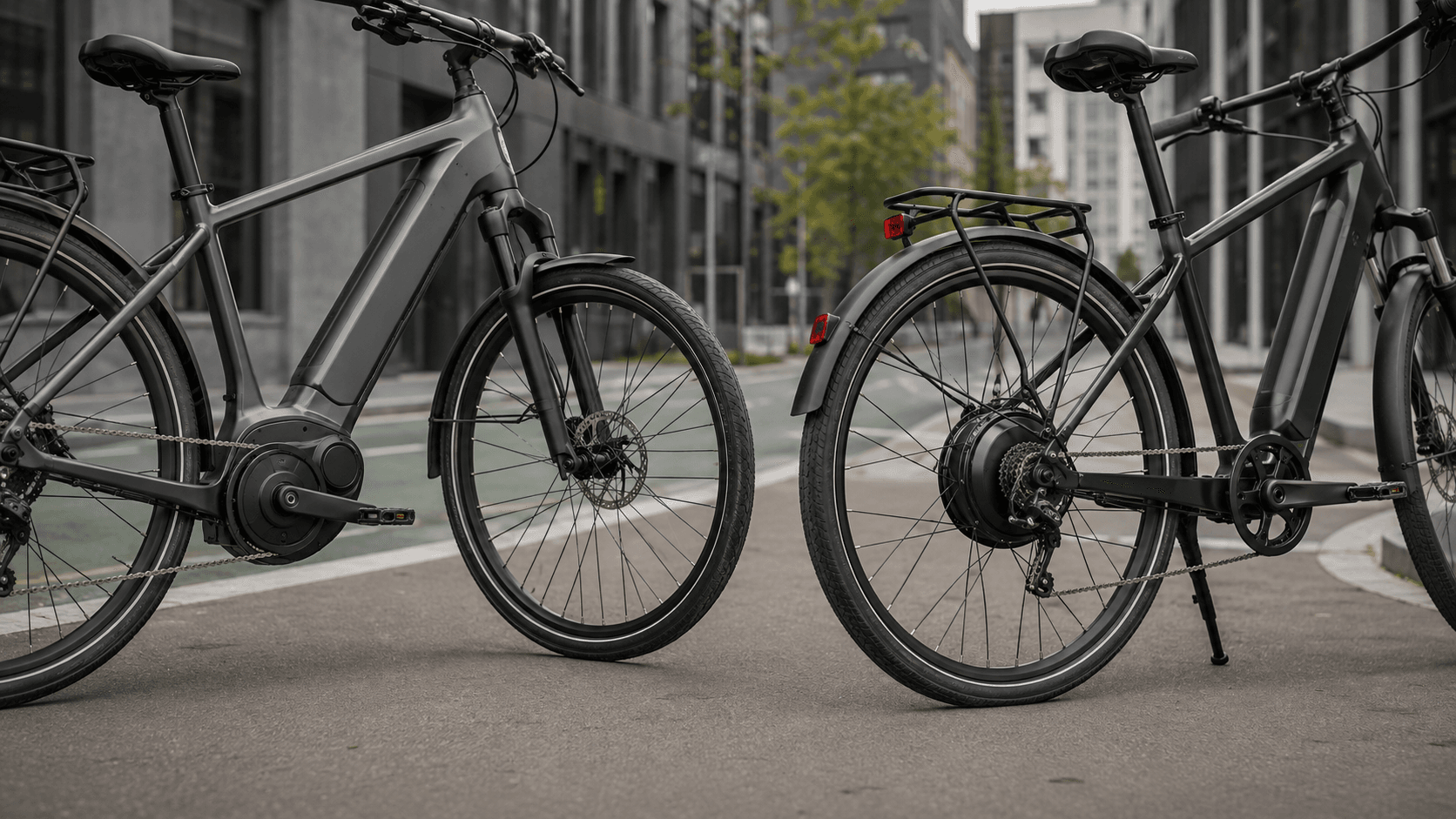
Choosing between a mid-drive motor and a hub motor is one of the most important decisions when buying an electric bike. Motor position strongly influences how an e-bike accelerates, climbs, handles and responds to pedalling, as well as its long-term servicing costs.
The basic distinction is straightforward. A hub motor drives one of the wheels directly, while a mid-drive motor is mounted near the cranks and transfers its power through the bike’s drivetrain. In practice, however, neither design is automatically better. Hub-driven e-bikes are often affordable, quiet and well suited to everyday urban journeys. Mid-drive systems tend to feel more natural, make better use of the bike’s gears and perform particularly well on steep hills, loose surfaces and heavily loaded bikes.
This guide explains how the two main types of e-bike motors differ in power delivery, efficiency, handling, maintenance and cost. If you are comparing complete bikes rather than motor layouts alone, our guide to the best ebike can help you evaluate how the motor fits into the wider package.
Mid-drive vs hub motor: the short answer
For predominantly flat commutes, leisure rides and budget-conscious buying, a good rear hub motor is often the most sensible choice. It delivers dependable assistance without sending additional power through the chain and gears, and the complete bike will usually cost less than an equivalent mid-drive model.
A mid-drive motor is normally the stronger option for hilly routes, cargo carrying, off-road use and riders who want assistance that closely follows their own effort. Its central position improves weight distribution, while its ability to use the bike’s gears helps it operate effectively at low climbing speeds. The trade-off is a higher purchase price and potentially faster wear to the chain, cassette and chainring.
| Factor | Hub motor | Mid-drive motor |
|---|---|---|
| Motor position | Inside the front or rear wheel hub | At the bottom bracket, between the pedals |
| Power delivery | Drives the wheel independently of the bicycle gears | Sends power through the chain or belt and rear gearing |
| Typical ride feel | Smooth and often more noticeable as a push | Responsive and closely connected to pedalling |
| Hill performance | Good on modest gradients when correctly specified | Usually better on long or steep climbs |
| Weight distribution | Extra weight at one wheel | Low and central |
| Drivetrain wear | Motor does not add load to the chain and cassette | Motor torque increases drivetrain load |
| Wheel servicing | Motor wheel can be more awkward to remove and repair | Wheels remain broadly conventional |
| Typical price | Lower | Higher |
| Often best for | Urban riding, gentle terrain, value-focused commuters | Hills, cargo bikes, mountain bikes and premium trekking bikes |
How e-bike motors actually work
Most modern e-bikes use a brushless motor, commonly described as a brushless DC or BLDC motor. Unlike an older brushed design, it does not rely on physical brushes rubbing against a rotating commutator. Electronic switching controls the magnetic fields that turn the motor, reducing mechanical wear and allowing compact, efficient operation.
The motor is only one part of the drive system. The battery supplies electrical energy, the controller regulates how that energy reaches the motor, and sensors determine when and how strongly assistance should be delivered. Software then shapes the response. Two bikes with motors carrying similar specifications can consequently feel very different on the road.
Cadence sensors and torque sensors
A cadence sensor detects whether the cranks are rotating. In a basic system, pedalling triggers a predetermined level of motor assistance. This can feel like a distinct push, especially when the assistance setting is high. Cadence-based control is common on inexpensive hub-driven bikes, although it is not exclusive to them.
A torque sensor measures how hard the rider is pressing on the pedals. The controller can then add assistance in proportion to that effort. Push harder and the motor responds more strongly; ease off and the support falls away. This normally creates a more intuitive sensation and gives finer control when starting, climbing or riding slowly. Torque sensing is widely associated with mid-drive systems, but increasingly appears on better hub-motor e-bikes too. It is therefore important to check the individual bike rather than assuming that motor location reveals the sensor type.
What does watt (W) mean on an e-bike?
A watt (W) is a unit of power. On an e-bike, the rated motor power tells you how quickly the motor can deliver energy under defined operating conditions. It does not, by itself, tell you how strongly the bike will pull away, how well it will climb or how natural the assistance will feel.
Torque, measured in newton metres (Nm), describes rotational force. It is relevant to acceleration and climbing, but torque figures are not always measured or presented consistently across manufacturers. Motor gearing, wheel diameter, controller programming, heat management, total bike weight and the available bicycle gears all affect real-world performance. A 250 W mid-drive can therefore climb more convincingly than a nominally similar hub motor because it can use a low bicycle gear to keep the motor turning in an effective operating range.
It is also essential to distinguish continuous rated power from short-duration peak output. In Great Britain, an electrically assisted pedal cycle must have pedals, its motor must have a maximum continuous rated power of no more than 250 W, and electrical assistance must cut off at 15.5 mph. A compliant EAPC can be ridden like a conventional bicycle without registration, tax or insurance. A machine outside the relevant requirements may be treated as a moped or motorcycle instead. The current rules are explained by the UK Government’s EAPC guidance.
An advertised peak figure does not make an e-bike faster beyond the legal assistance limit, nor does it provide a reliable basis for comparing two road-legal models. For UK buyers, the quality and calibration of a compliant 250 W system matter far more than an attention-grabbing power number.
What is a hub motor?
A hub motor is integrated into the centre of a wheel and turns that wheel directly. It can be fitted at the front or rear, although rear hub motors are much more common on complete e-bikes. Because the motor does not need to transfer its output through the bicycle’s chain and gears, the electrical drive and mechanical drivetrain remain largely independent.
When you pedal, the sensors signal the controller and the hub motor rotates the wheel. Changing gear alters the effort required from your legs, but it does not change the motor’s own mechanical ratio. That separation is central to both the strengths and limitations of the design.
Rear hub motors
A rear hub motor usually provides better traction than a front motor because more rider weight sits over the back wheel, particularly during acceleration or when climbing. The pushing sensation also tends to feel more familiar than being pulled from the front. Rear hub systems dominate the commuter and value-focused e-bike market for these reasons.
The motor adds weight to the rear wheel, however, and may complicate puncture repairs. The rear end can become particularly heavy when a rack-mounted battery, panniers and the motor are all concentrated in the same area. Good frame geometry can manage this well, but the difference is noticeable beside a balanced mid-drive bike.
Front hub motors
A front hub motor leaves the rear drivetrain untouched and can work well at moderate assistance levels. With less weight over the front tyre, however, it may lose traction on wet leaves, gravel or steep climbs and can make the steering feel heavier. It is now less common on premium complete bikes.
Geared and direct-drive hub motors
Not all hub motors operate in the same way. A geared hub motor uses internal reduction gears so that a small motor can spin quickly while the wheel turns more slowly. These units are usually compact, relatively light and capable of useful low-speed torque, making them popular for everyday e-bikes. An internal freewheel generally allows the bike to roll with little motor drag when assistance is switched off.
A direct-drive hub motor has no internal reduction gears. Its outer shell rotates as part of the wheel, making the construction simple and quiet. These units are normally larger and heavier, and can be less effective at low speeds. Some support regenerative braking, although the energy recovered is usually modest and the feature is uncommon on mainstream UK e-bikes.
What is a mid-drive motor?
A mid-drive motor is mounted at the bottom bracket, where the crank arms and pedals meet the frame. Rather than turning a wheel directly, it applies power through the chainring. The rider and motor therefore share the same chain or belt, cassette or hub gear, and rear wheel.
This arrangement allows the motor to benefit from the bike’s gears. Select a low gear for a steep climb and both your legs and the motor gain mechanical advantage. Select a higher gear on level ground and the system can support a faster road speed up to the legal assistance limit. That adaptability is why mid-drive systems are common on electric mountain bikes, cargo bikes and premium trekking machines.
The motor’s low, central location also concentrates mass near the bike’s natural centre of gravity. Bosch highlights this balanced weight distribution and direct power transfer through the chain as core characteristics of a central drive system in its official e-bike guidance. The result is often handling that feels closer to a conventional bicycle, despite the extra overall weight.
Power delivery and ride feel
Motor specifications are useful, but the character of the assistance becomes much clearer from the saddle. A well-tuned hub motor can be smooth and quiet, while a poorly calibrated mid-drive can feel less refined than its price suggests. Even so, each layout has recognisable tendencies.
Starting from a standstill
A cadence-controlled hub motor may take part of a crank revolution to recognise that you are pedalling, then deliver a noticeable surge. Manufacturers can reduce this delay through more responsive sensors and careful programming, but inexpensive systems sometimes feel abrupt in heavy traffic or at tight junctions.
A torque-sensing mid-drive usually responds as soon as pressure is applied to the pedal. This makes controlled starts easier, particularly on an incline or when carrying a passenger or cargo. A torque-sensing hub motor can offer similarly prompt control, so again the sensor and software deserve as much attention as the motor position.
Climbing hills
On a moderate hill, a well-chosen rear hub motor can provide ample support. On a long, steep climb, it must continue operating at a speed dictated by the wheel. If road speed falls substantially, the motor may run outside its most efficient range, draw more current and generate additional heat.
A mid-drive rider can shift into a lower gear, allowing the motor to turn faster even while the bike travels slowly. This generally improves sustained climbing and makes a mid-drive especially valuable in hilly parts of Britain. The benefit depends on correct gear selection. Starting a steep climb in a high gear forces both rider and motor to labour and places unnecessary strain on the drivetrain.
Riding on flat roads
On flatter urban routes, the mid-drive’s gearing advantage matters less. A hub motor can settle into its efficient cruising range and provide quiet, consistent support. Because it drives the wheel independently, the motor may continue to deliver steady assistance even if the rider’s gear choice is less than ideal. For uncomplicated commuting, that predictability is a genuine advantage rather than a compromise.
Handling and traction
A mid-drive keeps its mass low and between the wheels, which usually improves balance when cornering, lifting the bike over a kerb or riding on rough ground. It also leaves the wheels lighter and more responsive. Mountain bikers often prefer this centralised mass because it has less influence on suspension movement than a heavy motor built into a wheel.
A rear hub motor places several additional kilograms at the back, while a front hub motor adds weight to the steering. The effect may be minor on a stable city bike, but it becomes more obvious on technical trails, when carrying the bike upstairs or when trying to fit it onto a rack. For folding e-bikes, total mass and how that mass is distributed also affect how manageable the folded package feels. Our best foldable ebike guide considers portability as well as motor performance.
Efficiency, battery range and heat
There is no universal efficiency winner. Rider weight, gradients, wind, tyre pressure, temperature, assistance level, speed, cargo and battery condition can outweigh the difference between motor positions.
A mid-drive has the potential to operate efficiently across changing gradients because the rider can select a gear that keeps the motor spinning comfortably. This is particularly useful on long climbs or mixed terrain. If the rider changes gear late, uses excessive assistance or repeatedly grinds uphill in a high gear, much of that theoretical advantage disappears.
A hub motor cannot use the bike’s gears to adapt. On a flat or gently rolling commute, it may remain in a favourable operating range and return excellent mileage. On steep, slow climbs, efficiency can fall and heat can build.
Battery capacity is expressed in watt-hours (Wh), not watts. A 500 Wh battery theoretically stores twice the energy of a 250 Wh battery, although capacity alone does not determine range. Treat maximum manufacturer claims as best-case estimates.
Maintenance and repair costs
Both motor types can be reliable when properly designed, installed and used. Their maintenance burdens simply appear in different places.
Hub motor maintenance
Because a hub motor does not send its torque through the bicycle’s chain, chainring and cassette, those components experience only the rider’s input. Drivetrain wear can therefore be similar to that of a conventional bike, assuming the increased weight and mileage of electric assistance are taken into account.
The sealed motor is generally low maintenance, but the motor wheel is more awkward to service. Disconnecting its cable, managing anti-rotation washers and lifting a heavy wheel can complicate a puncture repair. Spoke replacement or wheel truing may also require a mechanic familiar with hub motors.
Geared hub motors contain internal gears and a clutch that can eventually wear, while direct-drive units have fewer moving parts. In either case, availability of replacement parts matters. A theoretically repairable motor is of limited value if the supplier cannot provide internal components or a compatible wheel several years later.
Mid-drive maintenance
A mid-drive leaves both wheels conventional, so tyre, tube, rim and spoke work is normally straightforward. The motor may also be easier for an authorised workshop to remove as a complete unit. Premium systems often have established diagnostic software and dealer networks, although repairs outside warranty can be costly and some internal parts may not be serviced individually.
The main consumable cost is the drivetrain. Motor and rider apply force through the same chain, sprockets and chainring, so shifting under load accelerates wear. Keep the chain clean and lubricated, check it regularly, ease pedal pressure during shifts and replace it before it damages the cassette.
A belt drive paired with an internal gear hub can reduce routine cleaning and chain wear, but it does not eliminate maintenance. It also tends to raise the purchase price, and not every internal gear hub is rated for every motor’s torque.
Purchase price and long-term value
Hub motors are generally cheaper to manufacture and integrate into a frame. This helps explain their prevalence on entry-level commuters, compact bikes and direct-to-consumer models. If your journeys are mostly on paved, moderate terrain, a sensibly specified rear hub system may give you everything you need without charging for capabilities you will rarely use.
Mid-drive bikes typically cost more because the motor must be integrated around the bottom bracket and paired with a drivetrain capable of handling additional torque. Established systems may also include sophisticated sensors, refined software, displays, app connectivity and a broad service network. You are paying for the complete ecosystem as well as the physical motor.
The lowest purchase price is not necessarily the lowest ownership cost. Check whether replacement batteries, displays, controllers, motor parts and chargers are available in the UK. Compare the motor and battery warranties, identify local workshops and ask about diagnostic support. Dependable parts support can make a modest hub bike better value than an obscure mid-drive model.
Which motor suits each type of rider?
Urban commuters
For flat and gently rolling city journeys, a rear hub motor is often the value sweet spot. It is quiet, capable and usually cheaper. Choose torque sensing for precise control in traffic. If the route includes repeated steep climbs, a mid-drive becomes more attractive.
Riders in hilly areas
A mid-drive is usually better for sustained or severe gradients. Consider gear range, cooling, bike weight and assistance quality, not just maximum torque. A strong rear hub system can still handle occasional hills, especially under a lighter rider.
Cargo and family cycling
Cargo bikes must start and climb under substantial weight. A mid-drive’s low gearing and central mass make it the usual choice, although robust hub motors can work well on flatter routes. Payload rating, brakes, wheel strength and after-sales support remain critical.
Mountain biking and unpaved trails
Mid-drive systems dominate serious electric mountain bikes because their central mass, low-speed control and wide gearing suit technical terrain. A hub motor can work on towpaths and gentle trails, but its weight distribution and fixed motor ratio are disadvantages on difficult climbs.
Folding-bike users
Hub motors are common on folding e-bikes because they simplify frame integration and control cost. A mid-drive folder can climb and balance better but is usually more expensive. Folded dimensions, carry points and complete weight may matter more if you regularly use trains or stairs.
What to check before buying
The mid-drive versus hub motor question narrows the field, but it should not decide the purchase alone. Use the following checks to assess the complete system:
- Legal compliance: Confirm a UK road-use model meets EAPC requirements, including the 250 W maximum continuous rated power and 15.5 mph assistance cut-off.
- Sensor type: Torque sensing usually gives finer, more proportional assistance, while a basic cadence system may feel more forceful and less natural.
- Gear range: A mid-drive needs suitable low gears to deliver its climbing advantage. Gear range still matters to the rider on a hub bike.
- Battery and removal: Consider real journeys, charging access, replacement cost and secure removal.
- Motor tuning: A test ride reveals start-up delay, noise, assistance transitions and control at low speed better than a specification sheet.
- Bike weight: Avoid a bike that is too heavy to store, lift or transport.
- Brakes and tyres: Extra speed, weight and mileage demand dependable stopping power and tyres appropriate to British weather.
- Parts and servicing: Check diagnostic support, warranty coverage and electronic parts supply.
- Drivetrain specification: On a mid-drive, confirm the chain, belt, cassette or gear hub is suitable for the motor’s torque.
- Your actual route: Buy for the hills, surfaces, loads and storage constraints you face each week, not for an exceptional ride you may never make.
Common motor myths
“A higher watt figure always means a stronger e-bike”
Wattage alone is a poor guide to ride quality or climbing performance. Two legal 250 W systems can differ significantly because of motor gearing, available torque, controller calibration, cooling, sensor quality and bicycle gearing. It is more useful to test how the bike starts and climbs under realistic load.
“All hub motors feel unnatural”
Basic cadence systems can surge, but a well-programmed torque-sensing hub motor can feel smooth. Crude behaviour is usually caused by sensing and software, not motor location alone.
“Mid-drives are unreliable because they wear chains”
Mid-drives increase drivetrain load, but cleaning, timely chain replacement and considerate shifting can produce reasonable component life. They require more drivetrain care, not automatic distrust.
“Hub motors need no maintenance”
The motor may need little attention, but its wheel still has bearings, spokes, a tyre and electrical connections. Internal gears can wear, and repair depends on parts availability.
Conclusion: mid-drive or hub motor?
Choose a hub motor if you want an affordable, uncomplicated e-bike for urban riding, moderate gradients and everyday transport. A quality rear hub system can be quiet, efficient and durable, while placing less stress on the conventional drivetrain. For many British commuters, it is the rational choice.
Choose a mid-drive motor if your routes are steep, you carry heavy loads, ride technical terrain or value balanced handling and highly responsive assistance. Its ability to work through the bike’s gears is a meaningful mechanical advantage, not just a premium marketing feature. Be prepared for a higher initial price and more diligent drivetrain maintenance.
Compare complete bikes rather than isolated motor figures. Sensors, gearing, battery support, brakes, geometry and servicing determine whether an e-bike remains enjoyable. The best motor suits your terrain, load and maintenance expectations without charging for performance you do not need.
Frequently asked questions
Is a mid-drive motor better than a hub motor?
Not in every situation. Mid-drives are generally better for steep hills, heavy loads and technical riding because they use the bike’s gears and keep weight central. Hub motors are often better value for flat or rolling urban routes and place less additional load on the chain and cassette.
Which motor type is more reliable?
Both can be reliable. Hub motors simplify the drive path but complicate wheel repairs, while mid-drives leave the wheels conventional but increase drivetrain wear. Manufacturer support and spare parts matter more than broad claims.
Does a mid-drive e-bike have a longer range?
It can be more efficient on steep terrain when the rider selects appropriate gears. On flat roads, a hub motor can be equally efficient. Battery capacity, assistance, weather and rider weight often matter more.
Can I ride an e-bike if the battery is flat?
Yes, but the experience varies. Most geared hub motors freewheel with little resistance, while a good mid-drive also adds limited drag when switched off. In either case, the bike’s additional weight makes unassisted pedalling harder than on a comparable conventional bicycle.
Are rear hub motors better than front hub motors?
Rear hub motors normally offer better traction and more familiar handling, which is why they are more common. Front hub motors can be simple and practical, but may spin more easily on loose or wet surfaces and add weight to the steering.