
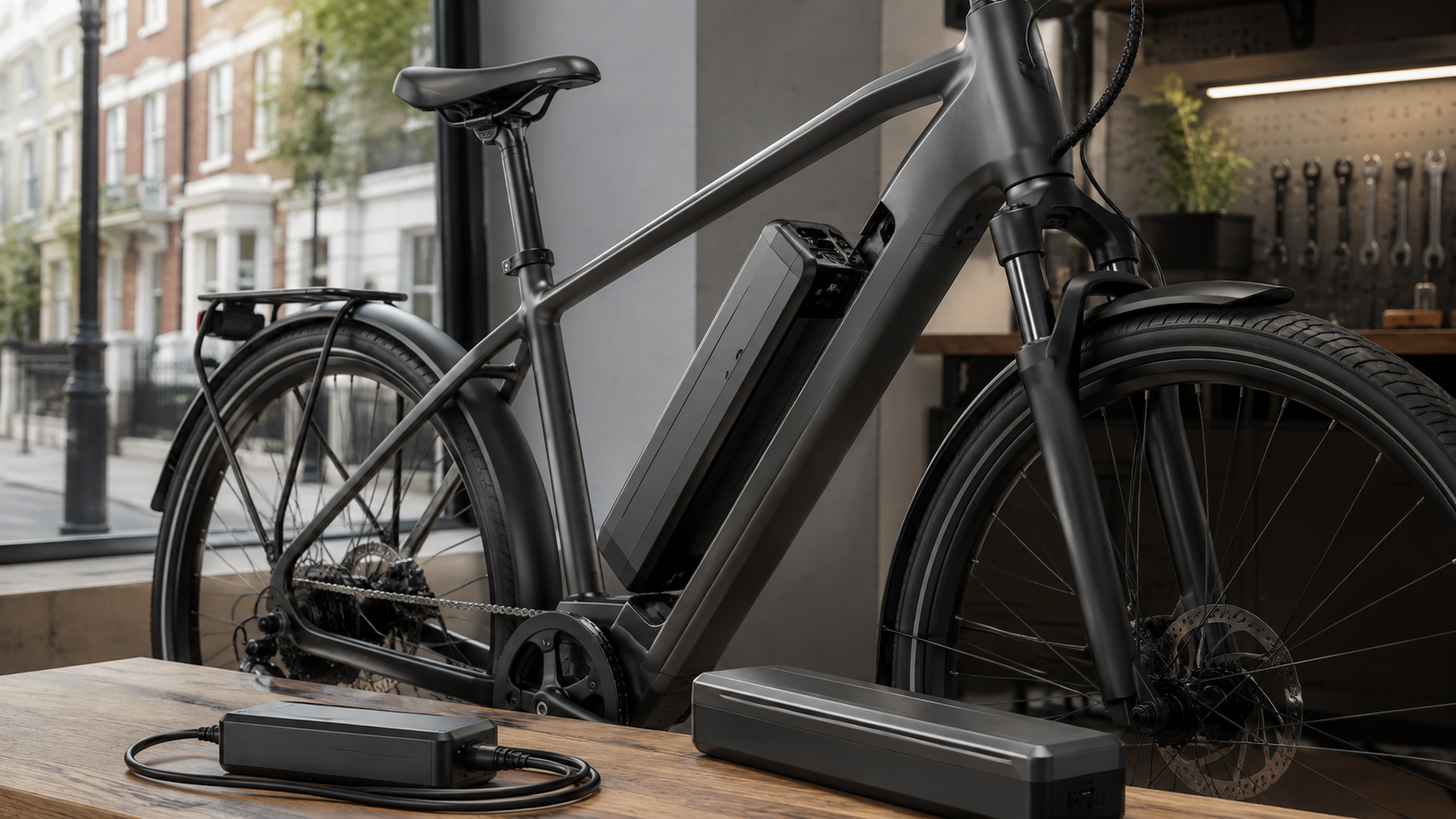
E-bike batteries are often reduced to a single number on a specification sheet, yet that number influences far more than the distance between charges. Battery size affects the weight, price, handling and practicality of the complete bike. It can determine whether you comfortably complete a winter commute or spend the final few miles pedalling a heavy bicycle without assistance.
The difficulty is that battery specifications mix volts, amps, amp-hours and watt-hours, while range claims are normally based on favourable conditions. A 500 Wh battery may take one rider a considerable distance on flat roads but empty much sooner under a heavier rider climbing steep hills in maximum assistance. Neither result means the specification is wrong. It means e-bike range is produced by a complete system, not the battery alone.
This guide explains how to read the figures, choose an appropriate battery capacity, estimate realistic range and protect e-bike battery life. It also covers charging safety, cold weather, replacement costs and the compromises hidden behind very large batteries.
E-bike battery specifications at a glance
The easiest way to understand e-bike batteries is to separate power from energy. Power describes how quickly energy is being used or delivered at a particular moment. Energy describes how much work can be supplied over time.
| Specification | Unit | What it describes | Why it matters |
|---|---|---|---|
| Voltage | Volt (V) | Electrical potential difference | Must match the motor system and controller |
| Current | Ampere (A) | Rate of electrical charge flow | Affects instantaneous electrical demand and charger speed |
| Charge capacity | Amp-hour (Ah) | Charge stored at a stated voltage | Useful only when voltage is also known |
| Energy capacity | Watt-hour (Wh) | Total nominal stored energy | Best headline figure for comparing potential range |
| Motor power | Watt (W) | Rate at which the motor delivers power | Not the same as battery capacity |
| Torque | Newton metre (Nm) | Rotational force from the motor | Influences acceleration and climbing feel, but not stored energy |
For most buyers, watt-hours are the most useful battery figure. Voltage and amp-hours explain how that total is produced, while amps are more relevant to current delivery and charging than to the distance a battery can cover.
How e-bike batteries work
Most modern e-bike batteries use lithium-ion cells grouped into a sealed pack. Cells are connected in series to achieve the required voltage and in parallel to increase capacity. A battery management system, commonly shortened to BMS, monitors cell voltage, current and temperature, controls charging and discharge, and communicates with the bike and charger.
The capacity printed on the case is normally a nominal energy figure. Riders may not have access to every theoretical watt-hour because the management system keeps protective margins at the upper and lower ends of the charge range. The display may therefore show zero even though the cells retain a small reserve. This is intentional protection, not hidden usable range.
Battery position
A battery may sit on the down tube, slide into the frame, mount behind the seat tube or rest beneath a rear rack. A low, central pack generally balances better than a heavy rack battery positioned high over the rear wheel. Integrated designs look cleaner and gain frame protection, while external packs are often easier to remove, charge indoors and replace.
How to read volts, amps and watt-hours
These units are related, but they are not interchangeable. Understanding the difference prevents several common buying mistakes.
Voltage: the system’s electrical pressure
Voltage can be compared loosely with pressure pushing water through a pipe. Many mainstream European systems use a nominal 36 V architecture, while some cargo bikes and conversion kits use 48 V. Higher voltage does not automatically mean a faster or better bike. Voltage, connectors, communication protocol, current capability and firmware must all be compatible.
Battery voltage also changes during use. A pack described as 36 V has a higher measured voltage when fully charged and a lower one near empty. The advertised figure identifies its nominal system class rather than a constant reading.
Ampere (A): current at a particular moment
An ampere (A) measures current, meaning the rate at which charge flows. The controller draws more amps under heavy demand, and watts are calculated from volts multiplied by amps. Chargers also have current ratings, so a compatible 4 A unit can charge faster than a 2 A unit. It must still be approved for the battery because its charging profile and temperature controls also matter.
Amp-hours (Ah): charge capacity
Amp-hours describe stored charge. A 14 Ah pack could theoretically provide 14 A for one hour or 7 A for two hours under defined conditions. The unit is useful at the same voltage, but a 15 Ah battery does not necessarily contain more energy than a 12 Ah battery operating at a higher voltage.
Watt-hours (Wh): the range figure that matters most
Watt-hours express energy capacity. The approximate calculation is simple:
Voltage (V) × amp-hours (Ah) = watt-hours (Wh)
A 36 V, 13.9 Ah battery contains approximately 500 Wh:
36 × 13.9 = 500.4 Wh
A 48 V, 10 Ah battery contains 480 Wh:
48 × 10 = 480 Wh
Despite its lower Ah figure, the second pack stores nearly the same nominal energy. This is why watt-hours provide the clearest first comparison. Current Bosch specifications, for example, list 36 V packs with different Ah ratings that correspond to energy capacities from roughly 360 Wh to 800 Wh. The relationship can be seen in the manufacturer’s official battery comparison.
Watts and watt-hours are not the same
A 250 W motor and a 500 Wh battery describe different things. The motor figure is a rate of power delivery, while the battery figure is stored energy. In a simplified and unrealistic calculation, a 500 Wh pack could supply 500 W for one hour or 250 W for two hours. An actual e-bike constantly changes its power demand, loses some energy through electrical and mechanical inefficiency, and receives part of its propulsion from the rider.
In Great Britain, a road-legal electrically assisted pedal cycle must have a motor with a maximum continuous rated output no greater than 250 W, and assistance must cut out at 15.5 mph. The battery may contain 400, 500 or 800 Wh without changing that legal motor limit. Current requirements are set out in the UK Government’s EAPC guidance.
How much battery capacity do you need?
Bigger e-bike batteries provide a larger energy reserve, but also add cost and weight. Buying the greatest capacity available is sensible for some riders, but unnecessary for others.
| Nominal capacity | Often suited to | Main compromise |
| 250 to 400 Wh | Lightweight e-bikes, short commutes, flatter routes and range extenders | Less reserve for hills, cold weather and detours |
| 400 to 550 Wh | General commuting, leisure riding and mixed everyday use | May require careful management on long or very hilly rides |
| 600 to 800 Wh | Touring, frequent hills, heavier riders, e-MTBs and cargo use | Higher purchase price and battery weight |
| More than 800 Wh or dual batteries | Long-distance touring, commercial cargo work and demanding all-day riding | Significant cost, mass and charging time |
These are broad use cases, not range promises. A light rider contributing strongly in Eco mode may tour with a modest battery, while a loaded cargo bike tackling repeated climbs can require far more energy.
Start with the hardest regular journey
Choose capacity around the most demanding regular journey, then add a reserve. A 12-mile round commute over gentle roads does not require the battery of a 40-mile Pennine route. Finishing with a useful margin protects against headwinds, cold, diversions and gradual ageing.
Range extenders and dual batteries
A range extender adds energy only when needed, while dual-battery systems suit cargo and long-distance touring. Both require explicit system and frame compatibility. Never improvise a second-battery connection or use an unapproved adapter.
Smaller batteries are common on compact bikes because portability is a core part of the design. When comparing the best foldable ebike, check complete weight and battery removability alongside headline range.
What determines real e-bike range?
There is no single honest distance that applies to every rider. Shimano’s buying guidance explicitly identifies bike weight, rider weight, terrain and assistance behaviour as major range variables. Even a manufacturer’s careful estimate remains a scenario rather than a guarantee.
The best way to think about e-bike range is energy consumption per mile or kilometre. If a 500 Wh battery uses an average of 10 Wh per kilometre, the theoretical range is about 50 km, or 31 miles. At 15 Wh per kilometre, the same pack provides roughly 33 km, or 21 miles. These figures illustrate the calculation rather than predicting a particular bike.
Assistance level
The selected support mode has a direct effect on consumption. Eco assistance asks the rider to contribute more, while Turbo or Boost supplies a larger share of the work. Adaptive modes may vary support automatically according to pedal pressure, gradient or acceleration.
Brief maximum assistance for a safe start or steep ramp is not the main problem. Range falls when high support is used throughout a journey. Appropriate shifting and lower assistance once moving conserve energy.
Rider weight, luggage and passengers
Additional mass requires more energy during acceleration and climbing. On flat ground at steady speed, weight is less influential than aerodynamic drag and rolling resistance, but urban riding includes repeated starts and British routes rarely remain perfectly level.
The effect becomes pronounced on hills. Raising an extra 20 kg through 500 vertical metres requires about 27 Wh of additional mechanical energy before drivetrain and motor losses are considered. The rider will supply some of that work, but it demonstrates why two people using identical bikes can report very different results.
Include locks, panniers, shopping, child seats and cargo when assessing load. Cargo-bike range should be evaluated at a realistic payload.
Terrain and total climbing
Total elevation gain is often more informative than the steepest gradient. Constant rolling terrain repeatedly demands acceleration and climbing, while mud, gravel and soft ground add rolling resistance. On an e-MTB, hours of assistance or metres climbed may be more useful than road distance.
Speed and wind resistance
Air resistance rises rapidly with speed. Riding close to the assistance cut-off into a headwind can use far more energy than travelling a little slower in calm conditions. An upright city-bike position, loose clothing and large panniers increase the frontal area pushing through the air.
A fast, exposed commute can therefore drain a battery faster than a longer sheltered ride. Lowering speed slightly is an effective way to preserve range.
Stops, starts and riding style
Repeated hard acceleration consumes energy, especially on a heavy bike. Anticipating traffic lights and maintaining momentum reduce demand. With a mid-drive, shift down before a climb so the motor can turn efficiently. A hub motor cannot use the bicycle gears, so slow climbing may move it outside its best operating range.
Tyres, maintenance and bike design
Underinflated tyres increase rolling resistance, while dragging brakes, a dry chain and worn bearings waste energy. Use pressure appropriate to the rider, tyre and surface within the manufacturer’s limits.
Motor efficiency, wheel size, geometry, total bike mass and software tuning create further differences. This is why the best ebike is not simply the model with the largest battery. A well-designed complete system can make better use of a smaller pack.
Temperature
Cold conditions temporarily reduce lithium-ion performance and therefore usable range. Bosch advises warming a removable battery to room temperature before setting off when temperatures are below freezing. Once the battery returns to a moderate temperature, much of this cold-related performance loss should recover.
Heat is the greater concern for permanent ageing. Avoid leaving the battery in direct summer sun, a hot vehicle or beside a heat source. Never charge it outside the permitted temperature range in its manual.
How to estimate your own e-bike range
Manufacturer calculators are useful for comparing scenarios, but your own riding data is more valuable. Use a repeatable route and measure consumption once the battery has completed its initial use and the display is behaving consistently.
- Charge the battery fully for a planned test ride.
- Record the starting percentage, distance, assistance mode, temperature and approximate load.
- Ride a route representative of your normal terrain and pace.
- Record the finishing percentage and distance.
- Calculate the proportion used and extrapolate cautiously.
If a 500 Wh battery falls from 100% to 60% over 14 miles, it has nominally used about 200 Wh. That equals roughly 14.3 Wh per mile. Dividing 500 Wh by that consumption suggests about 35 miles from full to empty under similar conditions.
Do not plan a critical 35-mile journey from one result. Indicators are not perfectly linear and conditions change. Apply a 20 to 30% reserve until repeated rides establish a reliable pattern, then re-test in winter or with luggage if relevant.
The remaining-range display should also be treated as a live estimate. It normally adjusts according to recent consumption, selected mode and sometimes route data. A sudden drop after a climb may partially recover on easier terrain without any energy being restored.
E-bike battery life: how long should a battery last?
E-bike battery life has two meanings. One is runtime, meaning how long a charge lasts during a ride. The other is service life, meaning the years and charge cycles before the pack loses enough capacity to warrant replacement.
Lithium-ion batteries age through both use and time. Cycle ageing comes from charging and discharging. Calendar ageing continues even when the battery is rarely used, driven by chemical reactions within the cells. Heat and prolonged storage at very high or very low charge levels can accelerate that deterioration.
No honest universal lifespan exists because cell chemistry, temperature, discharge depth, charging and calendar age all matter. Bosch notes that exact service life cannot be predicted and that lithium-ion packs do not suffer memory effect from partial charging. A dealer may be able to measure remaining capacity.
What is a charging cycle?
A full equivalent cycle means using energy equal to 100% of the battery’s capacity, not necessarily discharging from full to empty in one ride. Two uses of 50% amount to roughly one full equivalent cycle. Short top-ups therefore do not each count as a complete cycle.
Capacity fades gradually. A battery may remain usable after noticeable degradation, but reduced range that suits a short commuter could be unacceptable for touring.
Charging habits that support battery longevity
Partial charging is acceptable for modern lithium-ion e-bike batteries. There is no need to run the pack flat before connecting it. In fact, routinely forcing it to the protection cut-off adds inconvenience and leaves no range reserve.
Charge sufficiently for the next ride. A full charge makes sense before a long journey, but prolonged storage at 100% is unnecessary. Some systems offer an 80% limit or storage mode.
Allow a hot battery to cool before charging. Use only the supplied or manufacturer-authorised charger, and unplug it once charging is complete in accordance with the instructions. A charger’s current rating affects charge time, but compatibility and safety take priority over speed.
Long-term storage
If the bike will not be used for weeks or months, follow its manual. Bosch recommends storing many of its batteries at roughly 30 to 60% charge in a dry, temperate location. Check the state of charge periodically because the electronics consume a small amount of energy even when the bike is unused.
Do not store it flat. Keep it away from sunlight, heaters, moisture and combustible material, and protect exposed terminals from dirt, metal objects and damage.
Charging and storing e-bike batteries safely
Quality e-bike batteries are generally safe when used correctly, but lithium-ion failure can develop rapidly. Buy a reputable system, retain its charger and follow the manual.
Current UK Government battery safety advice says to use the supplied or authorised charger, avoid charging on escape routes, let a hot battery cool and charge only while awake and present. It also warns against incompatible replacement packs and chargers.
Follow these practical precautions:
- Charge on a stable, dry surface with ventilation around the battery and charger.
- Keep the charging area away from exits, stairs and flammable materials.
- Do not cover the charger or battery while charging.
- Inspect the case, cable, plug and mounting points after a crash or hard impact.
- Stop using a battery that is swollen, leaking, unusually hot, hissing or producing an unusual smell.
- Do not open, rebuild or modify the battery pack.
- Avoid pressure washing around the battery, contacts and motor electronics.
- Buy replacement batteries and chargers through the manufacturer or an authorised retailer.
If a battery is smoking or on fire, get out, stay out and call 999. Do not place a damaged or end-of-life e-bike battery in household waste. Contact the manufacturer, retailer or local authority for an appropriate take-back or recycling route.
Removable or integrated battery?
Battery format changes everyday convenience even when capacity is identical.
Advantages of a removable battery
A removable pack can be carried indoors for charging, protected from freezing conditions and swapped where permitted. Removing it also lightens the bike for transport. The disadvantages are visible seams, a lock and a mounting mechanism that can develop play or noise.
Advantages of an integrated battery
An integrated pack can look cleaner, place weight centrally and gain frame protection. Some require tools or workshop access, while a fixed battery means taking the complete bike to a socket.
Before buying, remove and reinstall the battery if possible. Check its weight, handle and key position. Ask about replacement cost and long-term availability because an unsupported proprietary pack can shorten the life of an otherwise excellent bike.
Buying an e-bike battery: the questions that matter
Do not judge e-bike batteries by capacity alone. Ask the retailer or manufacturer:
- What is the nominal capacity in watt-hours?
- Is the battery removable without tools?
- What does the battery weigh?
- How long does a full and 50% charge take with the supplied charger?
- What range is realistic for your weight, terrain and preferred assistance mode?
- How long is the battery warranty, and how is excessive capacity loss assessed?
- What does a genuine replacement cost today?
- Are replacement packs and chargers stocked in the UK?
- Can a dealer measure battery health and diagnose faults?
- Is a compatible range extender or second battery supported?
For a used e-bike, request the purchase documentation, original charger and keys. Inspect the case and mount, and ask whether an authorised dealer can test remaining capacity. Low mileage does not guarantee good health because age, heat and poor storage also cause degradation.
Common e-bike battery myths
“The battery must be completely empty before charging”
False. Modern lithium-ion e-bike batteries do not need full discharge to prevent memory effect. Partial charging is normal and often more practical.
“A 750 Wh battery always travels 50% farther than a 500 Wh battery”
Only if the bikes and riding conditions use energy at the same rate. The larger pack contains 50% more nominal energy, but bike weight, motor efficiency, tyres, speed and assistance tuning may differ.
“Higher voltage means more range”
Not by itself. Range depends primarily on total energy in watt-hours and how efficiently that energy is used. A higher-voltage pack can have fewer amp-hours and still contain the same Wh.
“Cold weather permanently ruins the battery”
Cold usually causes a temporary reduction in available performance. Prolonged exposure outside specified limits is undesirable, but heat and inappropriate high-charge storage are generally more important drivers of permanent ageing.
“Any charger with the right plug will work”
This is dangerous. Matching connector shape does not prove that voltage, charging protocol, polarity or safety controls are compatible. Use only a charger approved by the system manufacturer.
Conclusion: understand the numbers, then buy for your route
The simplest way to compare e-bike batteries is to start with watt-hours. Voltage identifies the electrical system, ampere describes current, amp-hours describe charge at that voltage, and watt-hours reveal the nominal energy available. That makes Wh the strongest headline indicator of potential range, though never a distance guarantee.
Real range depends on the work the complete bike must perform. Rider weight, luggage, elevation, assistance mode, speed, wind, temperature, tyres and riding style all influence consumption. Choose enough capacity for your hardest regular journey with a sensible reserve, rather than buying from an optimistic maximum claim.
Battery quality and support are just as important as size. A well-managed 500 Wh system with genuine replacements, safe charging and reliable diagnostics may be a better long-term purchase than an obscure 800 Wh pack. Treat the battery as an expensive consumable, store it sensibly, avoid unnecessary heat and use only approved charging equipment. Those habits will do more for e-bike battery life than obsessing over every small top-up.
Frequently asked questions
What size e-bike battery do I need?
For short, relatively flat journeys, 250 to 400 Wh may be sufficient. General commuters often find 400 to 550 Wh practical, while hills, cargo and longer touring favour 600 Wh or more. Your rider weight, expected load, assistance level and charging access should determine the final choice.
How far will a 500 Wh e-bike battery travel?
There is no fixed distance. A simplified example gives 50 km at 10 Wh per kilometre or about 33 km at 15 Wh per kilometre. Actual range may be higher or lower depending on terrain, rider input, weight, speed, wind, temperature and the bike’s efficiency.
What is the difference between Ah and Wh?
Amp-hours measure charge capacity, while watt-hours measure energy. Watt-hours are calculated approximately by multiplying nominal voltage by amp-hours. Wh is better for comparing batteries with different voltages because an Ah figure alone does not reveal total stored energy.
Does a heavier rider need a larger battery?
Not automatically, but additional weight raises energy demand during acceleration and climbing. A heavier rider on steep terrain will generally achieve less range than a lighter rider under similar conditions, making a larger reserve useful when journeys approach the battery’s limit.
Should I charge my e-bike battery after every ride?
You may top up a lithium-ion battery whenever needed. It does not have to be empty first. Charge enough for the next journey, follow the manufacturer’s instructions and avoid leaving it fully charged for long periods when the bike will not be used.
Can I leave an e-bike battery charging overnight?
UK Government fire-safety guidance advises charging only while you are awake and present, and not leaving batteries on charge while asleep or away from home. Use the authorised charger, keep escape routes clear and disconnect it when charging is complete.