
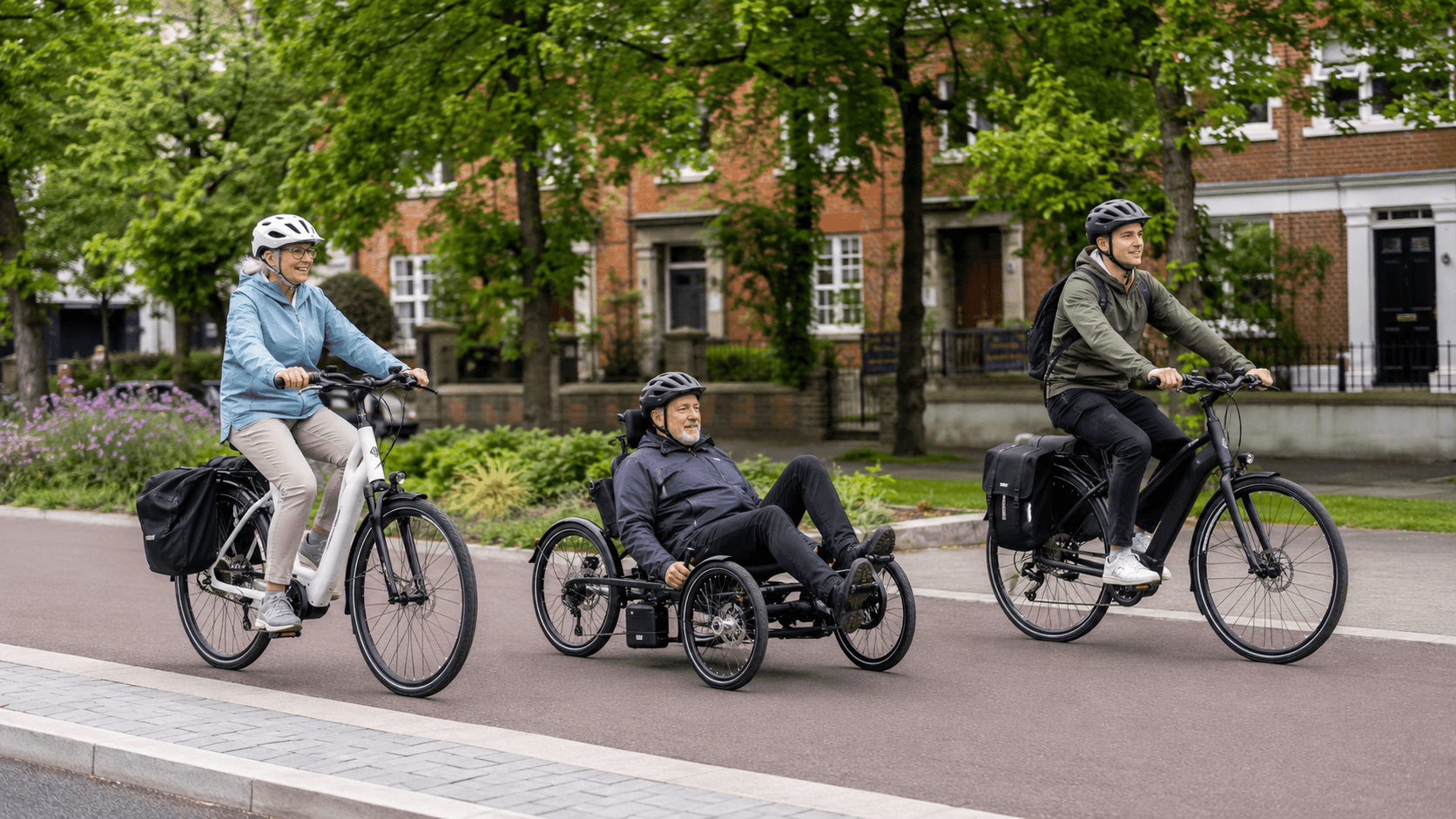
E-bikes are often discussed in terms of batteries, motor torque and environmental performance. Those factors matter, but they miss a more personal question: who gains the ability to travel when cycling requires less physical effort?
For a non-driver, an e-bike can open access to work beyond walking distance. For an older rider, it can make a familiar hill manageable and extend the years in which cycling feels realistic. For someone living with fatigue, joint pain or reduced strength, electrical assistance can turn an impossible journey into an independent one. These benefits place e-bike accessibility at the centre of a wider conversation about transportation equity and social sustainability.
An e-bike is not automatically accessible, however. A heavy crossbar frame, an unaffordable purchase price or a narrow access barrier can exclude a rider regardless of the motor. Some people need a tricycle, handcycle, recumbent or tandem rather than a standard two-wheeler. Others need training, secure storage or the confidence that they can stop and start safely.
The social impact of e-bikes therefore depends on more than sales growth. It depends on whether bikes, streets, funding and services are designed around people with different bodies, incomes, ages and travel needs.
What e-bike accessibility really means
Accessibility is sometimes used as shorthand for a low step-through frame. That is useful, but incomplete. Genuine e-bike accessibility means that a person can obtain, understand, use, store, maintain and travel safely with an appropriate cycle.
| Dimension | What accessibility requires |
|---|---|
| Physical | A cycle that suits the rider’s balance, strength, reach, mobility and sensory needs |
| Financial | Affordable purchase, hire or loan options, including adapted models |
| Geographic | Safe and connected routes to useful destinations |
| Practical | Secure parking, charging, servicing and space to store the cycle |
| Digital | Displays and hire apps that are clear and usable, with non-digital alternatives where possible |
| Social | Freedom from stigma, harassment and assumptions about who “looks like” a cyclist |
| Institutional | Rules and services that recognise different cycle types and mobility needs |
Table of Contents
A rider may be physically capable of using an e-bike but unable to afford one. Another may own the perfect adapted e-cycle but find local paths blocked by barriers too narrow for it. A third may be able to ride independently but unable to take the cycle on a train or find parking near work.
This distinction matters because the purpose of accessibility is not simply to put more products on the market. It is to improve people’s ability to reach employment, education, healthcare, shops, family and social life.
Why transportation equity matters in the UK
Transport opportunity is not distributed equally. Driving requires a licence, access to a suitable vehicle and the ability to meet fuel, insurance, maintenance and parking costs. Public transport may be infrequent, inaccessible or poorly connected outside major urban corridors. Walking works well for many short journeys, but distance, pain, fatigue and time can make it impractical.
These limitations affect some groups more heavily than others. Department for Transport statistics reported that in 2023, 29% of disabled adults in England lived in households without access to a car, compared with 16% of non-disabled adults. Disabled adults also made fewer journeys on average, with particularly large differences among older people. The figures do not prove that an e-bike would suit every person, but they show why additional transport options matter. The latest published breakdowns are available in the government’s transport disability and accessibility statistics.
Transportation equity does not mean giving everyone the same bicycle. It means reducing avoidable differences in access to opportunity. For some people, that may involve a standard e-bike. For others, it could mean subsidised public transport, an accessible taxi, a mobility scooter or an adapted electric cycle. Good policy treats these modes as complementary rather than forcing every traveller into one solution.
How e-bikes support people who do not drive
A legal electrically assisted pedal cycle can be used in Great Britain without a driving licence, registration, vehicle tax or motor insurance. The rider must be at least 14, the motor’s maximum continuous rated power must not exceed 250 W, and assistance must cut out at 15.5 mph. This makes an EAPC administratively much closer to a bicycle than a moped.
That simplicity can be transformative for people who cannot drive, choose not to drive or cannot justify owning a car.
Expanding the practical journey radius
Walking may be comfortable for a one-mile trip but unrealistic for a six-mile commute. A conventional bicycle covers more ground, yet hills, headwinds and the need to arrive presentably can discourage regular use. Electrical assistance reduces those barriers without removing the rider’s control.
The result is a useful middle distance between walking and motorised travel. An e-bike can connect residential areas to industrial estates, colleges, hospitals and railway stations that are awkward to reach by bus. It can also support shift workers whose hours fall outside public transport timetables.
Supporting one-car and car-free households
In a one-car household, different work schedules can create complicated lifts and duplicated journeys. An e-bike gives one household member an independent option without the cost of a second car. For a car-free household, it can handle shopping, school runs and local appointments that would otherwise require several bus connections or regular taxis.
This is where the social value extends beyond an individual ride. More independent household members can reduce scheduling pressure, increase access to employment and free the shared car for the person who genuinely needs it.
Connecting with public transport
An e-bike can solve the first or last part of a multimodal journey. Riding to a station expands the area from which rail becomes practical, while a folding model may travel with the rider where operator rules permit.
Folding does not automatically mean accessible. Many electric folders remain heavy, and small wheels, compact geometry or stiff folding mechanisms can be difficult for riders with limited strength or balance. When comparing the best foldable ebike, the carry weight, folded stability and ease of operation deserve as much attention as folded dimensions.
E-bikes and older riders
The stereotype of e-bikes as products only for older people is outdated, but older riders remain an important part of e-bike demographics. Assistance can help people continue cycling when hills, wind or declining strength make a conventional bicycle less appealing.
Research into older e-bike users frequently identifies continuity as a central motivation. Riders are not necessarily abandoning exercise. They are using assistance to preserve a valued activity, travel farther or participate with faster family members. One study of older adults described e-bikes as a way to extend people’s cycling lives, while qualitative research has connected them with independent mobility and active ageing.
Assistance can make effort more predictable
The fear of not having enough energy for the return journey is a powerful barrier. An e-bike gives the rider the option to increase assistance after an unexpected headwind, a steep climb or the onset of fatigue. That reserve can make leaving home feel less risky.
Predictability is particularly valuable when physical capacity varies from day to day. The rider can contribute more when feeling strong and rely on greater support when necessary, rather than cancelling the entire journey.
Confidence depends on handling, not just power
E-bikes are heavier than comparable conventional bicycles. That weight is less noticeable once moving, but matters when mounting, parking, turning tightly or catching a bike that begins to lean. Older buyers should therefore avoid choosing solely by battery range or motor torque.
A low step-through frame, moderate overall weight, upright posture and predictable torque-sensing assistance can be more helpful than maximum power. Hydraulic brakes with comfortable lever reach, stable tyres and an easily controlled walk-assist function may also improve confidence.
The safest choice is a properly fitted test ride in realistic conditions. Riders should practise starts, stops, junction observations, tight turns and pushing the bike before committing to a model.
E-bike accessibility for disabled people and those with physical constraints
Disability is not a single category, and neither is accessible cycling. A person with limited walking ability may cycle comfortably because the body is supported and the movement creates less impact. Another may need three wheels because balance, coordination or muscle control makes a standard bicycle unsuitable. Some people cannot cycle safely at all.
E-bike accessibility must therefore begin with individual capability rather than diagnosis. It should also recognise non-visible conditions, including chronic pain, reduced stamina, breathing difficulties and fluctuating fatigue.
Electrical assistance as a mobility tool
For some disabled riders, a cycle is not recreational equipment but a mobility aid. Wheels for Wellbeing’s research has repeatedly found disabled cyclists who report that cycling is easier than walking and who view their cycle as essential to independence. Its Guide to Inclusive Cycling also stresses that many disabled people use ordinary two-wheeled cycles, even though others require specialist designs.
Assistance can compensate for reduced leg or arm strength, help with slopes and make longer journeys possible. It can also reduce the boom-and-bust pattern in which a person completes an outbound journey but lacks the energy to return.
These benefits should not be presented as treatment. An e-bike does not cure a health condition, and advice from an appropriate clinician or rehabilitation professional may be necessary where exertion, balance or medication affects safety.
Adapted and non-standard e-cycles
Standard step-through bikes are only one part of inclusive cycling. Electrically assisted options include:
- upright tricycles for riders who benefit from three-wheel stability
- recumbent trikes with supportive seating and a low centre of gravity
- handcycles powered primarily through the arms
- tandem cycles for riders who need a companion to steer or support navigation
- side-by-side cycles that enable communication and shared control
- wheelchair transporter and companion cycles
- cargo cycles adapted to carry a passenger or mobility equipment
Each design solves a different problem and introduces different requirements. A tricycle does not require the same dynamic balance as a bicycle, but it is wider, handles cambers differently and needs more parking space. A recumbent can provide excellent support, but its low position may reduce visibility in some traffic environments.
The best solution usually emerges through specialist assessment and repeated trials, not an online specification table.
Invisible barriers and social assumptions
Disabled cyclists are sometimes challenged because they do not match the public image of a disabled traveller. A person may dismount and walk only a short distance, use an e-bike where cycling is permitted, or need to remain seated while others are expected to dismount. Staff and bystanders may not understand that the cycle functions as a mobility aid.
This social barrier affects confidence. Inclusive transport requires better awareness that someone can be unable to walk far and still be capable of cycling, and that disability is not always visible.
What motivates people to choose an e-bike?
The popular explanation is that riders want an easier bicycle. Real motivations are more varied and often overlap.
Practicality and time
An e-bike can make journey times more consistent by reducing the impact of hills and headwinds. Riders may choose it because parking is difficult, the bus is indirect or a conventional bicycle leaves them too tired for work. The motivation is transport efficiency rather than enthusiasm for cycling technology.
Independence
For non-drivers, older people and some disabled riders, the strongest motivation is control over when and where they travel. Independence means attending an appointment without arranging a lift, visiting friends spontaneously or taking a job beyond walking distance.
Reduced physical barriers
Some riders want to avoid arriving sweaty. Others need help with a specific hill or want reassurance against fatigue. Assistance allows the same cycle to respond to changing terrain and energy levels, which makes regular use more realistic.
Cost control
Charging an e-bike and maintaining its mechanical components can cost considerably less than running a car, although battery replacement, insurance and servicing must be included. The potential saving matters most when the e-bike genuinely replaces paid travel rather than becoming an additional leisure purchase.
Health, wellbeing and social connection
E-bike riders still pedal and can accumulate meaningful physical activity. Because assistance often encourages longer or more frequent journeys, an e-bike may support an active routine even if each mile requires less effort than conventional cycling.
The social benefit can be just as important. Couples and friendship groups with different fitness levels can ride together. An older family member may keep pace, while a person returning after illness can participate without fearing every climb.
Environmental values
Some buyers are motivated by lower-emission travel and reduced car use. That contributes to social sustainability when e-bike journeys replace driving, reduce local noise and free street space. The benefit is smaller when the e-bike primarily replaces walking or conventional cycling, so claims should focus on actual travel change rather than the product alone.
E-bike demographics are broader than the stereotype
Early consumer markets often frame e-bikes as either premium sporting equipment or mobility support for older riders. In reality, potential users include commuters, students, parents, shift workers, carers, disabled cyclists, delivery riders and households reducing car ownership.
Shared schemes have helped make e-bikes visible to people who would not buy one without prior experience. A Local Government Association review of UK shared micromobility reported motivations including easier hills, reduced fatigue, longer journeys and gaps in public transport. It also found that e-bike sharing can replace some car and taxi journeys. These figures show potential, but do not mean shared services are automatically equitable.
Commercial hire users can still skew towards people with smartphones, bank cards and confidence riding in traffic. Operating zones often favour central, high-demand neighbourhoods. Per-minute pricing may penalise slower riders, while inaccessible docking or heavy standard frames exclude some disabled users.
To broaden e-bike demographics, schemes must be intentionally inclusive rather than assuming that availability equals access.
The barriers preventing equitable e-bike use
Electrical assistance removes one barrier, physical effort, but leaves many others intact.
Purchase price
Good e-bikes cost more than conventional bicycles, while adapted e-cycles can be substantially more expensive. The battery, motor, specialist frame and low production volumes all add cost. Those facing the greatest transport disadvantage may have the least access to savings, credit or salary-sacrifice schemes.
Cycle to Work can help eligible employees, but it does not serve everyone. People outside paid employment, on insecure contracts or unable to sacrifice enough salary may receive little benefit. Equitable policy needs grants, long-term loans, community hire and refurbished options alongside employment-based tax incentives.
Storage, charging and theft
An e-bike can be difficult to carry into an upstairs flat and too valuable to leave outside. Adapted cycles may not fit conventional bike sheds or racks. A resident without secure ground-floor storage and a nearby socket can be excluded before the first ride.
Battery removal helps, but the frame still needs protection. Secure residential parking should accommodate trikes, cargo bikes and recumbents rather than assuming every cycle fits a narrow wheel channel.
Inaccessible infrastructure
A cycle route is only as accessible as its narrowest point. Chicane barriers, closely spaced bollards, steep ramps, high kerbs and sharp turns can block wider or longer cycles. Poor surfaces may be uncomfortable or unsafe for riders whose pain, balance or grip is affected by vibration.
Active Travel England advises that access controls should generally be avoided and, where necessary, must preserve access for wheelchairs, mobility scooters and all cycle types. Its guidance on access-control barriers emphasises sufficient manoeuvring space without forcing riders to dismount.
Traffic danger and confidence
Assistance cannot compensate for a hostile road. A rider who is older, less confident or using a wide tricycle may feel particularly vulnerable beside fast traffic. Protected routes, forgiving junctions and lower motor-traffic speeds are therefore accessibility measures, not optional extras.
Training should be available on the rider’s actual type of cycle. A brief session on a standard bicycle is not adequate preparation for a heavy e-bike or a three-wheeled design with different cornering behaviour.
Maintenance and repair access
An e-bike that cannot be repaired locally is unreliable transport. Proprietary electronics, unavailable batteries and workshops unwilling to service adapted cycles can leave users stranded. This burden is greater for someone who cannot simply drive the bike to a distant dealer.
Retailers and public programmes should consider collection, mobile servicing, loan bikes and long-term parts support. Social sustainability includes keeping equipment usable, not merely funding its purchase.
What an accessible e-bike should offer
No design works for everyone, but several features improve usability for a broad range of riders.
Easy mounting and a suitable riding position
A genuinely low step-through frame reduces the height through which a leg must move. Adjustable handlebars, saddle position and short-reach brake levers help fit the cycle to different bodies. Riders needing back or neck support may benefit from a more upright position or a specialist seat.
Predictable assistance
Torque sensing usually provides support in proportion to pedal pressure, which can make low-speed control feel natural. A cadence sensor may require less force to trigger assistance, which can help a rider with limited leg strength, but abrupt programming can be unsettling. The correct choice depends on the individual and the quality of calibration.
Manageable weight
Motor assistance disguises weight while riding, not while parking or lifting. Buyers should test whether they can push the bike with assistance off, use walk mode, turn it in a narrow space and raise it onto a stand. A removable battery may make transport easier.
Clear controls
Buttons should be reachable without releasing the grip and identifiable by touch. Displays need legible contrast and should not rely on tiny symbols. Riders with limited dexterity may need simple controls, while those with visual impairments benefit from clear feedback and minimal menu depth.
Appropriate stability and braking
Tyre width, frame geometry, centre of gravity and wheel configuration affect confidence. Brakes should provide sufficient power without excessive lever force. Parking brakes are valuable on some trikes and cargo cycles because three wheels do not prevent rolling on a slope.
When comparing the best electric bike, these functional details should carry more weight than maximum range or the number of app features.
Building social sustainability around e-bikes
E-bikes create their greatest social value when public policy and local services remove barriers around the product.
Provide trials before purchase
A short showroom lap is not enough to evaluate fatigue, comfort or confidence. Multi-day loans allow people to test their commute, storage arrangement and charging routine. Specialist inclusive cycling centres can help match riders with adapted designs.
Target support beyond existing cyclists
Subsidies achieve little equity if they mainly discount premium bikes for affluent households. Programmes should reach non-drivers, disabled people, lower-income workers and neighbourhoods with poor public transport. Referral partnerships with employers, healthcare providers and community organisations can help, provided participation remains voluntary.
Design shared schemes for inclusion
An equitable hire system needs affordable passes, low-income tariffs and payment options that do not depend entirely on a modern smartphone or credit card. Service areas should include residential districts and essential destinations, not only tourist centres. Fleets can also include step-through frames, cargo bikes and selected adapted cycles.
Build infrastructure for every cycle
Routes, crossings and parking should be tested with trikes, handcycles, cargo bikes and trailers. Designers need direct participation from disabled cyclists and older residents. Inclusive design often benefits everyone by creating smoother surfaces, wider turning areas and fewer unnecessary barriers.
Measure outcomes rather than registrations
Success is not the number of e-bikes distributed. Better measures include access to work and services, reduction in transport costs, journeys that replaced car travel, continued use after a trial, and participation among groups previously excluded from cycling.
Conclusion: e-bike accessibility is about freedom to participate
E-bikes can expand the distance people travel, reduce the impact of hills and make physical effort more controllable. For non-drivers, older adults and some people with disabilities or health constraints, that can mean greater independence, access to opportunity and participation in everyday life.
Those benefits make e-bikes relevant to transportation equity and social sustainability, but they are not guaranteed by a motor. Cost, bike weight, inaccessible routes, narrow barriers, theft risk and poor repair support can reproduce the same inequalities found elsewhere in transport.
True e-bike accessibility requires the right cycle for the individual, affordable ways to obtain it and streets that accommodate different bodies and cycle designs. When those conditions are met, the e-bike becomes more than a cleaner vehicle. It becomes a practical tool for giving more people control over where they can go, when they can leave and how fully they can take part in society.
Frequently asked questions
Are e-bikes suitable for older people?
They can be, provided the bike fits the rider’s balance, strength and mobility. A low step-through frame, predictable assistance, manageable weight and comfortable brakes are often more important than maximum torque. A supervised test ride should include mounting, stopping, tight turns, parking and pushing the bike.
Can disabled people use e-bikes?
Many can, but needs vary widely. Some disabled riders use standard e-bikes, while others need electric trikes, handcycles, recumbents or tandems. An e-bike is not suitable for every condition. Specialist assessment and trials can identify the appropriate cycle and any necessary adaptations.
Can an e-bike be used as a mobility aid in the UK?
Some disabled people regard their cycle as a mobility aid, but cycles and EAPCs do not currently receive all the same legal treatment as recognised powered mobility devices. Rules governing pavements, public spaces and transport can therefore create difficulties. Riders should check current national and local requirements.
Do e-bikes provide exercise if the motor helps?
Yes. A legal pedal-assist e-bike still requires pedalling, although the motor reduces the effort needed. Assistance may encourage people to travel farther or ride more often. The actual activity level depends on the support mode, terrain, journey length and how much effort the rider contributes.
Are e-bikes cheaper than cars?
Usually in operating terms, but the comparison depends on use. Purchase price, battery replacement, servicing, insurance, locks and storage should be included. The greatest household saving occurs when an e-bike replaces car ownership, fuel, parking, taxi or public transport costs rather than adding another leisure expense.
How can e-bike hire schemes improve transportation equity?
Schemes can offer low-income tariffs, cash or card alternatives, accessible apps, broad service areas and bikes suited to different riders. Longer trial loans may be more inclusive than per-minute hire for people who need time to build confidence or test a regular journey.
What is the most accessible type of e-bike?
There is no universal answer. A lightweight step-through bike suits many riders, but someone with balance difficulties may need a tricycle, while another person may require a handcycle or supportive recumbent. Fit, controls, stability, storage and the local route must all be considered.
What is the biggest barrier to e-bike accessibility?
The answer varies by person and place. Purchase cost, fear of traffic, secure storage, cycle weight and inaccessible infrastructure are all significant. For adapted cycles, limited availability and specialist servicing can be particularly restrictive. Removing only the physical effort barrier is not enough.