
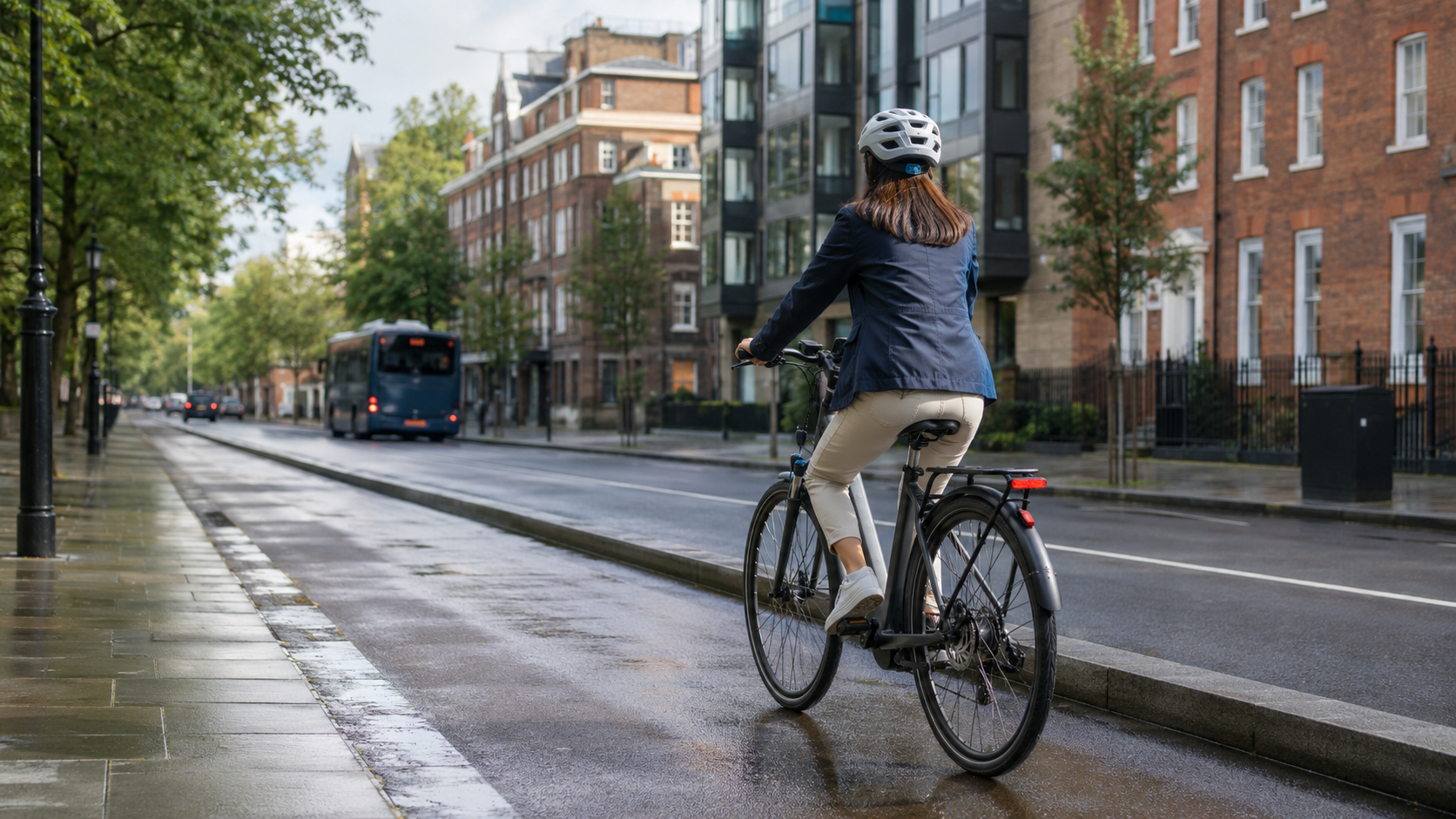
The way people move around British cities is beginning to change. For much of the past century, the private car has shaped how streets are designed, where homes are built and how far people expect to travel for work, shopping and leisure. Cars remain essential for many journeys, particularly in rural areas and for people with specific accessibility needs, but their dominance creates familiar urban problems: congestion, air pollution, noise, expensive parking and streets that leave limited space for anyone outside a vehicle.
Eco-friendly transportation offers a different approach. Rather than replacing every petrol car with another vehicle of similar size and weight, it asks whether some journeys can be made using smaller, cleaner and more efficient forms of transport. Walking, conventional cycling and public transport remain central to that shift, but e-bikes are increasingly important because they make cycling practical for more people and for a wider range of journeys.
An electric bike cannot replace every car trip. It will not carry a family across the country, move a wardrobe or meet every mobility requirement. What it can do is replace many of the short and medium-distance journeys for which a car is convenient but not strictly necessary. Commuting across town, collecting groceries, travelling to a railway station and taking children to school can all become realistic e-bike journeys when hills, headwinds and physical effort are reduced.
That distinction matters. The rise of the e-bike is not really about creating a faster bicycle. It is about giving cities a credible alternative between a conventional bike and a car. As more people discover that alternative, e-bikes could play a substantial role in sustainable commuting, cleaner urban mobility and the creation of more accessible, liveable neighbourhoods across the UK.
Why British cities need new ways to travel
The environmental case for changing urban transport is considerable. Provisional government figures show that domestic transport accounted for 31 per cent of UK greenhouse gas emissions in 2025, making it the country’s largest emitting sector. Petrol and diesel road vehicles remained the principal source within that total. Transport emissions also increased between 2024 and 2025, illustrating how difficult it is to reduce the sector’s climate impact through vehicle efficiency alone. UK government emissions data
Electrifying cars is an important part of the answer, but electric cars still require substantial resources to manufacture. They occupy the same road and parking space as combustion vehicles, contribute to congestion and produce particulate pollution through tyre and brake wear. A city in which every petrol car is replaced by an electric car may have lower exhaust emissions, but it will still devote enormous amounts of public space to moving and storing heavy private vehicles.
Eco-friendly transportation takes a broader view. It combines public transport, walking, cycling, e-bikes, shared mobility and cleaner vehicles, matching each mode to the journeys it performs most efficiently.
The problem of short car journeys
Urban car dependence is not driven exclusively by long journeys. Cars are frequently used for trips that cover only a few miles, often because the alternatives feel inconvenient, unsafe or physically demanding.
A distance of four or five miles may be too far to walk regularly, particularly when time is limited. The same distance is manageable on a conventional bicycle for an experienced rider, but can be discouraging for someone facing steep hills, strong winds, work clothes or concerns about arriving tired and sweaty.
This is where the e-bike changes the calculation. Electric assistance does not remove the need to pedal, but it reduces the effort required to accelerate, climb and maintain a useful speed. A journey that feels ambitious on an ordinary bicycle can become routine on an e-bike.
Cycling remains underused in England
The National Travel Survey recorded an average of 15 cycling trips per person in England during 2024. Cycling represented around 2 per cent of trips and 1 per cent of distance travelled, even though the average distance cycled per person rose by 12 per cent from the previous year. National Travel Survey 2024
These figures include conventional bicycles and e-bikes, but they demonstrate the scale of the opportunity. Cycling does not need to replace most journeys to make a meaningful difference. Moving even a proportion of suitable car trips onto bicycles and e-bikes would reduce traffic on crowded routes and give people another practical transport choice.
London provides an indication of what sustained infrastructure investment can achieve. Transport for London estimated that around 1.5 million cycle journeys were made each day in 2025, while the capital’s strategic cycle network had expanded to more than 431 kilometres. Cycling conditions remain uneven, but the growth shows that behaviour can change when routes become safer, more connected and more visible. Transport for London cycling data
Why e-bikes are becoming central to eco-friendly transportation
An e-bike combines the compact size and low resource demands of a bicycle with a small electric motor that assists the rider. This makes it more capable than a conventional bike without turning it into a miniature car.
The assistance is most valuable during the demanding parts of a journey. Starting at a junction, climbing a hill, riding into a headwind or carrying shopping becomes easier, while the rider still contributes through pedalling. This balance allows e-bikes to extend the practical range of cycling without requiring the battery capacity, road space or energy consumption of an electric car.
A small amount of energy moves the rider a long way
E-bikes are remarkably energy efficient because the motor moves a lightweight vehicle and receives help from the rider. Their batteries are usually measured in hundreds of watt-hours rather than the tens of kilowatt-hours found in electric cars.
Exact consumption varies with rider weight, terrain, assistance level, temperature and tyre pressure. Even so, charging an e-bike typically requires only a modest amount of electricity. For many owners, several days of local travel can be covered with less energy than many household appliances use during a single cycle.
The environmental advantage is therefore not dependent on the electricity grid being completely renewable. Cleaner electricity improves the result, but the fundamental benefit comes from using much less energy to move each person.
Manufacturing still has an environmental cost
No vehicle is emission-free over its full life. An e-bike requires aluminium or steel, tyres, electronics, a motor and a lithium-ion battery. These components create emissions during extraction, manufacturing and transport.
The phrase eco-friendly transportation should not be used to imply that e-bikes have no environmental impact. Their advantage is comparative. An e-bike is dramatically smaller and lighter than a car and normally requires a much smaller battery. It therefore demands fewer materials and less energy to manufacture, while consuming very little electricity during use.
Durability is important to the final calculation. A well-built e-bike used regularly for many years distributes its manufacturing footprint across thousands of journeys. A poorly supported model that becomes unusable when its battery or display fails is far less sustainable.
The greatest benefit comes from replacing car journeys
An e-bike produces the most significant environmental saving when it replaces a car or taxi journey. If it replaces walking, conventional cycling or an already-running bus service, the carbon benefit is smaller and may sometimes be negligible.
This does not mean every e-bike trip must directly replace a car trip to be worthwhile. An e-bike may help a household avoid buying a second car, enable someone to combine cycling with rail or make a low-car lifestyle practical over the long term. These wider changes are difficult to measure one journey at a time.
Research modelling the potential of e-bikes in England found that their ability to reduce car emissions is especially strong outside the densest urban centres, where journeys are longer and public transport may be less comprehensive. The maximum theoretical saving should not be mistaken for a forecast, but the study illustrates how much potential exists when e-bikes replace suitable car mileage. Research on e-bikes and car emissions in England
How e-bikes can replace everyday car trips
The strongest case for e-bikes is not built around occasional leisure rides. It comes from ordinary journeys repeated several times each week.
Commuting across towns and cities
A commuter travelling between three and ten miles may find an e-bike particularly effective. The journey is long enough for walking to be impractical, but often short enough that driving provides little time advantage once congestion and parking are considered.
Electric assistance makes journey times more consistent. Hills and headwinds have less effect, and the rider can choose a lower assistance level when conditions are easy and a higher one when arriving promptly matters more than maximising range.
Unlike a car journey, the travel time is less vulnerable to a single congested junction bringing the route to a standstill. Unlike public transport, the rider does not need to wait for a timetable or make multiple changes. The e-bike offers much of the door-to-door convenience that makes cars attractive, but in a far smaller form.
Sustainable commuting also becomes more realistic for people who need to dress formally or lack showers at work. Riders still exert themselves, but assistance allows them to regulate effort and avoid turning every commute into a training session.
Shopping and everyday errands
Many urban car trips involve collecting groceries, visiting the post office or travelling between several nearby destinations. These journeys are well suited to e-bikes because the motor reduces the effect of additional weight.
A strong rear rack and a pair of panniers can carry a meaningful grocery shop without affecting steering as much as a heavy rucksack. Front racks and baskets are useful for lighter items, while a trailer can expand capacity for occasional larger loads.
The e-bike also removes much of the friction associated with parking. A rider can often stop close to the destination rather than searching for a space and walking back. The time saved at each stop makes the bicycle particularly effective for a sequence of short errands.
Secure parking remains essential. Leaving an expensive e-bike outside several shops requires a high-quality lock, appropriate insurance and fixed stands in visible locations. Cities that want e-bikes to replace shopping trips must therefore treat cycle parking as part of the transport network, not as an optional extra.
School runs and family journeys
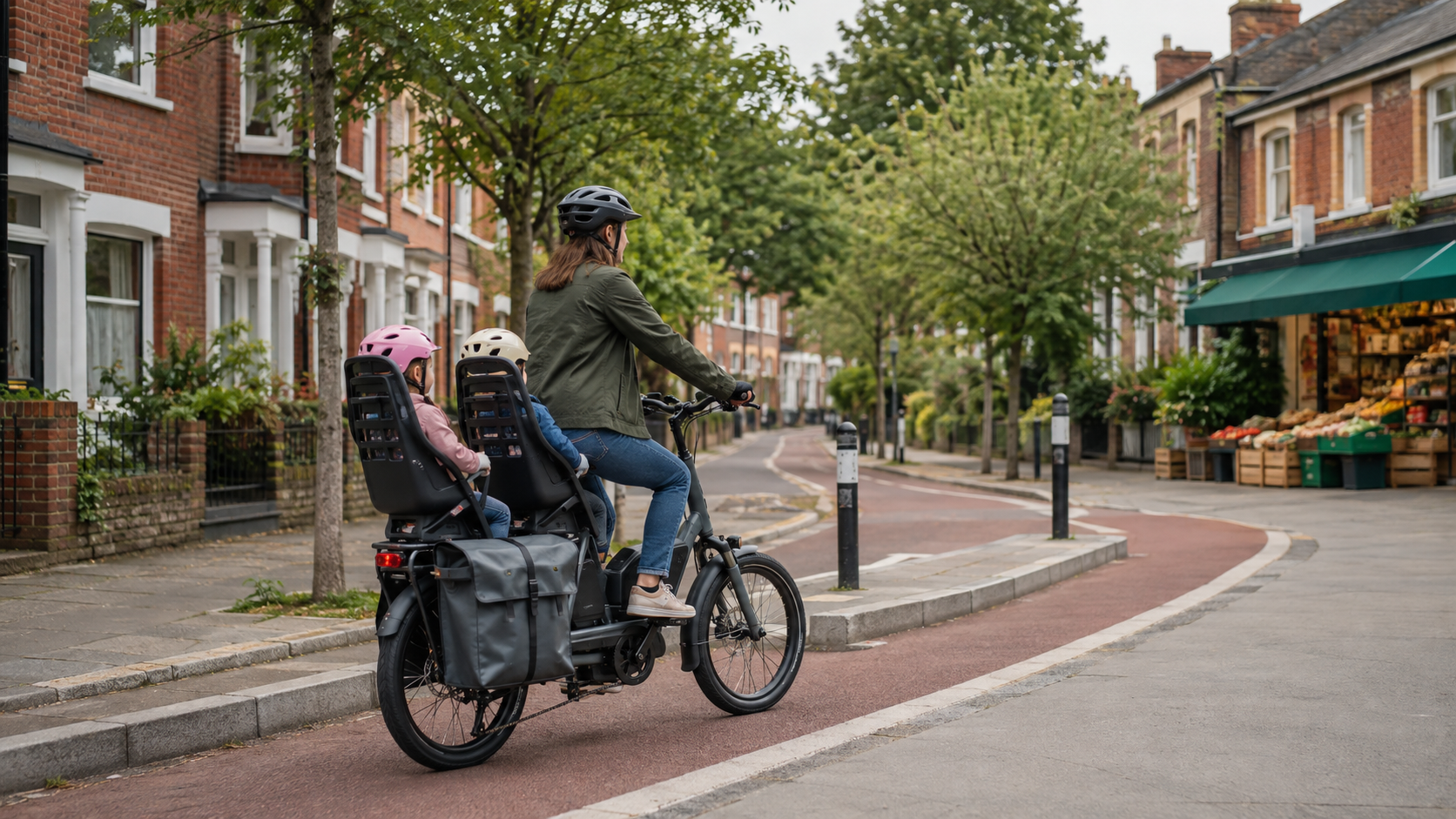
Electric cargo bikes can carry children, groceries and everyday equipment over distances that would be demanding on a conventional cycle. Longtail models place passengers behind the rider, while front-loading cargo bikes carry them in a box between the handlebar and front wheel.
For some households, an e-cargo bike can replace a second car. It may cover nursery runs, school journeys and local shopping while the remaining car is reserved for longer or less suitable trips.
This is not a simple choice everywhere. Safe routes, secure home storage and weather protection all influence whether families feel confident using cargo bikes. The bikes are also larger and more expensive than standard models. Nevertheless, they demonstrate that green travel is not limited to solo commuters carrying a laptop.
Deliveries and small businesses
E-cargo bikes can also replace vans for some urban deliveries. They are particularly effective where a driver would otherwise spend much of the day moving short distances, queuing in traffic and searching for loading space.
A cargo cycle will not replace a van carrying heavy equipment across a region, but it can transport parcels, food, tools and supplies within compact service areas. For businesses, the benefits may include predictable journey times, lower running costs and easier access to congested streets.
Cities benefit when suitable van journeys move to smaller vehicles. Cargo bikes require less kerb space, create less noise and pose less danger to other road users than full-sized commercial vehicles.
E-bikes make sustainable commuting more accessible
Conventional cycling is already one of the most efficient forms of transport, but it is not equally practical for everyone. Fitness, age, health, terrain and confidence all influence whether a bicycle feels like a realistic daily option.
An e-bike does not remove every barrier. Riders still need balance, road awareness and enough physical ability to control the bicycle. However, assistance can reduce several of the obstacles that prevent people from considering cycling.
Hills become part of the route rather than a barrier
Topography has a major effect on cycling uptake. A short journey can feel difficult when it includes a steep climb, particularly if the rider is carrying luggage or cannot recover before arriving at work.
Electric assistance allows the same journey to be completed with more predictable effort. This can expand the area that a person considers accessible by bicycle and connect neighbourhoods that appear close on a map but feel separated by gradients.
The benefit is especially relevant in hilly British cities such as Bristol, Sheffield, Bath and parts of Edinburgh. Infrastructure remains necessary, but e-bikes ensure that a cycle route does not need to be almost flat before it becomes useful to a broad group of riders.
Assistance reduces differences in pace and fitness
People often avoid cycling with partners or colleagues because they worry about holding the group back. An e-bike can reduce differences in fitness and allow riders of varying abilities to travel together at a comfortable pace.
This may help older adults continue cycling, support people returning after illness and allow commuters to choose cycling without first building a high level of fitness. Some people with mobility limitations also use e-bikes, e-trikes and adapted cycles as mobility aids, although the appropriate design varies considerably between individuals.
Accessibility must therefore be considered when infrastructure and parking are designed. Narrow barriers, steep ramps and vertical cycle racks may exclude heavier e-bikes, cargo bikes, tricycles and adapted cycles even when a route itself is suitable.
The rider still receives physical activity
Electric assistance does not mean passive transport. On a legal pedal-assist e-bike, the rider normally has to pedal for the motor to assist. The effort can be adjusted, but it is not eliminated.
An e-bike rider may exercise less intensely per mile than someone on a conventional bicycle, yet cover longer distances or ride more frequently. For a person who would otherwise drive, even moderate activity integrated into the daily journey can be valuable.
This is one reason e-bikes occupy a useful position in urban mobility. They offer enough assistance to make cycling achievable while retaining the active element that distinguishes a bicycle from a motor vehicle.
E-bikes and public transport can work together
Eco-friendly transportation is most effective when different modes complement one another. An e-bike does not need to complete an entire journey to reduce car dependence.
Solving the first-and-last-mile problem
A railway station may be only three miles from home, yet poor bus frequency or expensive parking can make driving the whole journey seem easier. An e-bike can cover the first section quickly and allow the rider to continue by train.
The same applies at the destination. Secure cycle parking or a second hire bike can bridge the gap between a station and a workplace that is too far to walk comfortably.
This combination expands the practical reach of public transport without requiring every residential area to have a direct route to every employment centre.
Folding e-bikes add flexibility
Taking a full-sized e-bike onto a busy train is not always possible, particularly during peak periods. Its weight and dimensions also make stairs, narrow platforms and crowded carriages difficult.
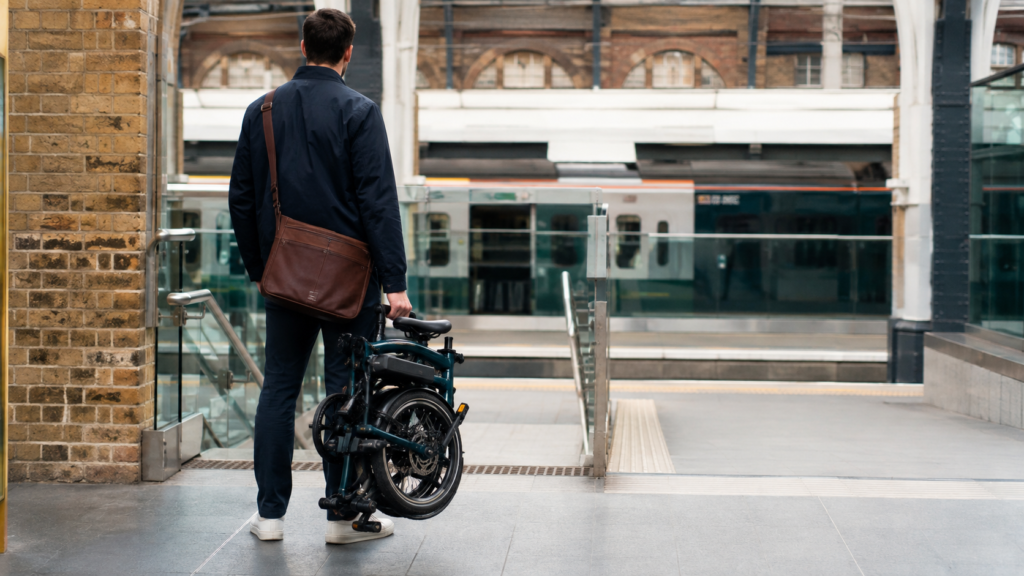
A compact foldable electric bike can be a better option for mixed journeys. It may fit into permitted luggage areas, under a desk or inside a small flat, while still providing assistance for the road sections at either end.
Folding does not automatically mean easy to carry. Many electric folding bikes remain relatively heavy, and railway operators have different rules about cycles, battery-powered equipment and peak travel. Buyers should check the folded dimensions, actual carrying weight and the policies of the services they use regularly.
Shared e-bikes can provide occasional access
Not everyone needs to own an e-bike. Docked and dockless hire schemes allow people to use one for a single journey, connect with public transport or test whether cycling works for their routine.
Shared schemes can make e-bikes visible and reduce the initial cost barrier. Their environmental performance, however, depends on how the fleet is managed. Redistribution vans, short product lifespans and poor charging logistics can reduce the benefit.
A well-run system needs durable bicycles, responsible parking, efficient maintenance and coverage beyond tourist centres. It should complement public transport rather than compete only for journeys that would otherwise be walked.
How e-bikes contribute to more liveable cities
The value of e-bikes is not limited to direct carbon savings. A shift from cars to smaller forms of transport changes how urban space can be used and how streets feel to the people living beside them.
Less congestion from suitable car journeys
An e-bike occupies far less road space than a car and can carry one person efficiently without surrounding them with an empty passenger compartment. When enough travellers switch, more people can move through a constrained corridor without continually widening the road.
The effect is strongest when e-bike trips genuinely replace cars. Moving someone from a bus or pavement onto an e-bike does not reduce congestion, while replacing a solo car commute does.
E-bikes should therefore be viewed as part of a demand-management strategy rather than simply another vehicle added to crowded streets.
Cleaner air at street level
Legal e-bikes produce no exhaust emissions during use. Replacing petrol and diesel journeys can reduce nitrogen oxides and other pollutants where people live, walk and attend school.
Tyres and brakes still create particulate matter, but an e-bike weighs a fraction of a car. It requires less energy to accelerate and places far less load on its tyres and braking system.
Air-quality improvements depend on scale and location. Replacing a car trip on a busy urban street is more valuable to local air quality than replacing a rural journey where few people are exposed. Cities should therefore focus on routes with both high traffic and large numbers of residents.
Quieter streets
Electric cars reduce engine noise at low speeds, but tyre noise remains, especially as speed rises. E-bikes are quieter because they are lighter and travel more slowly.
A quieter street is not merely more pleasant. It can improve the environment around homes, schools and local businesses, making it easier for people to talk and spend time outside.
Cargo-bike deliveries may be particularly useful during early or late hours when van noise causes disturbance. Operators must still ride responsibly, but the underlying vehicle is inherently quieter.
More efficient use of public space
Cars spend much of their lives parked. In dense neighbourhoods, this creates constant pressure on kerbs, pavements and developable land. A single car parking space can accommodate several bicycles, while secure cycle hubs can serve many travellers in an area that would hold relatively few cars.
Reducing parking demand allows cities to use space for wider pavements, trees, benches, play areas, loading bays or outdoor seating. These changes make streets destinations rather than corridors designed primarily for vehicle storage.
This does not mean removing every parking space. Disabled parking, deliveries, tradespeople and residents with essential vehicle needs must be accommodated. The opportunity lies in reducing unnecessary car storage so that scarce space can serve more purposes.
Stronger local neighbourhoods
People travelling by e-bike can stop at local shops more easily than drivers who must find parking. The manageable range of an e-bike also connects neighbourhood businesses without encouraging every journey towards out-of-town retail parks.
Safer, calmer streets may increase footfall and make high streets more attractive places to spend time. The result can be a more local form of urban mobility in which travel supports neighbourhood life rather than bypassing it.
The current UK rules for electric bikes
Consumers need to understand the difference between a legal e-bike and an electrically powered vehicle that falls into another regulatory category.
In Great Britain, a qualifying e-bike is known as an Electrically Assisted Pedal Cycle, or EAPC. The motor must have a maximum continuous rated output of no more than 250 watts, the pedals must be capable of propelling the bike and electrical assistance must cut out at 15.5 mph. Riders must be at least 14 years old.
A compliant EAPC can generally be used like a conventional bicycle. It does not require vehicle registration, road tax, a driving licence or compulsory motor insurance. If the bike exceeds the power or assisted-speed limits, or can be propelled in a way that does not meet the applicable requirements, it may be treated as a moped or motorcycle. Official UK e-bike rules
Why legality matters for eco-friendly transportation
Illegal and heavily modified electric bikes can undermine public confidence. High-powered machines capable of substantial speeds are not equivalent to ordinary pedal cycles, even if they resemble bicycles.
This distinction matters for safety, infrastructure design and public acceptance. Cycle lanes built for a mixture of conventional bikes and compliant e-bikes may not safely accommodate unregistered electric motorcycles.
Buyers should be cautious about conversion kits or imported models advertised with high motor ratings and unrestricted throttles. A legitimate seller should clearly explain the continuous rated power, assistance cut-off and legal classification.
Devolved transport policy creates local variation
The core EAPC framework applies broadly across Great Britain, but transport investment and cycling policy vary between England, Scotland, Wales and Northern Ireland. Local authorities also differ in how quickly they build routes, provide parking and support hire schemes.
This means the practical experience of owning an e-bike can change dramatically between cities. A legal bicycle may be the same nationwide, but the quality of the surrounding network is not.
The barriers preventing wider e-bike adoption
E-bikes make cycling easier, but they cannot compensate for every weakness in the urban environment.
Unsafe and disconnected routes
Fear of traffic remains one of the most significant barriers to cycling. A painted lane that ends at a complex junction does little to help a nervous rider complete the entire journey.
Good infrastructure must be continuous, legible and designed around real destinations. Protected tracks are valuable on busy roads, but quieter residential streets, safe junctions and low-traffic connections are also part of the network.
Routes should accommodate different cycle types. Cargo bikes, trailers, tricycles and adapted cycles require more width and larger turning spaces than a conventional two-wheeled bicycle.
England’s current cycling and walking strategy sets a vision for 55 per cent of short stages in towns and cities to be walked or cycled by 2035. Reaching that target will require infrastructure that feels usable to ordinary residents, not only confident existing cyclists. Third Cycling and Walking Investment Strategy
Theft and inadequate parking
An e-bike is a valuable and easily resold object. Theft risk can discourage people from using one for precisely the journeys that cities want to shift away from cars.
A cable lock is rarely sufficient. Owners generally need a high-quality lock, a secure attachment point and insurance that reflects where and how the bike is stored. Removable batteries and displays should be taken indoors when appropriate, although carrying a heavy battery is not always convenient.
Cities, workplaces and residential developments need secure parking rather than isolated stands hidden from view. Ground-level access also matters because many e-bikes are too heavy to carry up stairs.
Purchase price
E-bikes cost more than comparable conventional bicycles because they include a motor, battery, controller and electronic display. Reliable brakes and stronger components may add further expense.
The initial price can still be lower than the annual cost of running a car, but that comparison does not help someone who cannot afford the purchase. Salary-sacrifice schemes, workplace loans, hire programmes and targeted grants can make access more equitable.
Used e-bikes may provide better value, but the buyer should investigate battery health, charger safety and replacement-part availability. A low purchase price can be misleading if a proprietary battery is already near the end of its useful life.
British weather
Rain, wind and cold do not make e-bike use impossible, but they affect convenience and range. Full-length mudguards, reliable lights, puncture-resistant tyres and waterproof luggage make year-round riding far more practical.
Cold temperatures can temporarily reduce battery performance. Riders should allow extra range during winter and store the battery according to the manufacturer’s instructions.
Infrastructure maintenance matters as much as equipment. Leaves, ice, standing water and uncleared snow can make cycle routes hazardous even when adjacent carriageways remain usable.
The environmental trade-offs of e-bike growth
A credible discussion of green travel must address batteries, product lifespan and responsible disposal rather than presenting electrification as impact-free.
Battery production and replacement
Lithium-ion batteries require energy and mined materials. Their environmental cost is small compared with the battery in an electric car, but it is not insignificant.
Battery lifespan depends on chemistry, charging habits, storage temperature and use. Owners can reduce premature degradation by following the manufacturer’s guidance, avoiding prolonged exposure to extreme heat and using the correct charger.
Replacement availability is crucial. A bicycle that is mechanically sound should not become obsolete because its battery uses a discontinued casing or software lock.
Repairability and parts support
Standard bicycle components such as chains, cassettes, brake pads and tyres can often be replaced by any competent workshop. Motors, displays and batteries may be more proprietary.
Before buying, consumers should investigate the warranty, dealer network and expected availability of electronic parts. A slightly more expensive model with long-term support may have a lower environmental and financial cost than a cheap bike that cannot be repaired.
Choosing durable equipment is part of eco-friendly transportation. Sustainability depends not only on what powers a vehicle, but on how long it remains useful.
Charging and fire safety
Most e-bike batteries are safe when manufactured, used and charged correctly. Problems are more likely with damaged cells, incompatible chargers, poor-quality conversion kits or unauthorised repairs.
The battery should be charged with the approved charger on a stable surface, away from escape routes and combustible materials. It should not be used if it is swollen, cracked, unusually hot or producing an unfamiliar smell.
Responsible charging protects both safety and sustainability. A damaged battery must be handled through an appropriate recycling or specialist disposal route, not placed in household waste.
How to choose an e-bike for sustainable urban travel
The most sustainable e-bike is not necessarily the model with the longest range or the most powerful-feeling assistance. It is the one that suits the owner’s regular journeys, can be maintained locally and is used often enough to replace higher-emission travel.
City and hybrid e-bikes
City e-bikes usually have an upright riding position, mudguards, lights, a rack and tyres suited to tarmac. They are ideal for everyday commuting and shopping where comfort and practicality matter more than off-road ability.
Hybrid models may use a slightly more active riding position and wider gear range. They work well for mixed urban and suburban routes, particularly when the journey includes poor surfaces, towpaths or longer sections.
For most commuters, these categories provide the best balance between efficiency, comfort and carrying capacity.
Folding e-bikes
A folding model is useful when storage is limited or the journey includes public transport. The trade-offs may include smaller wheels, reduced luggage capacity, additional frame weight and less composed handling on rough roads.
The fold should be genuinely useful rather than merely present. Check how long it takes, whether the folded bike stays together and whether it can be rolled rather than carried.
Electric cargo bikes
Cargo models are designed for carrying children, goods or business equipment. They can replace a wider range of car journeys but require secure ground-level storage and confident handling.
Hydraulic disc brakes are highly desirable because the combined weight of bike, rider and load can be substantial. A stable stand, suitable passenger equipment and correctly rated carrying system are equally important.
Battery range and real-world use
Advertised range is an estimate, not a guarantee. Higher assistance, cold weather, hills, low tyre pressure and heavy loads all reduce the distance available from a charge.
Instead of buying the largest possible battery, calculate the length of a demanding normal day and add a sensible reserve. A smaller battery may reduce weight and cost, while a larger one may be justified for long journeys or infrequent charging.
A removable battery is useful for people who cannot charge where the bicycle is parked. It also makes winter storage and security easier.
Motor position and ride quality
Hub motors are common on affordable urban e-bikes and can provide smooth, effective assistance. Mid-drive motors apply power through the bicycle’s drivetrain and often feel more natural on steep or varied routes.
Torque sensors measure how hard the rider pedals and adjust assistance proportionally. Cadence sensors primarily detect that the cranks are turning. A well-tuned cadence system can work perfectly well for simple commuting, but torque sensing usually provides finer control.
The best system depends on terrain, budget and personal preference. A test ride is more informative than comparing nominal torque figures without context.
Brakes, tyres and carrying equipment
An e-bike is typically heavier and faster to accelerate than a conventional bicycle. Reliable brakes and appropriate tyres therefore matter. Hydraulic disc brakes provide strong, consistent stopping performance and require less hand force, making them especially valuable on cargo bikes, steep routes and heavier commuter models.
Puncture-resistant tyres can prevent a minor roadside problem from disrupting the entire journey. Integrated lights, full-length mudguards, a sturdy rack and a stable kickstand also make the bike more useful in daily life.
Readers comparing complete models can consult our guide to the best ebike for a closer look at the features, compromises and bike types suited to different riders.
What cities must do to support the transition
Individual purchases alone will not transform urban mobility. E-bikes become genuinely useful when streets, workplaces, homes and public transport systems are designed to accommodate them.
Build complete networks
A cycle route is only as useful as its weakest section. Cities need networks that connect residential areas with workplaces, schools, shops and transport hubs without forcing riders into intimidating gaps.
Junctions require particular attention because this is where different movements conflict. Clear priority, protected signals and good visibility can make a greater difference than a high-quality track that ends before the most difficult point.
Provide secure, inclusive parking
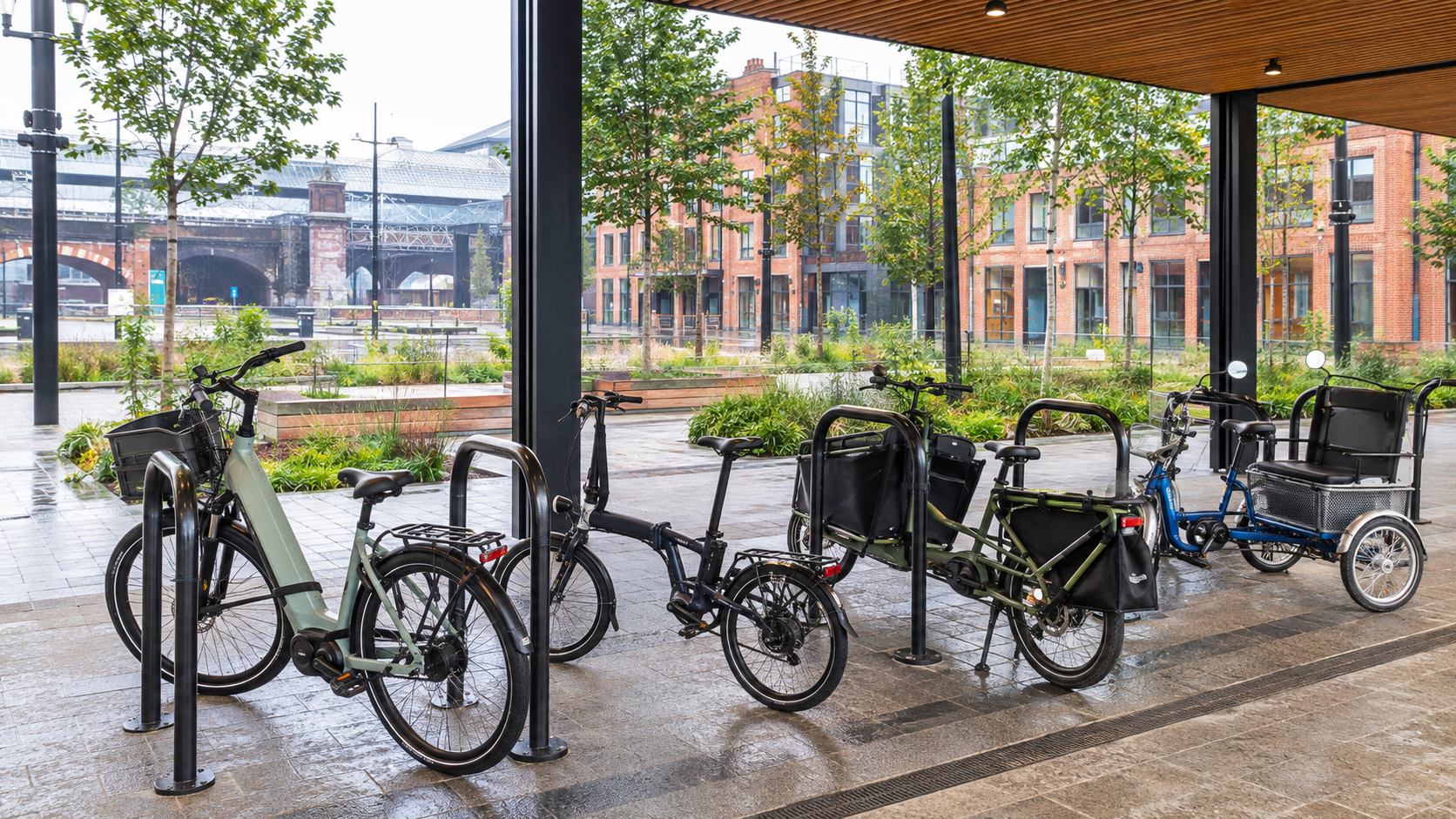
Parking should accommodate longtail bikes, cargo cycles, folding bikes and adapted designs rather than assuming every cycle has the same dimensions. Sheffield stands remain useful, but secure hubs and resident storage are needed for longer stays.
New housing should include cycle storage that is easy to reach without stairs, narrow doors or repeated lifting. A nominal cycle room in an inaccessible basement will not persuade residents to replace car journeys.
Integrate e-bikes with rail and bus services
Secure parking at stations allows riders to leave a full-sized e-bike and continue by public transport. Charging may be helpful in some locations, but security and convenient access are usually more important because many commutes fit comfortably within one charge.
Operators should communicate clear rules for folding bikes and full-sized cycles. Uncertainty makes multimodal journeys harder to plan and encourages people to drive instead.
Support access rather than only ownership
Long-term hire, employer fleets, community loan schemes and e-bike libraries allow people to test the technology before making a large purchase. These programmes can also reach residents who cannot use salary-sacrifice arrangements.
Support should include training, route planning and maintenance. Giving someone access to an e-bike is less useful if they do not feel safe riding it or have nowhere secure to store it.
How individuals can make an e-bike genuinely sustainable
Buying an e-bike does not automatically reduce a person’s carbon footprint. The result depends on how it is used and which journeys it replaces.
Start with repeated car trips that fall within a comfortable cycling distance. The commute, school run, supermarket visit or station journey is more important than an occasional recreational ride because it occurs week after week.
Plan a safe route rather than copying the route normally driven. The best cycling journey may use quieter streets, parks, filtered neighbourhoods and dedicated tracks, even if it is slightly longer.
Equip the bicycle for ordinary life. Panniers, lights, mudguards and a suitable lock often create more transport value than an oversized battery or complex display.
Maintain tyre pressure, brakes and drivetrain. A neglected bike is less efficient, less pleasant to ride and more likely to be abandoned. Regular maintenance extends its lifespan and preserves the environmental benefit of the original manufacturing impact.
Most importantly, use the e-bike as part of a flexible transport mix. Walk very short distances, take public transport when it is more appropriate and retain access to a car for journeys that genuinely need one. Eco-friendly transportation is not about forcing every trip onto one mode. It is about avoiding the default use of the largest and most resource-intensive vehicle for every purpose.
The future of eco-friendly transportation in UK cities
E-bikes will not solve congestion, climate change or transport inequality on their own. They still need safe streets, secure parking, responsible manufacturing and integration with public transport. They also need to be understood as bicycles with assistance, not as a justification for allowing unrestricted electric motorcycles into cycle infrastructure.
Their potential is nevertheless substantial. E-bikes make sustainable commuting possible over longer distances, reduce the physical effect of hills and loads, and allow more people to consider cycling for everyday transport. Cargo models broaden the range of replaceable car and van journeys, while folding designs connect homes and workplaces with rail.
The most important change is not technological but behavioural. An e-bike can turn a journey that people believe requires a car into one that can be made with a small amount of electricity, limited road space and useful physical activity. Repeated across thousands of commuters, shoppers, families and businesses, that shift can reduce emissions while making streets quieter and less congested.
The rise of eco-friendly transportation should therefore not be measured only by the number of electric vehicles sold. A genuinely sustainable city is one where people have several safe and practical ways to travel, and where the car is used because a journey requires it rather than because no realistic alternative exists.
E-bikes help create that choice. In modern British cities, their greatest contribution may be making green travel feel less like a sacrifice and more like the simplest way to get where you need to go.
Laminat og gode lakkerte overflater er vanligvis enklest i en travel hverdag. De tåler hyppig avtørking og er relativt motstandsdyktige mot flekker. Fenix gir i tillegg en matt overflate med få fingermerker. Oljet tre krever mer pleie, men har fordelen av at små skader ofte kan repareres lokalt.
Frequently asked questions about eco-friendly transportation and e-bikes
Are e-bikes really better for the environment than electric cars?
For suitable individual journeys, e-bikes generally require far less energy and material because they are much smaller and lighter. Their batteries are a fraction of the size of electric-car batteries. Electric cars remain necessary for many trips, but replacing a short solo car journey with an e-bike usually provides a larger efficiency gain than changing only the car’s power source.
Can an e-bike replace a car in the UK?
It can replace many local car journeys, but whether it can replace car ownership depends on the household. Distance, children, work equipment, disability, weather, public transport and secure storage all matter. For some homes, an e-bike can replace a second car. For others, it reduces mileage while the car remains available for longer or specialised journeys.
How far can most people commute by e-bike?
There is no universal limit, but assistance makes commutes of several miles practical for many riders. Journey quality matters as much as distance. A longer route on protected tracks may feel easier than a short route through hostile junctions. Battery capacity, terrain, fitness and charging access should also be considered.
Do e-bikes count as active travel?
Yes. Legal pedal-assist e-bikes require the rider to pedal, even though the motor reduces the effort. Riders can select lower assistance when they want more exercise and increase it for hills, heavy loads or difficult weather. The activity level varies, but an e-bike journey is not passive in the same way as travelling in a car.
Are e-bikes legal in cycle lanes?
A compliant EAPC can generally be used wherever conventional bicycles are permitted, including cycle lanes and cycle tracks. An electric vehicle that exceeds the EAPC limits may be classified as a moped or motorcycle and cannot simply be treated as a bicycle. Buyers should verify compliance rather than relying on appearance or marketing language.
What is the most environmentally friendly type of e-bike?
There is no single best type. A durable city bike used daily to replace car commutes may deliver a greater benefit than a lightweight model ridden occasionally. Look for appropriate battery capacity, repairable components, manufacturer support and practical equipment. The most sustainable choice is a bike that fits the intended journeys and remains useful for many years.
Is charging an e-bike expensive?
The electricity cost is typically very low because e-bike batteries are small compared with electric-car batteries and household energy use. Exact cost depends on battery capacity and tariff, but charging expense is rarely a major part of ownership. Maintenance, insurance, locks and eventual battery replacement are more significant long-term considerations.
Do cities need charging stations for e-bikes?
Public charging can help couriers, long-distance riders and shared fleets, but most private e-bikes have enough range for daily urban travel and can be charged at home or work. Secure parking is usually the more urgent requirement. Charging facilities must also use safe, compatible systems rather than encouraging unattended use of unsuitable chargers.