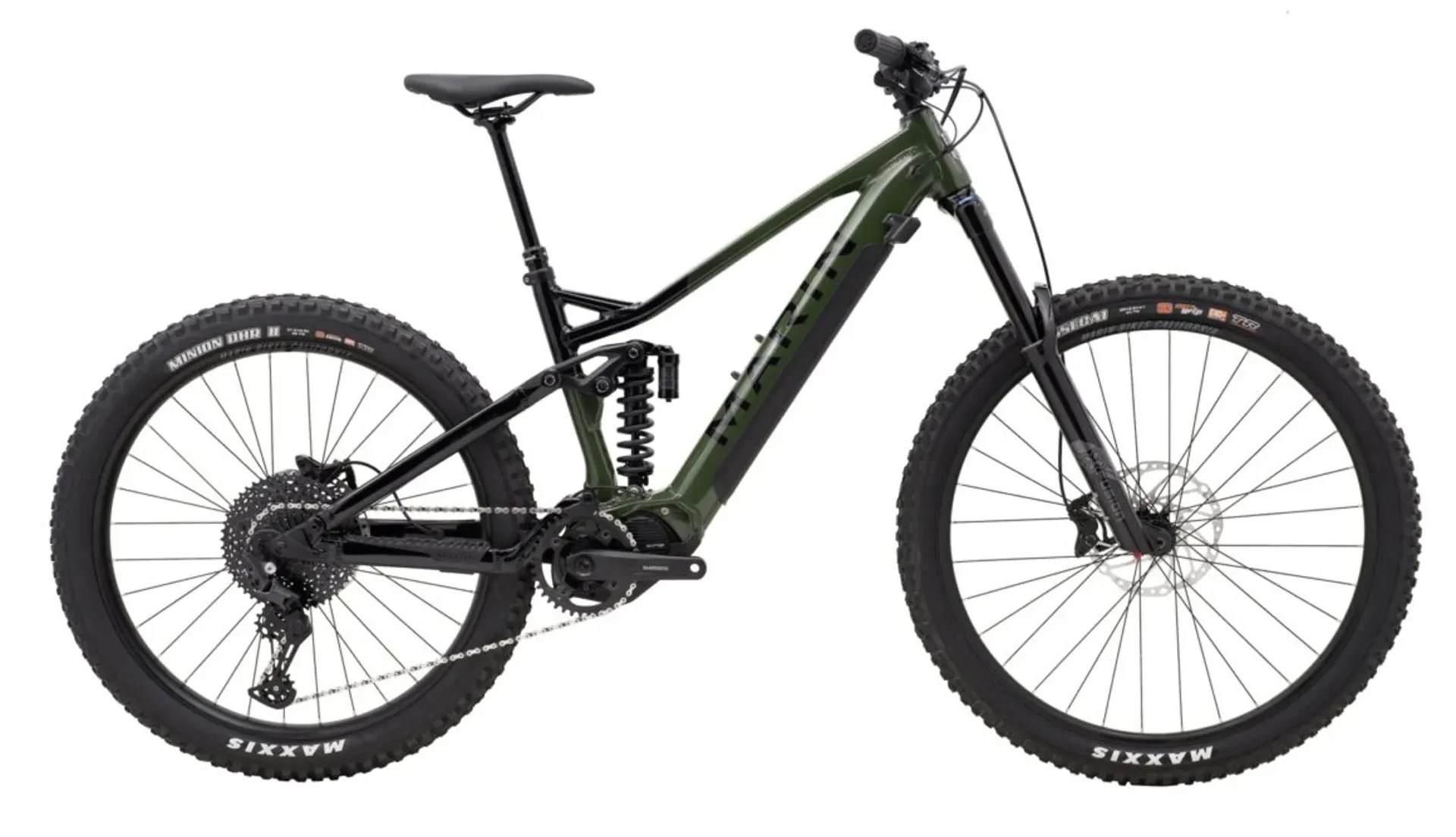
The Marin Alpine Trail E1 is a full-power electric enduro bike designed for steep climbs, technical descents and the kind of riding that makes lighter trail ebikes feel out of their depth.
For 2026, Marin has comprehensively redesigned it around Bosch’s latest Performance Line CX motor, an 800 Wh removable battery and 170 mm front and 160 mm rear suspension. It also gains adjustable geometry, mixed 29/27.5-inch wheels and a noticeably lighter Series 4 aluminium frame.
In this Marin Alpine Trail E1 review, we look at whether that combination can deliver genuinely high-level enduro performance without stepping into the increasingly expensive upper end of the eMTB market, and whether it deserves consideration alongside the models in our best eMTB guide.
Affiliate disclosure: This article contains affiliate links. If you make a purchase through one of these links, E-Bike Guru may earn a commission at no extra cost to you. This helps support our work and does not influence our recommendations.
Marin Alpine Trail E1 Review Summary
The Marin Alpine Trail E1 is an unusually capable full-power eMTB for its position in the market. Bosch’s latest CX motor provides huge climbing assistance, the 800 Wh battery gives it proper big-day potential, and Marin has concentrated its budget on components that genuinely affect trail performance.
Its strongest attribute is composure. The suspension remains controlled through repeated impacts, the Schwalbe tyres generate enormous grip and the geometry encourages you to keep pushing when trails become steep and rough. It feels considerably more expensive on difficult descents than its component labels might suggest.
There is one unavoidable compromise: it is heavy. At around 26 kg, the Alpine Trail E1 prefers carrying speed and smashing through rough terrain to being flicked between lines. Riders wanting an agile, playful eMTB have better options. For aggressive riders who value stability, traction, range and descending confidence, however, this is an exceptionally convincing package.
Score: 8.9/10
Pros
- Extremely powerful Bosch Gen 5 CX motor
- Large removable 800 Wh battery
- Composed suspension performs beyond expectations
- Outstanding Schwalbe Magic Mary tyres
- Powerful TRP DHR EVO Comp brakes
- Excellent equipment for its market position
Cons
- Heavy at around 26 kg
- Less playful than lighter rivals
- X-Fusion fork can be noticeably noisy
- Rear shock reliability deserves monitoring
Who It Is For
The Alpine Trail E1 suits aggressive trail and enduro riders who want maximum climbing assistance and enough suspension for genuinely demanding terrain without paying flagship-bike money. It is particularly good for riders who prioritise grip, stability and repeated uplift-style laps under their own power. Riders who spend most of their time on mellow trails, value low weight or want an especially lively bike should consider something lighter and shorter-travel.
Table of Contents
Marin Alpine Trail E1 Specifications
| Specification | Marin Alpine Trail E1 |
|---|---|
| Motor | Bosch Performance Line CX Gen 5 |
| Motor position | Mid-drive |
| Nominal power | 250 W |
| Peak power | Up to 750 W |
| Maximum torque | Up to 120 Nm |
| Maximum support | Up to 600% in applicable conditions |
| Battery | Bosch PowerTube 800 |
| Battery capacity | 800 Wh |
| Battery | Removable |
| Range extender | Bosch PowerMore 250 compatible |
| Claimed range | Approximately 15–55 miles / 25–90 km |
| Assisted speed | 15.5 mph UK limit |
| Frame | Series 4 aluminium |
| Rear travel | 160 mm MultiTrac 2 LT |
| Fork | X-Fusion Vengeance HLR |
| Fork travel | 170 mm |
| Rear shock | X-Fusion H3A HLR air |
| Wheels | 29 in front, 27.5 in rear |
| Tyres | Schwalbe Magic Mary Radial Gravity Pro |
| Tyre size | 2.5 in front and rear |
| Brakes | TRP DHR EVO Comp |
| Rotors | 200 mm front and rear |
| Gearing | Shimano CUES LINKGLIDE 10-speed |
| Cassette | 11–48T |
| Dropper | TranzX adjustable-travel |
| Display | Bosch Kiox 400C |
| Connectivity | Bosch eBike Flow |
| Approximate weight | Around 26 kg in Large |
| Sizes | S, M, L, XL |
| Head angle | 63.5°, adjustable ±0.75° |
| Seat angle | 79° |
| Typical price position | Mid-range/full-power eMTB |
Design and Build Quality
Frame and Finish
The 2026 Alpine Trail E represents a substantial step forward from its predecessor.
Marin has reshaped the Series 4 aluminium chassis around the fifth-generation Bosch CX system and managed to remove approximately 1.3 kg from the previous frame package. That does not make the complete E1 light, but the frame itself is cleaner, slimmer and much less cumbersome than before.
The 800 Wh battery sits inside the oversized down tube while remaining removable. Marin has deliberately positioned the battery relatively low, helping prevent the front-heavy feeling that can plague large-battery enduro ebikes.
There is also around 37 mm more ground clearance than before, an important change on a bike designed to climb rocky technical trails where motor housings regularly encounter rocks and ledges.
Cable routing is internally sealed, the rear uses Boost spacing and Marin has adopted SRAM’s Universal Derailleur Hanger standard. None of this is glamorous, but it gives the frame a thoroughly current foundation.
Adjustable Geometry
Marin has gone unusually far with chassis adjustment.
The headset can alter the head angle by 0.75 degrees in either direction. Combined with the standard 63.5-degree position, riders can move between approximately 62.75 and 64.25 degrees.
A separate flip-chip changes both bottom-bracket height and chainstay length. The shorter setting uses roughly 442 mm stays and a higher bottom bracket, while the longer configuration extends them to around 450 mm and lowers the bike.
These are meaningful changes rather than novelty adjustments. The short/high arrangement encourages easier direction changes and greater pedal clearance. The long/low configuration increases stability and front-wheel weighting on particularly steep terrain.
Motor Performance and Power Delivery
Bosch Performance Line CX Gen 5
The fifth-generation Bosch Performance Line CX is one of the main reasons the E1 looks so competitive.
Its nominal output remains compatible with UK electrically assisted bicycle regulations, but peak output can reach 750 W. More significantly, Bosch’s latest software allows compatible CX systems to reach up to 120 Nm of torque and as much as 600% assistance in the situations where its extended boost is available.
It is important to understand what that 120 Nm figure actually means.
The motor does not simply deliver maximum torque continuously whenever Turbo mode is selected. Bosch’s latest system uses rider input, cadence and the riding situation to provide additional short-term assistance, particularly at lower speeds and on technical climbs. Maximum support is strongest below approximately 15 km/h, where enormous assistance is genuinely useful for clearing steep steps, roots and ledges.
That makes more sense than simply turning the CX into an uncontrollable 120 Nm motor.
Acceleration and Pedal Assistance
Power delivery remains one of Bosch’s strengths.
The E1 moves away decisively when pressure reaches the pedals, yet the motor still responds to rider effort rather than completely taking over. The result is plenty of acceleration without the disconnected sensation of merely rotating the pedals while the motor does everything else.
Bosch’s eMTB modes are especially effective on changing terrain. Assistance automatically increases as pedal input rises, allowing you to approach an obstacle relatively gently before receiving considerably more power when you stamp on the pedals.
Turbo is more aggressive and can make steep access climbs disappear remarkably quickly.
There are more explosive systems available. The highest-output competitors can accelerate harder, and some react fractionally faster during extremely technical manoeuvres. What Bosch continues to do particularly well is combine considerable power with predictable delivery.
Technical Climbing
The combination of the CX motor, steep 79-degree seat angle and supple rear suspension makes the Alpine Trail E1 formidable uphill.
The steep seat position keeps the rider centred enough to maintain front-wheel control on severe gradients, while the rear suspension generates excellent traction when loose stones and roots would have a hardtail or poorly controlled suspension bike spinning its tyre.
Short 150 mm cranks also help. They reduce pedal strikes and allow you to continue turning the cranks through awkward rock sections where longer arms would repeatedly clip the terrain.
There is enough motor output that outright power rarely becomes the limiting factor.
The bike’s weight does occasionally become one.
Technical climbing that requires repeatedly lifting or repositioning the wheels demands noticeably more physical effort than on a lighter eMTB. The motor can propel 26 kg uphill remarkably quickly, but it cannot remove that mass when you need to hop sideways across a rut.
Battery Range and Charging
Real-World Range
An 800 Wh battery is exactly what we want to see on a full-power enduro machine.
Marin quotes an extremely broad range of approximately 15 to 55 miles, which is more useful than pretending an eMTB has one meaningful maximum range figure. How much vertical climbing you accumulate matters enormously.
Spend an entire ride repeatedly attacking steep climbs in Turbo and the lower half of that range becomes relevant. Ride more efficiently in Tour or eMTB modes across rolling terrain and 30 to 40 miles becomes considerably more achievable. Eco riding on easier ground can push the bike towards the upper end.
For the Alpine Trail’s intended use, distance is arguably the wrong metric anyway. An 800 Wh battery provides enough energy for a substantial amount of climbing and repeated descending before range anxiety becomes the dominant consideration.
Bosch’s current CX system is also comparatively efficient when its output is sensibly configured. You do not need to run the full 120 Nm setting continuously, and reducing assistance can noticeably extend useful riding time.
Charging and Battery Practicality
The PowerTube 800 can be charged in the bike or removed.
That is a significant practical advantage over several increasingly popular eMTBs with permanently installed batteries. The bike can remain in a garage while the battery charges indoors, and riders travelling with the bike have more flexibility.
With Bosch’s 4A charger, a completely depleted PowerTube 800 takes roughly seven hours to recharge, with around half capacity reached after approximately two and a half hours.
There are two particularly useful expansion options.
A Bosch PowerTube 600 can be installed when reducing weight matters more than maximum range. No special frame conversion is required. Alternatively, the 250 Wh PowerMore extender increases total available capacity to approximately 1,050 Wh.
That modularity is one of the strongest aspects of the entire electrical package.
Ride Quality and Suspension
X-Fusion Vengeance HLR Fork
X-Fusion does not have the showroom prestige of Fox or RockShox, but dismissing the Vengeance HLR because of the logo would be a mistake.
Its 170 mm travel is appropriate for the chassis, and there is enough damping adjustment to properly tune it rather than simply setting air pressure and hoping for the best. High and low-speed compression and rebound adjustments allow significantly more control than the basic forks frequently fitted to less expensive full-power eMTBs.
Performance through repeated rough impacts is particularly convincing. The front wheel stays controlled rather than bouncing unpredictably between rocks, and there is sufficient support deeper in the stroke to resist diving aggressively under braking.
The main complaint is noise. Fluid movement through the damper can be surprisingly audible, especially when the trail becomes busy. It sounds less refined than premium suspension even when the actual damping remains effective.
X-Fusion H3A HLR Rear Shock
The air-sprung H3A controls 160 mm of Marin’s MultiTrac 2 LT rear suspension.
Small-bump sensitivity is good, providing useful traction when climbing across broken surfaces. Once descending, the suspension progresses naturally through its travel and handles larger impacts without immediately using everything available.
The result is a rear end that feels very settled.
There is one reliability caveat. A rear shock on an extensively tested early E1 developed an oil leak and required replacement. The replacement operated normally, and there is not enough evidence to describe this as a widespread Alpine Trail problem.
It is nevertheless something we would monitor, particularly because X-Fusion’s service footprint is smaller than that of Fox or RockShox in some areas of the UK.
Ride Position and Rider Fit
Marin’s sizing is deliberately progressive.
Reach increases from 430 mm in Small to 460 mm in Medium, 490 mm in Large and a substantial 520 mm in XL. The steep 79-degree effective seat tube prevents those figures making the bike feel excessively stretched when seated.
The result is an efficient climbing position. You remain relatively central rather than sitting far behind the bottom bracket and fighting to keep the front wheel planted.
Standover is also low for a 160 mm eMTB, and the TranzX post provides size-specific travel. Medium gets around 170 mm, while Large and XL receive 200 mm, giving taller riders plenty of clearance when descending.
There is substantial size progression between frames, so riders near the boundary should consider intended handling rather than simply defaulting to the larger option. Downsizing will make a heavy bike easier to manipulate, while sizing up emphasises stability.
Braking and Handling
TRP DHR EVO Comp Brakes
The DHR EVO Comp brakes are exactly the sort of component choice that makes the E1 specification work.
They are serious four-piston brakes rather than an obvious budget substitute, paired with 200 mm rotors at both ends.
Power is substantial, but lever control is equally important. There is enough modulation to make small speed corrections without constantly locking the tyres, while stronger pressure produces the braking force required to control a 26 kg bike on prolonged steep descents.
Heat management is also considerably more appropriate for enduro riding than the smaller brakes fitted to some entry-level eMTBs.
There is very little here we would rush to upgrade.
Handling and Stability
The Alpine Trail E1’s character becomes clearest when the trail deteriorates.
It wants to remain planted.
The 29-inch front wheel rolls confidently through holes and rock gardens, while the smaller 27.5-inch rear wheel gives additional tyre clearance and makes the back of the bike slightly easier to move.
The 63.5-degree head angle provides substantial stability on steep trails, and the long wheelbase becomes increasingly beneficial as speed rises.
Grip is enormous. The Schwalbe Magic Mary Radial Gravity tyres are not inexpensive OEM rubber disguised by a familiar model name. The front uses an extremely soft compound, while the rear balances traction with greater durability. Their radial construction allows the casing to conform effectively to rough terrain.
That combination of tyres, weight and active suspension means the bike resists being deflected when hammering through loose rocks and braking bumps.
The trade-off is obvious on smoother trails.
A lighter bike will change direction with less effort, pump through rollers more energetically and become airborne more readily. The Marin can jump and move around, but you need to tell it to do so. It does not constantly encourage playful line changes.
This is a bike that would rather destroy the rough line than dance around it.
Gearing and Drivetrain
Shimano CUES might initially look like an obvious area where Marin has reduced cost. In practice, it is one of the smarter choices on the bike.
The 10-speed LINKGLIDE drivetrain uses an 11–48T cassette and components deliberately designed around durability under high drivetrain loads.
That matters considerably more on an eMTB than having another two sprockets.
The Bosch motor can place enormous torque through the chain and cassette, particularly when shifting during steep climbs. CUES uses wider, more substantial tooth profiles designed to cope with exactly that treatment.
Changes are positive rather than especially delicate, and the gaps between ratios are larger than on a high-end 12-speed drivetrain. Neither becomes a major issue once the motor is providing assistance.
More importantly, shifting remains dependable under pressure.
For a bike likely to accumulate a lot of vertical metres, the lower replacement cost and increased durability make considerably more sense than fitting an expensive race-oriented derailleur simply to improve the showroom specification.
Display, Controls and Smart Features
Kiox 400C Display
Even the entry E1 receives Bosch’s integrated Kiox 400C colour display.
It is positioned inside the top tube rather than perched above the handlebar, protecting it from impacts while leaving the cockpit uncluttered.
The two-inch colour screen can show speed, battery state, remaining range, power information, navigation instructions and other configurable ride data. Visibility is good and the layout provides enough information without requiring a large external computer.
A compact handlebar remote changes assistance levels and activates functions such as walk assistance without requiring you to remove a hand from the grip.
Bosch eBike Flow App
Bosch’s connected ecosystem is a significant ownership advantage.
The Flow app handles firmware updates, ride-mode configuration, navigation functions, ride recording and security features. Power delivery can also be adjusted, allowing riders to decide whether they actually want the maximum assistance available.
This becomes especially relevant with the 120 Nm update. Maximum torque can increase drivetrain wear and battery consumption, and not every trail benefits from enormous assistance.
The interface is not as technologically dramatic as some newer systems with smartphone-like touchscreen displays, but its functionality is mature and genuinely useful.
Wheels, Tyres and Everyday Trail Practicality
The E1 uses Marin’s own aluminium wheels with a 29 mm internal rim width.
They are tubeless compatible and appropriately proportioned for the 2.5-inch tyres. There is nothing particularly glamorous about the hubs or rims, but this is another area where Marin has prioritised suitable dimensions over expensive branding.
The tyres are significantly more noteworthy.
Running Schwalbe Magic Mary Gravity Pro Radials at both ends gives the E1 the sort of rubber frequently added as an immediate aftermarket upgrade. The Ultra Soft front compound maximises cornering and braking grip, while the slightly firmer rear survives powered climbing more effectively.
Rolling resistance is substantial, but complaining about that on a 170 mm Bosch-powered enduro bike misses the point.
There are also three sets of mounting bosses inside the front triangle. Depending on configuration, they can accommodate water, tools or the Bosch PowerMore range extender.
There are no commuter accessories, nor should there be. Riders comparing it with a broader best ebike selection should understand that the Alpine Trail E1 is unapologetically built around off-road performance.
Weight, Transport and Storage
Weight is the Alpine Trail E1’s most significant weakness.
A Large comes in at roughly 26 kg, depending on tyres, pedals and setup. That puts it at the heavy end even among full-power eMTBs.
On the ground, the motor and well-positioned mass disguise a surprising amount of it. Point the bike downhill and that weight becomes stability. Point it uphill and Bosch supplies more than enough assistance to compensate.
The problem appears when neither gravity nor electricity can help.
Lifting the bike over a gate, loading it into a vehicle or carrying it upstairs is hard work. Traditional roof-mounted bike racks are unlikely to be suitable, and owners need to check the individual weight limit of towbar carriers carefully.
Removing the 800 Wh battery before lifting helps considerably.
Owners particularly concerned about handling weight can also replace it with Bosch’s smaller 600 Wh battery. That sacrifices range but makes more sense than trying to save a few hundred grams through expensive carbon components.
Maintenance, Reliability and Ownership
The drivetrain should prove relatively economical to maintain by serious eMTB standards.
Shimano LINKGLIDE is specifically designed for durability, and replacement chains, cassettes and brake consumables are readily obtainable. Riders should still monitor chain wear carefully because 120 Nm of potential motor torque can be extremely hard on a neglected drivetrain.
The Bosch system is another advantage.
Performance Line CX is widely used, and the UK has an extensive network of Bosch-certified dealers capable of running diagnostics, installing updates and handling electrical warranty work. That reduces dependence on Marin-specific electronic components.
The removable battery also improves long-term serviceability.
Suspension requires more thought. X-Fusion parts are perfectly serviceable, but finding a workshop familiar with them may take slightly more effort than with Fox or RockShox. Given the isolated H3A leak seen during intensive early testing, keeping on top of shock servicing would be sensible.
Wheel bearings, suspension pivots and brake pads will inevitably receive considerable punishment if the bike is used as intended. This is a high-powered 26 kg enduro bike rather than a low-maintenance urban ebike.
Warranty and Customer Support
Marin’s established warranty structure provides five years of coverage on full-suspension frames for the original purchaser, while complete-bike components have shorter individual coverage and wear items are excluded.
Suspension and drivetrain components are generally handled under the respective component manufacturers’ policies rather than Marin’s frame warranty.
The Bosch electrical system receives separate support through Bosch’s service network, with two-year coverage typical for the motor, battery and related electrical components in the UK.
As with most performance mountain bikes, buying through an authorised dealer has meaningful advantages. Correct suspension setup, firmware updates, Bosch diagnostics and warranty claims are considerably easier when there is an established workshop between the rider and manufacturer.
Marin Alpine Trail E1 vs the Competition
Specialized Turbo Levo 4 Alloy
The latest Turbo Levo 4 Alloy is arguably the E1’s most dangerous competitor.
Specialized uses its own 3.1 motor with 105 Nm and 810 W peak output, alongside an even larger 840 Wh battery. It also has mixed wheels, adjustable geometry and a very sophisticated electronics ecosystem.
The Levo feels somewhat more refined and its motor integration is outstanding. Specialized has also spent years developing one of the strongest suspension platforms in the category.
The Marin counters with 170/160 mm travel rather than the Levo’s 160/150 mm arrangement, more aggressive enduro geometry, substantially more maximum torque and particularly strong brakes and tyres.
We would choose the Levo for mixed trail riding and the Marin if repeated steep, rough descents were the priority.
Santa Cruz Vala AL Deore
The Vala AL sits slightly above the Marin and uses the same Bosch CX motor, but takes a different approach.
Its 600 Wh battery is much smaller, yet the complete bike weighs around two kilograms less. The Santa Cruz therefore feels easier to move around and more energetic beneath the rider.
Its 160/150 mm suspension package also occupies more of an aggressive trail-bike position rather than the Marin’s heavier enduro focus.
The Vala’s chassis balance and suspension are outstanding, and its lifetime frame support gives it an ownership advantage. The Marin responds with much more standard battery capacity, additional suspension travel, better long-distance potential and a lower market position.
If agility matters most, the Vala is difficult to beat. If range and outright descending composure matter more, the Alpine Trail E1 has the stronger argument.
Canyon Strive:ON CF 8
The Canyon Strive:ON CF 8 makes the Marin’s weight particularly difficult to ignore.
It uses a carbon frame, Bosch power and aggressive enduro geometry while coming in noticeably lighter. Its Shimano Deore drivetrain and SLX brakes are also dependable equipment.
Canyon has produced an exceptionally capable gravity-focused eMTB, and riders prioritising dynamic handling should take it seriously.
The Alpine Trail responds with its larger 800 Wh battery, removable-battery flexibility, latest Bosch configuration, exceptionally grippy stock tyres and traditional dealer support.
Neither automatically wins. The Canyon is the more athletic bike, while the Marin feels more like an electric shuttle bike that happens to be exceptionally competent when ridden back downhill.
Value for Money
This is where the E1 specification starts to make considerable sense.
Marin has avoided spending money on components that look impressive in a shop while compromising the parts that matter on the trail.
The Bosch Gen 5 CX system is exactly the same fundamental motor platform used by significantly more expensive bikes. The 800 Wh battery is similarly uncompromised, as is the integrated Kiox display.
The brakes are genuinely enduro-capable. The tyres are outstanding. The suspension is extensively adjustable and performs far above what many riders will expect from X-Fusion. The CUES drivetrain is inexpensive, but arguably better suited to repeated high-torque use than a delicate premium drivetrain.
Where has the money been saved?
The frame is aluminium rather than carbon. The wheelset is basic. The cockpit is functional. The drivetrain lacks prestige. The suspension does not have Fox or RockShox branding.
Most of those compromises matter far more while reading a specification sheet than when hammering through a rock garden.
The one specification figure that does materially affect performance is the weight.
If the E1 were two kilograms lighter, it would be an extraordinary package. At around 26 kg, its appeal is narrower. You need to actually want the planted, high-speed character that accompanies the mass.
For that rider, the Alpine Trail E1 represents genuinely strong value rather than merely a relatively inexpensive purchase price.
Marin Alpine Trail E1 Review Verdict
The Marin Alpine Trail E1 is a bike built around unusually sensible priorities.
Instead of chasing a premium groupset or fashionable cockpit components, Marin has given the E1 a superb electrical system, huge battery, serious brakes, outstanding tyres and suspension capable of handling the terrain its geometry encourages you to attack.
Bosch’s latest CX motor removes almost any concern about climbing power. The 800 Wh battery gives it the endurance required for repeated laps, and the chassis becomes increasingly convincing as speeds rise and trails become rougher.
Its greatest strength is composure. Rocks, braking bumps and steep technical sections rarely disturb it.
Its biggest compromise is the other side of precisely the same characteristic. Around 26 kg of bike does not suddenly become light because the suspension works well. More agile competitors are easier to throw through corners, lift over trail features and reposition on technical climbs.
The isolated rear-shock failure seen during early hard testing is also worth watching, even though it does not currently justify describing the H3A as unreliable.
For riders who want a lively trail ebike, the Alpine Trail E1 would not be our first choice. For someone who wants to climb rapidly, descend aggressively and prioritises traction and confidence over low weight, it is one of the strongest full-power enduro packages in its part of the market.
The reason to buy the Alpine Trail E1 is simple: Marin has spent the budget where aggressive riders will actually feel it.
Score: 8.9/10
Frequently Asked Questions
How much torque does the Marin Alpine Trail E1 have?
The 2026 Alpine Trail E1 uses Bosch’s fifth-generation Performance Line CX motor, with up to 120 Nm available through Bosch’s latest performance software. Maximum assistance is situational rather than a continuous 120 Nm shove, with additional boost particularly relevant at lower speeds during steep technical climbing. Peak motor output is up to 750 W.
What is the real-world range of the Marin Alpine Trail E1?
Marin quotes approximately 15 to 55 miles from the 800 Wh battery, reflecting how dramatically terrain and assistance level affect an eMTB. Hard enduro riding with repeated Turbo-assisted climbs will put you towards the lower end, while mixed riding in more economical modes can comfortably extend the distance. A 250 Wh Bosch PowerMore extender is also compatible.
How heavy is the Marin Alpine Trail E1?
A size Large weighs around 26 kg depending on exact tyres, pedals and setup. That is heavy even for a modern full-power eMTB. The weight contributes to excellent stability on rough descents but makes the bike harder to manoeuvre dynamically and considerably more difficult to lift onto a vehicle rack or carry upstairs.
Can you remove the battery from the Marin Alpine Trail E1?
Yes. The 800 Wh Bosch PowerTube can be removed from the bike, allowing it to be charged indoors or taken out when transporting the bike. Marin has also designed the frame to accept Bosch’s smaller 600 Wh battery without additional conversion hardware, providing an interesting option for riders who occasionally prefer reduced weight over maximum range.
Is the Marin Alpine Trail E1 good for climbing?
Very. The Bosch CX motor provides enormous assistance, while the steep 79-degree seat angle, short 150 mm cranks and active rear suspension help maintain traction on steep technical climbs. Its only significant limitation uphill is weight. Sections requiring repeated wheel lifts or rapid changes of direction demand more rider effort than they would on a lighter eMTB.
Is the Marin Alpine Trail E1 good for bike parks and enduro riding?
Yes. This is arguably where the Alpine Trail E1 makes the most sense. Its 170 mm fork, 160 mm rear travel, slack geometry, powerful four-piston brakes and heavy-duty Schwalbe tyres are designed for steep and rough terrain. The Bosch motor effectively provides your own uplift, making it particularly attractive for riders who want to fit several descending laps into a ride without relying on lifts or shuttles.