
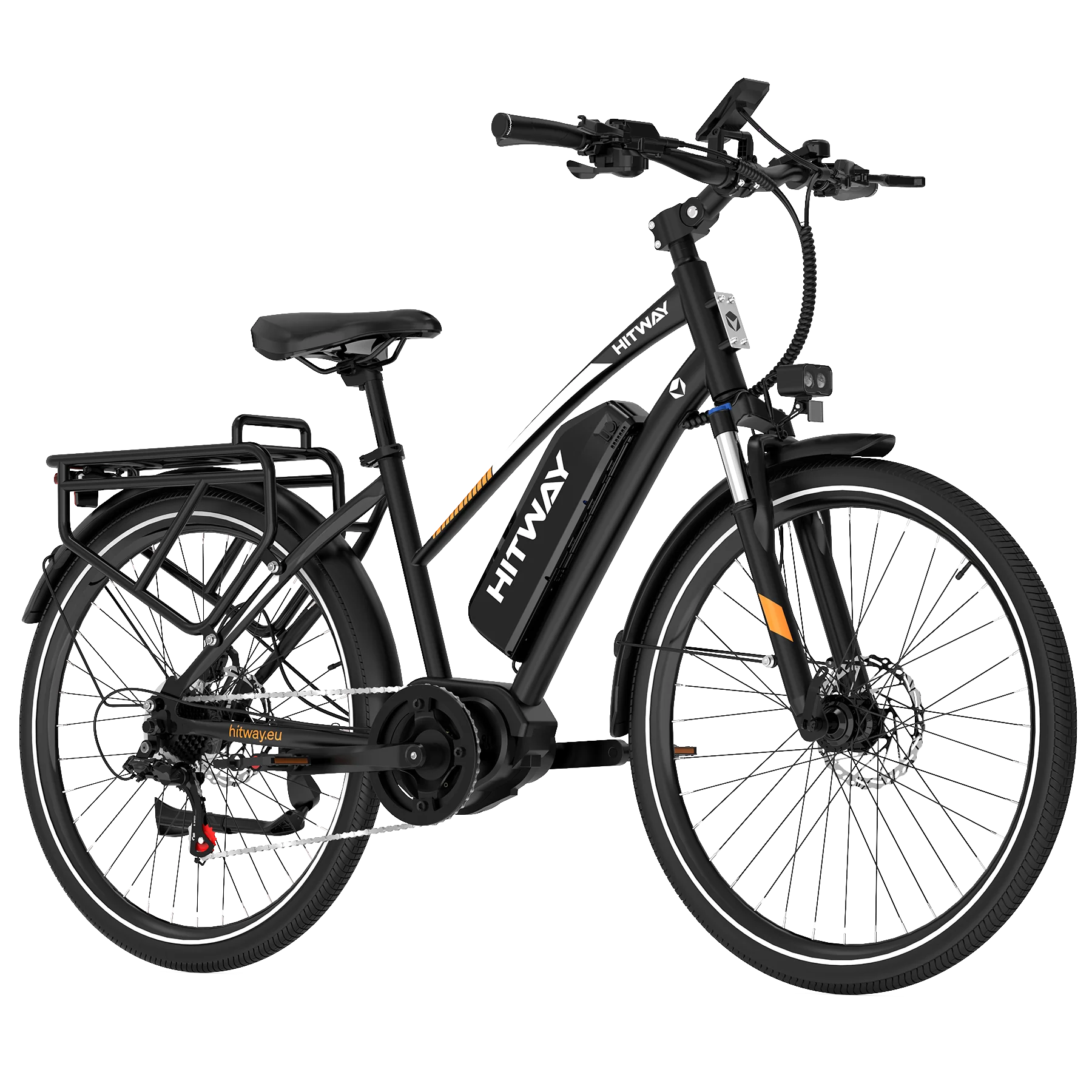
The HITWAY BK-U1 is an electric hybrid aimed at riders who want the natural assistance of a mid-drive motor without moving into the premium end of the ebike market.
Its specification is unusually ambitious for the segment. There is an Ananda mid-drive motor with torque sensing, hydraulic disc brakes, a removable integrated battery, front suspension and smart features including NFC unlocking and app connectivity.
That makes the BK-U1 particularly interesting for commuters and leisure riders considering their first serious electric bike. This HITWAY BK-U1 review looks at how those components work together, where HITWAY has saved money and whether the bike’s headline specifications translate into a genuinely strong everyday package.
HITWAY BK-U1 Review Summary
The HITWAY BK-U1 stands out because mid-drive motors remain relatively unusual among budget and lower mid-range electric bikes. Most competitors at this level use a motor in one of the wheel hubs. Putting the motor at the cranks allows the BK-U1 to use the bicycle’s gears, improves weight distribution and, combined with its torque sensor, produces a much more natural relationship between pedal effort and electrical assistance.
That is the bike’s biggest strength. The Ananda M60 does not have the sheer torque of the most powerful trekking systems, but it is responsive, smooth and well suited to commuting, hills and longer leisure rides. Hydraulic brakes, wide tyres, an adjustable stem, integrated lights and a rear rack strengthen the package further.
There are compromises. At 27.35 kg, the BK-U1 is very heavy for an urban hybrid. The seven-speed drivetrain is basic, the suspension fork is relatively simple and HITWAY’s advertised 150–180 km range should be viewed as an idealised maximum rather than an everyday expectation.
Even with those reservations, few ebikes in this part of the market combine a torque-sensing mid-drive with this much equipment.
Score: 8.7/10
Pros
- Mid-drive motor is unusual at this market position
- Torque sensor provides natural, responsive assistance
- Strong climbing performance for an urban commuter
- Hydraulic disc brakes
- Comfortable 27.5 × 2.2-inch tyres
- NFC unlocking and app connectivity add useful functionality
Cons
- Very heavy at 27.35 kg
- Advertised maximum range is highly optimistic
- Basic seven-speed drivetrain
- Suspension fork is designed more for comfort than serious off-road riding
Who It Is For
The HITWAY BK-U1 is particularly attractive to commuters and leisure riders who regularly encounter hills and want something more natural-feeling than a basic hub-motor ebike. It also suits riders looking for plenty of standard equipment without moving into premium pricing.
It is less appealing if you need to carry your bike upstairs, regularly take it on trains or want a lightweight hybrid that remains enjoyable to pedal without assistance.
Table of Contents
HITWAY BK-U1 Specifications
| Specification | HITWAY BK-U1 |
|---|---|
| Motor | Ananda M60 mid-drive |
| Motor power | 250 W |
| Motor torque | Up to 70 Nm based on current M60 specification |
| Sensor | Torque sensor |
| Battery | 36 V 13 Ah lithium-ion |
| Battery capacity | 468 Wh |
| Battery | Removable and frame-integrated |
| Claimed range | 150–180 km |
| Realistic mixed-use range | Roughly 70–95 km is a more sensible expectation for many riders |
| Charger | 3A |
| Charging time | Approximately 4–5 hours |
| Maximum assisted speed | 25 km/h / 15.5 mph |
| Pedal assistance | 5 levels |
| Frame | Aluminium alloy |
| Fork | Lockable suspension fork |
| Wheels | 27.5 inches |
| Tyres | 27.5 × 2.2-inch puncture-resistant pneumatic tyres |
| Brakes | ZOOM hydraulic disc brakes |
| Gearing | Shimano 7-speed |
| Display | TW35 LCD |
| Connectivity | Smartphone app and NFC |
| Lights | Integrated front and rear |
| Rear rack | Included |
| Waterproof rating | IPX5 listed on UK specification |
| Bike weight | 27.35 kg |
| Maximum payload | 150 kg |
| Recommended rider height | 165–190 cm |
| Market position | Budget to lower mid-range commuter ebike |
| Warranty | Two years under current UK policy |
One specification deserves clarification. Published torque figures for the BK-U1 are inconsistent. HITWAY has listed a slightly higher figure in some comparison material, while the current specification for the Ananda M60 motor itself gives a maximum of 70 Nm. We consider 70 Nm the safer figure to use.
Design and Build Quality
Frame and Finish
The BK-U1 looks considerably more integrated than many affordable electric bikes.
Its 468 Wh battery disappears into the large aluminium downtube, while the mid-mounted motor sits neatly around the crank area. There is still no disguising that this is an electric bike, but it avoids the obvious external battery and oversized rear hub found on many budget alternatives.
The conventional step-over frame gives the bike a hybrid or trekking appearance rather than a dedicated city-bike shape. It is available in black and silver, with relatively restrained graphics.
A 115 cm wheelbase contributes to the long, planted stance. Combined with the central motor position and battery mounted low in the frame, the weight distribution is much better balanced than on many heavy rear-hub ebikes.
That does not make the BK-U1 light. Far from it. At 27.35 kg, the chassis and equipment are clearly designed around durability and affordability rather than weight reduction.
Fit and finish are generally respectable for the category. Owner feedback suggests assembly is reasonably straightforward and the fundamental frame feels substantial. There have also been isolated reports of mudguards developing rattles over rough surfaces, illustrating the difference between a well-equipped affordable bike and the tighter finishing found on premium trekking models.
Integration and Component Quality
The component selection is pragmatic.
Rather than spending heavily on the drivetrain, HITWAY puts much of the available budget into the motor, torque sensor, battery and hydraulic brakes. That is a sensible hierarchy for an electric commuter.
The adjustable stem is particularly useful. Its broad angle adjustment lets riders bring the handlebar higher and closer for a more upright commuting position or lower it for a slightly sportier posture.
Integrated front and rear lighting and a rear cargo rack improve everyday usability. These are the types of components that make the difference between owning an electric bicycle and having a practical transport tool.
The Shimano seven-speed drivetrain is where the cost-saving becomes more obvious. It does the job, but it is considerably less sophisticated than the nine-, ten- and eleven-speed systems found on better trekking bikes.
Nothing about the BK-U1 feels luxurious. The impressive part is how much genuinely useful equipment HITWAY has managed to include without sacrificing the mid-drive system.
Motor Performance and Power Delivery
Ananda M60 Mid-Drive Motor
The BK-U1’s defining component is its Ananda M60 mid-drive motor.
Ananda is considerably less famous in the UK than Bosch or Shimano, but it is an established ebike drive manufacturer rather than an anonymous motor supplier. The M60 is specifically designed for urban electric bikes and uses integrated torque and cadence sensing.
Rated at 250 W, it complies with the power limit required for a normal UK electrically assisted pedal cycle.
Maximum torque is around 70 Nm, putting the M60 comfortably above many lightweight city-bike motors but below high-performance trekking and electric mountain-bike systems that now produce 80–100 Nm or more.
For the intended use, that is plenty.
The important difference between the BK-U1 and many affordable ebikes is not maximum power. It is how that power reaches the road.
A cheap cadence sensor mainly detects whether the cranks are turning. Start pedalling and the motor activates, sometimes with an obvious delay and surge.
The BK-U1’s torque sensor measures how much force you apply through the pedals. Push harder and the motor increases assistance. Relax your effort and it reduces support.
The result feels much more like riding a normal bicycle with stronger legs.
Acceleration and Pedal Assistance
Assistance arrives quickly from a standstill without being overly abrupt.
That makes the BK-U1 particularly pleasant in urban traffic. Pulling away from junctions requires much less effort, yet the bike does not suddenly surge forward the moment the pedals move.
There are five assistance levels. Moving upwards primarily changes how much the motor multiplies your input rather than simply assigning a different target speed to each setting.
Lower levels work well for flatter routes and extending range. Higher assistance makes more sense when accelerating repeatedly through traffic, climbing or riding into a strong headwind.
Because this is a mid-drive, gear selection matters.
Starting in a low gear lets the M60 spin efficiently and provides considerably better acceleration than trying to pull away in the hardest ratio. The same principle applies on hills.
This makes the BK-U1 feel more bicycle-like than a hub-driven commuter, but it also expects slightly more from the rider. Someone accustomed to leaving a hub-motor bike in one gear and allowing the motor to do everything will need to use the drivetrain properly.
At 25 km/h, assistance cuts out in accordance with UK regulations.
Unfortunately, the BK-U1 is not particularly enjoyable above that point. Once assistance disappears, you are pedalling a 27 kg bicycle with relatively wide tyres and an upright position. Holding significantly higher speeds requires meaningful effort.
Hill-Climbing Performance
Hills are one of the strongest arguments for buying the BK-U1.
A mid-drive can use the bicycle’s gears, so selecting an easier ratio effectively helps both rider and motor. A hub motor cannot do this because it drives the wheel independently of the bicycle drivetrain.
The 70 Nm M60 therefore feels stronger on steep gradients than its headline number might suggest.
Owner feedback also supports the basic behaviour: assistance responds strongly when pressure reaches the pedals, and moderate hills become much easier when the correct gear is selected.
The seven-speed drivetrain limits how finely you can manage cadence compared with a more sophisticated trekking groupset, but the available spread is adequate for everyday hills.
We would be much more cautious about HITWAY’s claim that the bike can effectively flatten extreme gradients. A heavy rider, luggage and a prolonged steep climb will still require meaningful pedal input.
What matters is that ordinary urban hills are firmly within the BK-U1’s comfort zone.
Battery Range and Charging
Real-World Range
The BK-U1 uses a 36 V, 13 Ah battery, giving a total capacity of 468 Wh.
That is a perfectly respectable battery for an everyday commuter, but it makes HITWAY’s advertised 150–180 km maximum range one of the more optimistic elements of the specification.
Covering 180 km from 468 Wh would require extremely low electrical consumption. Such figures may be technically possible under highly favourable conditions with a light rider, flat terrain and minimal assistance, but they should not form the basis of a normal buying decision.
A more useful expectation is around 70–95 km, or roughly 45–60 miles, for mixed everyday use, with substantial variation in either direction.
There is already owner feedback showing approximately 50–60 miles while regularly using a high assistance setting. That fits much more comfortably with what we would expect from a battery of this capacity.
Lower assistance, flatter routes and active rider input can extend the distance substantially. Cold weather, hills, headwinds, heavier riders and higher assistance reduce it.
This is still enough range for most commuters.
A typical daily journey can be completed repeatedly between charges, while weekend riders have enough capacity for meaningful longer trips.
The problem is not that the BK-U1 has poor range. It doesn’t. The problem is that the marketing figure creates an unrealistic benchmark for what is actually a perfectly decent medium-capacity battery.
Charging and Battery Practicality
The supplied 3A charger is another positive.
HITWAY quotes approximately four to five hours for a full charge. That is relatively quick for a battery of this size and means a partially depleted battery can gain a substantial amount of capacity during a working day.
The battery is removable as well as being integrated into the downtube.
That is important for anyone storing the bike in a shed, communal cycle area or garage without convenient electricity. The battery can be taken indoors and charged separately.
It also means the most expensive electrical component can be removed when the bike is left unused for longer periods.
Replacement BK-U1 batteries are available directly, which is reassuring from a long-term ownership perspective. Battery availability often matters far more several years into ebike ownership than it does when the bike is new.
Ride Quality and Comfort
Riding Position and Ergonomics
The BK-U1 has a relatively relaxed hybrid-bike position.
A 67 cm handlebar provides useful leverage without being excessively wide for cycle paths, while the adjustable stem allows a meaningful amount of control over reach and bar height.
That makes the bike more adaptable than a fixed-cockpit commuter.
Raise the stem and the position becomes more upright, reducing pressure through the wrists and putting the rider in a comfortable posture for traffic. Lowering it creates a more forward position that works better when covering longer distances.
The 27.5-inch wheels are also a sensible choice. They roll over potholes and broken surfaces much more smoothly than compact folding-bike wheels without making the bike excessively tall.
The recommended rider range of 165–190 cm is relatively broad, although there is only so much one frame can accommodate. Riders close to either extreme should pay particular attention to saddle position and reach.
At the shorter end, the traditional high top tube is also worth considering. Anyone who struggles with mounting a conventional frame may be happier with a step-through alternative.
Suspension and Tyres
HITWAY fits a lockable suspension fork, but does not publish enough detailed information about its construction or travel to justify treating it as a serious performance component.
That tells you broadly what to expect.
This is a comfort fork, not mountain-bike suspension.
On potholes, broken urban roads, kerbs and compacted gravel, it reduces the sharp impacts that would otherwise pass directly into the handlebar. The ability to lock it is useful on smooth roads, where eliminating unnecessary movement makes the bike feel slightly more efficient.
The 27.5 × 2.2-inch tyres contribute at least as much to comfort.
Their relatively high volume allows lower pressures than narrow city tyres, helping isolate the rider from cracks and coarse road surfaces. The extra width also improves confidence on gravel and loose paths.
The trade-off is rolling resistance.
Combined with the bike’s weight, the wide tyres contribute to the sluggishness you feel when riding without electrical assistance.
For an ebike that will spend almost all its time with the motor available, that is a reasonable compromise.
Braking and Handling
Braking Performance
Hydraulic disc brakes are a significant inclusion at this market level.
The BK-U1 uses ZOOM hydraulic discs, which require less hand effort than basic mechanical systems and provide more progressive control.
That matters on a 27 kg electric bike.
Stopping a heavy ebike repeatedly places much more demand on the brakes than stopping a lightweight hybrid, particularly once rider and luggage are added.
The ZOOM system provides the control required for normal commuting, wet-weather riding and moderate descents. Lever feel is reasonably progressive and braking force is easy to meter.
This is not the sort of brake system we would choose for prolonged technical mountain descents, but that is outside the BK-U1’s intended use anyway.
For an affordable commuter, hydraulic rather than mechanical brakes are exactly what we want to see.
Handling and Stability
The mid-drive architecture helps the BK-U1 considerably.
Instead of concentrating several kilograms in the rear wheel, the motor sits between the pedals. The battery is similarly located low and close to the centre of the frame.
That produces much more neutral weight distribution than many inexpensive rear-hub ebikes.
The 115 cm wheelbase adds stability. At normal cruising speeds, the bike feels planted rather than nervous and tracks predictably through broader corners.
Wide tyres reinforce that feeling on uneven surfaces.
The downside appears during slow manoeuvring.
At 27.35 kg, changing direction sharply or recovering from an awkward low-speed turn requires effort. Moving the bike through a crowded cycle rack also makes its mass obvious.
It is stable rather than nimble, which suits commuting and leisure riding better than sporty riding.
Gearing and Drivetrain
The BK-U1 uses a Shimano seven-speed derailleur system.
This is one of the clearest areas where the bike’s budget positioning becomes visible.
Seven gears are enough for normal commuting because the motor reduces the need for closely spaced ratios. A lower gear deals with starts and climbs, while the higher ratios cover normal cruising speeds.
Shifting is straightforward rather than sophisticated.
There is more space between ratios than on a nine- or ten-speed drivetrain, so finding the perfect cadence is sometimes harder. Riders tackling varied terrain regularly will notice this more than urban commuters.
Mid-drive torque also places more stress on the chain, cassette and derailleur than a hub motor does.
That makes shifting technique important.
Avoid changing gear while putting maximum pressure through the pedals. Easing off briefly during the shift reduces the shock travelling through the drivetrain and should improve component life.
Regular chain cleaning and lubrication matter for the same reason.
The drivetrain is adequate, but it is not a highlight. If HITWAY had fitted an upgraded eight- or nine-speed ebike-oriented system, the BK-U1 would feel more complete.
Display, Controls and Smart Features
TW35 Display and Controls
A TW35 LCD display handles the main riding information.
Speed, battery level and assistance settings are easy to monitor while riding, with physical controls for moving through the five assistance levels.
The presentation is functional rather than particularly sophisticated, but that is not a criticism at this level.
More interesting are the connected features.
NFC and App Connectivity
The BK-U1 supports NFC unlocking, with two NFC cards supplied.
Tapping the card provides a convenient way to activate the bike without working through conventional menus or keys every time.
There is also smartphone app connectivity.
The app can be used for ride information and certain bike settings, giving the BK-U1 a noticeably more modern feel than many basic electric hybrids.
It is important to understand what NFC security does and does not provide.
Preventing someone from activating the electrical system makes the bicycle less useful to an opportunistic thief, but it does not physically prevent anyone from carrying or rolling it away.
A proper lock remains essential.
The lock supplied with the bike is best viewed as an included extra rather than something we would depend on for regular public parking. A high-quality independent lock is a much more sensible investment.
Accessories and Everyday Practicality
The BK-U1 arrives with much of what a commuter actually needs.
There are integrated front and rear lights, eliminating the routine of charging and attaching separate units. The rear rack provides a straightforward way to add panniers or a basket for work equipment and shopping.
Mudguards are also fitted, which is particularly valuable for year-round UK riding.
The package even includes a basic pump, lock and installation tools. These accessories should not be mistaken for premium equipment, but they make initial setup easier.
A kickstand further improves everyday usability.
The result is a bike that feels designed around transportation rather than simply recreational cycling.
The 150 kg maximum payload is generous, although the stated limit applies to the complete load carried by the bicycle rather than giving permission to attach any accessory imaginable.
For child seats, trailers and heavily loaded rack systems, compatibility should always be checked specifically rather than inferred from the headline payload figure.
Weather protection is rated at IPX5 on the current UK specification, meaning ordinary wet riding should not cause concern. It does not mean the electrical system should be submerged or attacked directly with a pressure washer.
Weight, Storage and Transport
Weight is the BK-U1’s biggest everyday drawback.
At 27.35 kg, it is several kilograms heavier than many conventional electric hybrids and considerably heavier than lightweight urban ebikes.
The motor masks this extremely effectively while riding.
It cannot help you carry the bike upstairs.
Anyone living in an upper-floor flat should think carefully before buying. Even a short staircase becomes awkward when manoeuvring a long 27 kg bicycle.
Train use presents the same issue. Lifting the BK-U1 aboard or carrying it between platforms is much less convenient than doing the same with an 18–20 kg urban ebike.
The removable battery can reduce the bike’s lifting weight somewhat, but the frame, motor and remaining components are still substantial.
Vehicle bike racks require particular attention as well. Always check the rack’s per-bike weight limit, not just its total load rating.
If the BK-U1 will live in a ground-floor garage or secure shed, the weight becomes much less significant. For multimodal commuters, it could be a deciding factor.
Maintenance, Reliability and Ownership
The BK-U1 combines relatively conventional bicycle parts with a less common electrical platform.
Basic mechanical maintenance should present few problems. Shimano derailleur components, hydraulic brake pads, chains and tyres are familiar to bicycle workshops.
The Ananda drive system is the more important consideration.
Ananda is an established manufacturer, but its dealer and diagnostic network in the UK is nowhere near as extensive as Bosch’s or Shimano’s. That does not make the M60 unreliable, but it can affect how straightforward specialist servicing becomes several years into ownership.
HITWAY has begun building a network of UK partner repair shops and test-ride locations, although coverage remains far thinner than traditional high-street bicycle brands.
The direct-sales ownership model therefore requires some acceptance of remote troubleshooting.
Current warranty procedures typically begin with photos or video so support staff can diagnose the fault. Replacement parts may then be sent for the customer or a local workshop to install.
That system works well when the problem is obvious and the owner is reasonably practical. It is less convenient than simply wheeling the bike back into a nationwide dealer.
Owner reports for the BK-U1 itself are still relatively limited because the model is new. Early feedback is generally positive around ride comfort, assembly and motor behaviour, although occasional finishing issues such as rattling mudguards have appeared.
We would check every bolt, brake adjustment and drivetrain setting carefully after assembly and again after the first few rides.
Warranty and Customer Support
HITWAY’s current UK warranty provides two years of coverage for its electric bicycles, excluding normal wear items.
Interestingly, the remaining warranty period can also apply to subsequent owners if they can provide the original purchaser’s details and order information. The clock still starts when the first owner receives the bike.
Wear components such as tyres, brake pads, chains, sprockets, grips and pedals are excluded, which is normal.
Damage caused by poor maintenance, unauthorised modifications, unsuitable chargers and improper assembly is also excluded.
The most important difference compared with a conventional dealer purchase is the support process.
HITWAY generally diagnoses warranty claims remotely before dispatching replacement parts. Local repair reimbursement may sometimes be agreed, but it is not the same as having a large nationwide dealer network responsible for the bicycle from day one.
For experienced riders this is a reasonable trade-off for the unusually strong specification.
For buyers who value effortless workshop support above component value, a more established retail brand remains attractive.
HITWAY BK-U1 vs the Competition
HITWAY BK-U1 vs ENGWE L20 3.0 Pro
The ENGWE L20 3.0 Pro takes the affordable mid-drive concept much further towards a comfort-focused compact ebike.
It uses a substantially stronger 100 Nm mid-drive, a much larger 720 Wh battery and full suspension. There is also GPS-based connectivity and significantly faster charging.
The downside is even greater weight. The ENGWE exceeds 30 kg and its small, wide tyres create a very different riding experience from the conventional hybrid proportions of the BK-U1.
It also sits higher in the market.
Choose the ENGWE if maximum climbing power, battery capacity and comfort matter more than size and weight.
Choose the HITWAY if you prefer conventional 27.5-inch wheels, a more traditional bicycle layout and a lower entry point into mid-drive ownership.
HITWAY BK-U1 vs Decathlon Riverside 500E
The Riverside 500E follows almost the opposite philosophy.
It uses a rear hub motor rather than a mid-drive and offers less torque, but it is substantially lighter than the HITWAY. It also benefits from Decathlon’s large physical retail and workshop network.
For a rider who regularly lifts the bike or wants simple local support, that difference is meaningful.
The BK-U1 counters with stronger hill performance, a more natural mid-drive system, more advanced connected features and hydraulic brakes as part of a very complete commuting package.
On flat urban journeys, the lighter Riverside can make more sense.
For hills and riders specifically wanting mid-drive behaviour, the BK-U1 has the more interesting drivetrain.
HITWAY BK-U1 vs Raleigh Motus
The Raleigh Motus sits further up the traditional trekking-ebike ladder.
Its Bosch mid-drive system brings better established dealer support, excellent parts availability and a more mature electrical ecosystem. Overall finishing and long-term serviceability are also stronger reasons to choose Raleigh.
The BK-U1 competes on value.
Its Ananda motor offers strong assistance, the battery capacity is competitive and the standard equipment is generous considering where it sits in the market.
The difference is therefore less about immediate ability and more about ownership.
Raleigh is the safer choice for someone who wants a traditional bike-shop relationship and intends to keep the bike for many years.
The HITWAY provides much of the riding experience associated with a mid-drive trekking bike at a substantially more accessible level.
Value for Money
Value is where the BK-U1 makes its strongest argument.
Mid-drive motors are still relatively uncommon among budget electric bikes. Most bikes in this segment concentrate their spending on a large battery or eye-catching styling while using a basic rear hub motor and cadence sensor.
The BK-U1 takes a different approach.
Its Ananda M60 and torque sensor improve something the rider feels every few seconds. Starts are smoother, climbing is easier and assistance varies naturally with pedal pressure.
Hydraulic brakes are another meaningful inclusion.
NFC unlocking, app connectivity, integrated lighting, a rack, mudguards and an adjustable cockpit then add features that many buyers would otherwise have to add later.
The compromises are understandable.
The drivetrain is simple. The fork is basic. The bike is extremely heavy and the battery is medium-sized rather than enormous.
These are much easier shortcomings to accept than a poor motor or crude pedal-assist system.
There are also more established bikes with stronger dealer networks, and there are heavier direct-to-consumer rivals offering far more battery capacity and torque.
But within the affordable full-size commuter category, finding a genuine torque-sensing mid-drive remains difficult.
That makes the BK-U1 one of the more interesting best ebike contenders for riders prioritising hills and natural assistance over low weight or premium branding.
HITWAY BK-U1 Review Verdict
The HITWAY BK-U1 is not remarkable because it produces the biggest numbers. It is remarkable because of where HITWAY has chosen to spend its component budget.
The Ananda M60 mid-drive and torque sensor give the bike a fundamentally better assistance system than the cadence-sensing hub motors still common among affordable electric bikes. Power arrives according to how hard you pedal, weight is concentrated near the middle of the frame and the motor can make use of the bicycle’s gears on climbs.
That immediately makes the BK-U1 feel like a more serious ebike.
Hydraulic brakes, comfortable wide tyres, front suspension, integrated lights, a rack and connected features strengthen the package.
There are clear limitations. At 27.35 kg it is extremely heavy for a commuter. Seven-speed gearing is basic, the suspension is primarily there for comfort and the advertised maximum range is much more optimistic than buyers should expect in everyday conditions.
Long-term support is another area where established Bosch-equipped bikes retain an advantage.
Even so, the fundamental value equation is difficult to ignore. The BK-U1 delivers the most important benefits of a modern mid-drive ebike without requiring the buyer to move into the usual premium price categories.
If your commute includes hills and you want natural-feeling assistance without paying primarily for a famous motor badge, the HITWAY BK-U1 deserves serious consideration.
Score: 8.7/10
Frequently Asked Questions
What is the real-world range of the HITWAY BK-U1?
HITWAY advertises up to 150–180 km, but that represents an extremely optimistic maximum for a 468 Wh battery. Roughly 70–95 km, or around 45–60 miles, is a more sensible expectation for many riders in mixed everyday conditions. Lower assistance and flat terrain can extend that, while hills, cold weather, higher rider weight and strong assistance reduce it.
Is the HITWAY BK-U1 good for hills?
Yes. Hill climbing is one of the main reasons to choose the BK-U1 over an inexpensive hub-motor ebike. Its Ananda M60 mid-drive can use the bicycle’s gears, while the torque sensor increases assistance according to pedal pressure. Selecting an appropriately low gear allows the motor to maintain an efficient cadence and makes moderate and steeper urban climbs considerably easier.
How much torque does the HITWAY BK-U1 have?
Published figures are inconsistent. The Ananda M60 motor itself is currently specified at up to 70 Nm, although some HITWAY material has listed a slightly higher figure. We would use 70 Nm when comparing it with competitors. That is strong for a commuter-focused motor, although below the most powerful premium trekking and electric mountain-bike systems.
Can the HITWAY BK-U1 battery be removed?
Yes. The 36 V 13 Ah battery is integrated into the frame but removable for charging and storage. This is particularly useful if the bicycle is kept somewhere without a convenient electrical outlet. A removable battery can also be stored indoors during very cold weather and taken out when the bike is parked for extended periods.
Is the HITWAY BK-U1 legal in the UK?
The UK version uses a 250 W motor and provides pedal assistance up to 25 km/h or 15.5 mph, fitting the main power and assisted-speed requirements for an electrically assisted pedal cycle. It does not rely on a throttle for normal propulsion. Riders should leave the bike in its road-legal configuration rather than attempting to alter the assistance limit.
Is the HITWAY BK-U1 worth buying?
It makes a particularly strong case for riders who want a mid-drive ebike without entering the premium end of the market. The motor, torque sensor, hydraulic brakes and practical equipment are unusually strong for its category. Its weight, basic drivetrain and optimistic advertised range are the main compromises, while riders prioritising nationwide dealer support may prefer a more established retail brand.
