
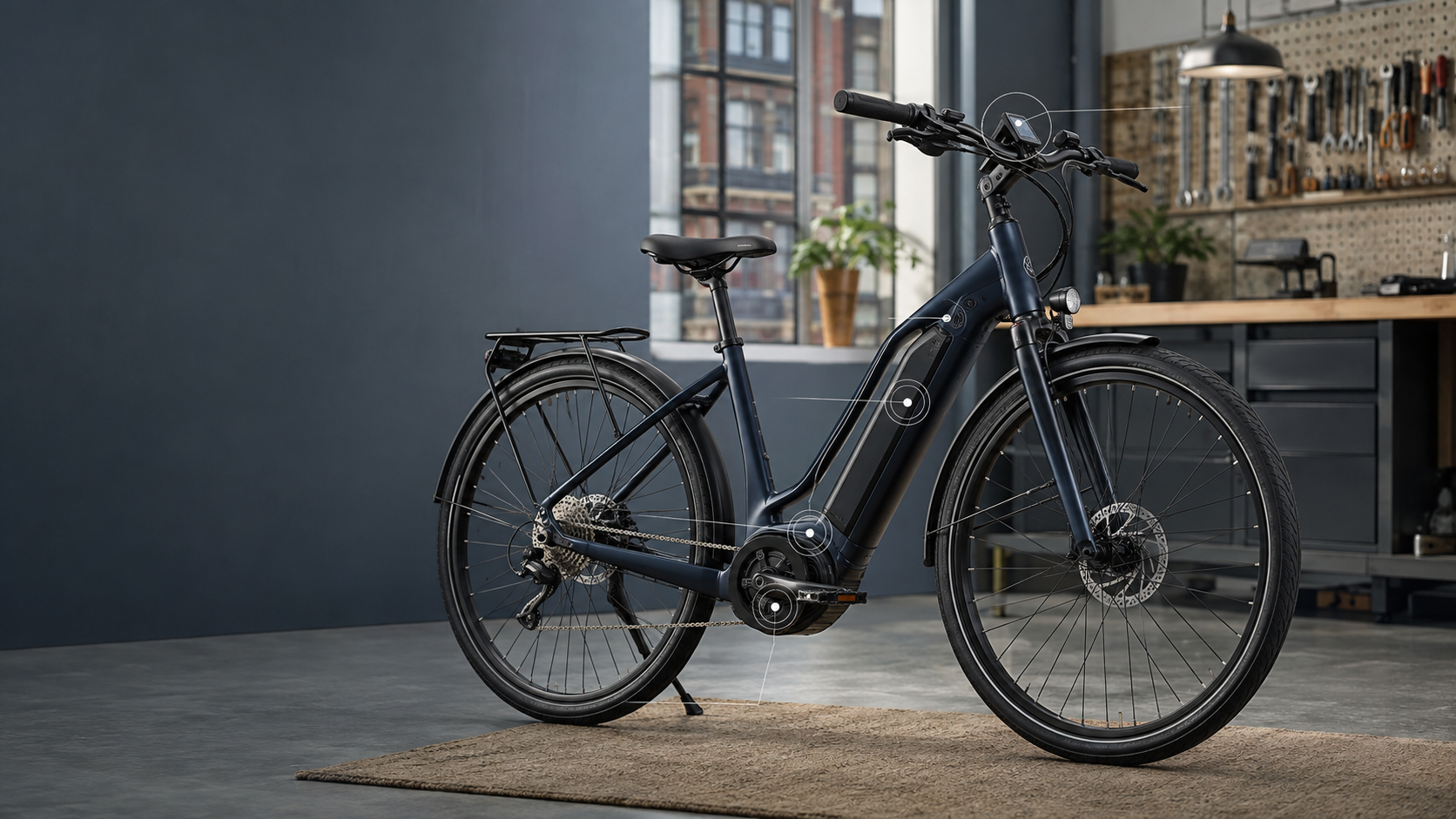
Buying an electric bike should be straightforward. In reality, product pages are filled with technical language about watt-hours, torque sensors, assist levels, mid-drive motors and battery management systems. Some of these terms are genuinely useful, while others are presented without enough context to help you compare one bike with another.
This e-bike glossary explains the terminology that matters when choosing, riding and maintaining an electric bike. It covers the electrical system, the mechanical components and the legal definitions used in the UK. It also explains several measurements that are commonly confused, including watts, watt-hours and newton metres.
Understanding these terms makes it much easier to look beyond marketing claims. A motor with a large torque figure is not automatically better for every rider, just as a large battery does not guarantee an impressive real-world range. The way the motor responds, the weight of the bike, the gearing and the terrain can be equally important.
You do not need to become an electrical engineer or bicycle mechanic. Once you understand a handful of core concepts, most e-bike specifications become much easier to interpret.
E-bike glossary: The five terms that matter most
If you only learn five terms before buying an electric bike, make them these:
| Term | What it means | Why it matters |
|---|---|---|
| EAPC | Electrically Assisted Pedal Cycle | Determines whether the bike is treated as an ordinary bicycle under UK law |
| Pedal Assist System | A system that activates the motor as you pedal | Describes how a legal e-bike normally delivers its assistance |
| Torque sensor | Measures how hard you press on the pedals | Usually produces smoother and more natural assistance |
| Watt-hours | The amount of energy stored in the battery | The most useful battery figure when comparing potential range |
| Motor torque | Turning force measured in newton metres | Helps indicate how strongly the motor can accelerate or climb |
These figures and definitions will not tell you everything about a bike, but they provide a solid basis for comparison. Once the terminology is familiar, guides to the best ebike models become much easier to evaluate.
Table of Contents
Assistance and control terminology
Pedal Assist System (PAS)
A Pedal Assist System, usually shortened to PAS, activates the motor when the rider pedals. Sensors detect pedalling activity and send information to the motor controller, which determines how much assistance to provide.
PAS is a broad term rather than a specific type of sensor. A basic system may use a cadence sensor that only recognises whether the cranks are turning. A more sophisticated system may combine torque, cadence and speed measurements to calculate assistance continuously.
The motor should stop assisting when you stop pedalling, apply the brakes on certain systems or reach the legal assistance limit. The bicycle can still be ridden without assistance, although the extra weight of the motor and battery may make it feel heavier than a conventional bike.
Assist levels
Assist levels allow the rider to choose how much help the motor provides. They are commonly given names such as Eco, Tour, Normal, Sport and Turbo, although the terminology varies between manufacturers.
A low assist level contributes less motor power and normally extends battery range. A high level provides stronger acceleration and makes climbing easier, but uses energy more quickly. It can also increase wear on the chain, cassette and other drivetrain components.
The number of assist levels is less important than how well they are calibrated. Three smooth and clearly differentiated settings can be more useful than nine levels that feel almost identical.
Support percentage
Support percentage describes how much power the motor adds in relation to the rider’s effort. If a system provides 200 per cent support and the rider contributes 100 watts through the pedals, the motor can add approximately 200 watts under the relevant conditions.
This figure should not be confused with battery charge or motor efficiency. Maximum support may only be available in certain modes, at suitable pedalling cadences and while the battery has sufficient charge.
Manufacturers calculate and present assistance differently, so support percentages are most useful when comparing drive units within the same motor system.
Progressive assistance
Progressive assistance increases or reduces motor support according to the rider’s effort, gradient and riding conditions. Rather than delivering one fixed output, the system responds dynamically.
This is most commonly associated with torque-sensing mid-drive motors. Press gently on the pedals and the motor responds softly. Push harder on a climb and the motor contributes more. Well-tuned progressive assistance makes an e-bike feel like a stronger version of an ordinary bicycle rather than a machine switching its motor on and off.
Assistance cut-off
The assistance cut-off is the speed at which the motor stops helping. On a road-legal UK EAPC, electrical assistance must cut out at 15.5 mph, equivalent to 25 km/h.
This is not a speed limiter for the bicycle itself. You can ride faster by pedalling or travelling downhill, but the motor must no longer contribute once the cut-off point is reached.
The transition can feel different between bikes. A refined system reduces its contribution gradually as the bike approaches the limit, while a less sophisticated motor can feel as though it has hit an invisible wall.
Walk assist
Walk assist uses the motor to help move a heavy e-bike while the rider walks alongside it. It can be useful when pushing a laden cargo bike, negotiating a steep ramp or moving a bike out of an underground car park.
The function normally operates at walking pace and requires the rider to hold a button. It is not intended as a riding mode and should not be confused with a full throttle.
Operation varies between motor systems. Some require the rider to select a particular mode or press a sequence of controls before walk assist becomes active.
Throttle
A throttle allows the rider to control motor output without relying entirely on pedal movement. It may use a twist grip, thumb lever or button.
Throttle rules are often misunderstood in the UK. An e-bike that can propel itself without pedalling above walking pace may require type approval as a twist-and-go vehicle. A product that does not meet the EAPC requirements can be treated as a moped or motorcycle, with requirements for registration, insurance, an appropriate licence and an approved motorcycle helmet.
Do not assume that a throttle-equipped bike is legal simply because the retailer describes it as an e-bike. The manufacturer or importer should be able to confirm its EAPC status and any applicable approval.
Controller
The controller is the electronic unit that regulates power between the battery and motor. It receives information from the sensors and rider controls, then determines how the motor should respond.
Controller programming has a major influence on ride quality. Two bikes using apparently similar motors can feel very different because their controllers deliver assistance at different speeds and intensities.
A well-tuned controller provides predictable acceleration and smooth transitions. Poor calibration can create delayed, abrupt or unnecessarily powerful assistance.
Display
The display shows information such as speed, battery charge, assist level, estimated range and journey distance. Some displays also provide navigation, fitness data and diagnostic warnings.
Larger colour displays are easy to read but can make the cockpit cluttered and may attract unwanted attention when parked. Minimal systems use a small control unit with coloured lights, leaving detailed information to a smartphone app.
A removable display can provide additional theft deterrence, but losing or damaging a proprietary display can make the bike difficult to operate.
Remote
A remote is the handlebar control used to change assist level, operate the display or activate features such as walk assist and lights. It allows these functions to be controlled without taking a hand off the grip.
Good remotes have buttons that can be distinguished by touch. This is particularly useful when wearing gloves or riding on rough ground.
Firmware
Firmware is the software installed within the motor, battery, display and other electronic components. Manufacturers may release updates to improve performance, correct faults or add functions.
Updates are sometimes installed through a phone app, while other systems require a dealer diagnostic tool. Firmware can affect motor response, battery management and compatibility, so updates should be completed according to the manufacturer’s instructions.
Torque sensor vs cadence sensor
The sensor system is one of the most important differences between inexpensive and premium electric bikes. It determines when the motor activates and how closely the assistance follows the rider’s input.
Torque sensor
A torque sensor measures the force being applied to the pedals. It is normally positioned around the bottom bracket, crank or rear dropout, depending on the system.
When the rider presses harder, the motor provides more help. When the rider pedals gently, the assistance becomes softer. This creates an intuitive relationship between human effort and motor output.
Torque-sensing systems are particularly useful when climbing, setting off in traffic or riding on loose surfaces. They give the rider finer control at low speed and normally feel more natural than a basic cadence system.
A torque sensor does not eliminate the need to select an appropriate assist level. The chosen mode still determines how strongly the motor multiplies the rider’s input.
Cadence sensor
A cadence sensor detects whether the cranks are rotating and, on more advanced versions, how quickly they are turning. Basic designs use a ring of magnets near the crank.
Once pedal movement is detected, the motor provides a predetermined amount of assistance based on the selected level. The rider may only need to rotate the pedals lightly to receive substantial help.
Cadence sensors are relatively simple and affordable. They can work well on leisure and utility bikes, especially for riders who want assistance without pressing hard on the pedals. The trade-off is less precise control.
A basic cadence system may take part of a crank rotation to activate, then continue briefly after the rider stops pedalling. This delay can feel awkward during tight turns or when setting off. Better controllers reduce the effect substantially.
Speed sensor
A speed sensor measures the bicycle’s road speed, usually by monitoring a magnet on the wheel or a signal within the motor.
It helps the system regulate assistance and ensures that motor support cuts out at the required speed. It is not the same as a cadence sensor, which measures pedal rotation, or a torque sensor, which measures pedal force.
Many modern e-bikes combine speed, cadence and torque data rather than relying on one measurement.
Cadence
Cadence is the speed at which the rider turns the pedals, measured in revolutions per minute, or rpm.
Mid-drive motors often operate most efficiently within a particular cadence range. Selecting an easier gear and pedalling at a steady rhythm can improve climbing performance, reduce strain on the drivetrain and use battery energy more efficiently.
Pushing slowly in a very hard gear may feel natural to some riders, but it can place high loads on the chain and motor.
E-bike motor terms
Drive unit
Drive unit is a general term for the motor assembly and its related sensors, gears and housing. It is most commonly used for a mid-drive motor positioned around the cranks.
The drive unit converts electrical energy from the battery into mechanical assistance. Its behaviour depends on motor design, software, sensors, gearing and the rider’s selected mode.
Mid-drive motor
A mid-drive motor is mounted in the centre of the bicycle around the bottom bracket. It transfers its power through the bike’s chain or belt and gearing.
Because the motor can use the bicycle’s gears, a mid-drive system is well suited to hills, cargo carrying and off-road riding. Central placement also gives the bike balanced weight distribution.
The disadvantages are cost and drivetrain wear. Motor torque passes through the chain, cassette and chainring, so poor shifting technique or heavily worn components can become expensive. Riders should ease pedal pressure slightly while changing gear, particularly under strong assistance.
Hub motor
A hub motor sits inside the front or rear wheel hub. It drives the wheel directly rather than sending motor power through the bicycle’s gears.
Hub motors are mechanically simpler and usually place less additional strain on the chain and cassette. They are common on affordable commuter, folding and leisure e-bikes.
Their performance on steep hills depends heavily on motor design, wheel size, controller tuning and total load. A hub motor cannot normally take advantage of the bicycle’s gears in the same way as a mid-drive system.
Rear-hub motor
A rear-hub motor is built into the rear wheel. The driving sensation feels more natural than with many front motors because assistance pushes the bike from behind.
Rear-hub systems provide good traction and work well on commuter and hybrid bikes. Removing the rear wheel can be more complicated because of the motor cable, axle hardware and the bike’s gears.
Front-hub motor
A front-hub motor pulls the bicycle from the front wheel. It is often found on conversion kits and some straightforward city bikes.
The system separates motor power from the rear drivetrain, but the extra weight can affect steering. Traction may also be reduced on wet, loose or steep surfaces because less rider weight sits over the front wheel.
Geared hub motor
A geared hub motor uses internal reduction gears to allow a smaller motor to turn efficiently while driving the wheel at a lower speed. These motors are generally compact and can freewheel with relatively little resistance when assistance is switched off.
The internal gears introduce additional moving parts and may produce a noticeable hum. Nevertheless, geared hubs are the most common hub-motor design on mainstream commuter e-bikes.
Direct-drive hub motor
A direct-drive hub motor connects the motor’s rotating section directly to the wheel without internal reduction gears. It is usually larger and heavier than a geared hub.
Direct-drive motors can be quiet and durable, and some support regenerative braking. They tend to be less efficient at low speeds and are relatively uncommon on road-legal UK consumer e-bikes.
Motor power
Motor power is measured in watts. It describes the rate at which the motor can perform work, but the number needs context.
A higher watt figure does not directly tell you how quickly a bike accelerates or how well it climbs. Torque, motor speed, gearing, controller settings, total weight and thermal management all influence performance.
For UK legality, the relevant figure is maximum continuous rated power, not a briefly available peak output.
Maximum continuous rated power
Maximum continuous rated power is the power a motor can provide continuously under specified conditions without overheating or suffering damage.
A UK EAPC must have a motor with a maximum continuous rated power of no more than 250 W. This is why legitimate bikes may be described as 250 W models even though their motors can produce higher mechanical output for short periods.
Peak power
Peak power is the maximum output a motor can provide briefly under suitable conditions. It may be available while accelerating or climbing, but cannot be maintained indefinitely.
Peak output can depend on battery charge, temperature, motor speed and software. Because manufacturers do not always measure it in the same way, peak watt figures are poor standalone comparison tools.
A motor advertising a peak above 250 W is not automatically illegal in the UK. The legal limit refers to continuous rated power, although the complete bike must still comply with all EAPC requirements.
Torque
Torque is turning force, measured in newton metres, or Nm. On an e-bike, it describes the rotational force the motor can apply to the drivetrain or wheel.
Higher torque can improve acceleration, climbing and load-carrying ability, particularly at lower speeds. Cargo bikes and electric mountain bikes generally benefit from more torque than lightweight urban bikes.
Maximum torque does not describe how smoothly that force is delivered or how long it remains available. Sensor quality, software and gearing can matter as much as the headline figure.
Newton metre
A newton metre is the unit used to measure torque. It should not be confused with watts, which measure power.
A motor can deliver substantial torque at low speed without producing exceptional power. Similarly, a motor with modest torque may still produce useful power when spinning quickly.
This explains why Nm and W figures cannot be used interchangeably.
Motor drag
Motor drag is the resistance felt when pedalling without assistance or above the cut-off speed. It can come from the motor, internal gearing, tyres and the additional mass of the e-bike.
Modern systems are often designed to minimise internal resistance, but differences remain. Motor drag matters if you regularly ride faster than 15.5 mph or expect to use the bike with the assistance switched off.
Regenerative braking
Regenerative braking uses the motor as a generator while slowing down, returning some energy to the battery.
It is common in electric cars but relatively rare on e-bikes. Most mid-drive and geared hub motors cannot provide it, and a bicycle has far less mass and kinetic energy available for recovery than a car.
Where regeneration is offered, the recovered range is usually modest. It should be treated as a secondary feature rather than a substitute for a larger battery or efficient riding.
Battery terminology
Battery capacity
Battery capacity describes the amount of energy the battery can store. For meaningful comparisons between e-bikes, it is usually expressed in watt-hours.
A larger capacity can support a longer range, but also tends to increase weight, size, charging time and cost. Capacity should be matched to the journey rather than maximised automatically.
Watt-hours
Watt-hours, abbreviated to Wh, measure stored energy. This is the most useful battery figure when estimating and comparing e-bike range.
A 500 Wh battery could theoretically provide 250 W for two hours or 100 W for five hours. Real systems experience electrical losses, and motor demand changes continuously, so this is not a literal range calculation.
Watt-hours can be calculated by multiplying battery voltage by ampere-hours. A 36 V, 14 Ah battery has a nominal capacity of approximately 504 Wh.
Watts
Watts, abbreviated to W, measure power at a particular moment. They are used to describe motor output and charging power.
Watts should not be confused with watt-hours. A 250 W motor power rating and a 500 Wh battery capacity describe different things, just as a car’s engine output and fuel-tank size describe different things.
Voltage
Voltage, measured in volts or V, describes the electrical potential of the battery system. Common e-bike systems use nominal voltages such as 36 V or 48 V.
A higher voltage is not automatically better. The battery, controller, motor, display and charger must be designed as a compatible system.
Never connect a battery or charger simply because the plug appears to fit.
Ampere-hours
Ampere-hours, abbreviated to Ah, describe the electrical charge stored in a battery. The figure only becomes useful for cross-bike comparisons when voltage is also known.
A 14 Ah battery operating at 36 V stores less energy than a 14 Ah battery operating at 48 V. Watt-hours account for both voltage and charge, which is why Wh is the clearer capacity measurement.
State of charge
State of charge, or SoC, is the amount of energy currently remaining in the battery, normally displayed as a percentage or series of bars.
A percentage is more informative than a five-bar indicator, but neither is perfectly precise. Battery voltage changes under load, in cold weather and as the battery ages, so the displayed figure may move slightly during a ride.
State of health
State of health, or SoH, estimates how much capacity and performance an ageing battery retains compared with when it was new.
A battery with 80 per cent state of health may only store around 80 per cent of its original usable energy. Dealer diagnostic tools can assess compatible batteries more accurately than judging them solely by the number of kilometres ridden.
Battery Management System
A Battery Management System, usually shortened to BMS, monitors and protects the battery pack. It manages charging, cell balance, temperature, voltage and current.
The BMS can shut the battery down if it detects unsafe conditions. It is an essential safety component, but it cannot make a damaged, incompatible or poorly manufactured battery safe.
Cell
An e-bike battery pack contains multiple individual lithium-ion cells connected together. The pack’s casing, wiring, sensors and BMS turn these cells into a usable battery system.
Cell brand is only one part of battery quality. Pack design, manufacturing consistency, physical protection and electronic management are equally important.
Charge cycle
A charge cycle represents cumulative charging equal to 100 per cent of the battery’s capacity. It does not necessarily mean one connection to the charger.
Charging from 50 to 100 per cent twice is approximately one full cycle. Batteries gradually lose usable capacity through cycling, age, heat and storage conditions.
Charging rate
Charging rate describes how quickly energy is supplied to the battery. A higher-output charger may reduce charging time, but it must be approved for the exact battery system.
Faster charging can produce more heat. The safest approach is to use the charger supplied or explicitly approved by the manufacturer rather than an unverified replacement.
Integrated battery
An integrated battery sits inside or partly inside the bicycle frame. It creates a clean appearance and may improve weight distribution and weather protection.
Some integrated batteries are removable, while others must remain in the bike for charging. Replacement cost, availability and ease of removal should be checked before purchase.
Removable battery
A removable battery can be detached for charging, storage or security. This is useful for riders who live in flats or cannot park near a power socket.
The battery lock is normally intended to retain the pack during use, not to provide complete theft protection. Taking the battery indoors may be sensible when the bike is parked for long periods.
Range extender
A range extender is a supplementary battery connected to the main e-bike system. It adds capacity without replacing the original battery.
Range extenders are smaller than full batteries and may fit into a bottle-cage mount. Compatibility is system-specific, so a generic battery should never be attached unless the manufacturer has approved it.
Dual-battery system
A dual-battery system uses two main batteries on the same bike. The controller may draw from them together or switch between them automatically.
This arrangement is useful for cargo bikes, touring and high-mileage work, but adds considerable weight and cost. It is different from simply carrying a spare battery in a bag.
Estimated range
Estimated range is the distance the system predicts can be covered with the remaining charge. It is a calculation, not a guarantee.
The estimate changes with assist level, rider input, gradient, speed, temperature, wind, tyre pressure, load and recent riding history. A display may show a high number after an easy journey and then reduce it rapidly on a steep climb.
Real-world range
Real-world range is the distance riders actually achieve under normal conditions. It is often lower than the most optimistic manufacturer figure.
Range claims should be assessed alongside battery capacity, terrain and testing conditions. A useful range estimate explains the rider weight, assist mode, route profile and weather rather than presenting one unexplained maximum.
Battery degradation
Battery degradation is the gradual loss of capacity and performance as a battery ages. It occurs through normal use, calendar ageing, heat exposure and charging cycles.
A degraded battery may still operate safely but provide less range. Sudden swelling, unusual heat, damage, odour or charging problems are not normal degradation and require professional assessment.
Common e-bike types
Pedelec
Pedelec is a general term for an electric bicycle that provides motor assistance while the rider pedals. The word combines “pedal” and “electric”.
In everyday UK usage, pedelec usually refers to a conventional EAPC with assistance that cuts out at 15.5 mph.
Commuter e-bike
A commuter e-bike is designed for regular journeys to work or education. It normally prioritises reliability, road comfort and practical equipment.
Common features include mudguards, lights, a rear rack, puncture-resistant tyres and an upright or moderately sporty riding position.
Hybrid e-bike
A hybrid e-bike combines characteristics from road, city and mountain bikes. It usually has flat handlebars, medium-width tyres and a versatile riding position.
Hybrids work well for commuting, leisure riding and light gravel routes. The term covers a broad range, so tyre clearance, gearing and equipment should be checked rather than assumed.
Electric mountain bike
An electric mountain bike, commonly called an e-MTB, is designed for off-road trails. It generally uses a mid-drive motor, wide tyres, powerful hydraulic disc brakes and suspension.
A hardtail e-MTB has front suspension only. A full-suspension model has suspension at both the front and rear.
Electric road bike
An electric road bike uses drop handlebars, relatively narrow tyres and a lightweight design. The motor and battery are often smaller than those fitted to trekking or mountain bikes.
Reduced system weight makes the bike easier to ride above the assistance cut-off, but usually means less torque or battery capacity.
Electric gravel bike
An electric gravel bike combines drop handlebars with wider tyres and clearance for unsealed roads. It sits between a road bike and a cross-country machine.
Motor assistance can make long mixed-surface routes more accessible, although extra weight affects handling on technical ground.
Folding e-bike
A folding e-bike has hinges or collapsible components that reduce its size for storage and transport. Most fold at the centre of the frame and at the handlebar stem.
Folded dimensions are more useful than the simple claim that a bicycle “folds”. Weight, carrying balance, wheel size and whether the bike can be rolled while folded are equally important. Models suited to mixed commuting and limited storage are compared in the guide to the best foldable electric bike.
Cargo e-bike
A cargo e-bike is built to carry children, shopping, tools or commercial loads. It has a stronger frame, higher permissible weight and dedicated carrying equipment.
Electric assistance is particularly useful when starting or climbing with a heavy load. Braking performance, stand stability and load capacity matter more than maximum speed.
Longtail
A longtail is a cargo bike with an extended rear frame and rack. It rides more like a conventional bicycle than many front-loading cargo designs.
The rear platform can carry panniers, child seats or passenger accessories, subject to the manufacturer’s weight limits.
Front-loader
A front-loader carries its main load in front of the rider, usually between the handlebar and front wheel. It is also called a box bike or long john.
The load remains visible to the rider and can provide substantial capacity. The long wheelbase requires more parking space and practice at low speeds.
Fat-tyre e-bike
A fat-tyre e-bike uses very wide tyres, often for soft sand, snow or a particular visual style. The large air volume can improve comfort and grip on loose ground.
Fat tyres also add rolling resistance and weight. On ordinary roads they can reduce range and make the bike feel less agile.
Step-through frame
A step-through frame has a low or absent top tube, making it easier to mount and dismount. It is useful for stop-start urban riding, restricted mobility and bikes fitted with rear cargo.
Modern frame design means a step-through bike is not inherently a women’s bicycle. It is a practical geometry suitable for any rider.
Diamond frame
A diamond frame uses a traditional high top tube connecting the head tube and seat tube. It can provide high stiffness with relatively little material.
The shape may be less convenient for riders with restricted movement or when a tall rear load makes it difficult to swing a leg over the saddle.
Speed pedelec
A speed pedelec, or S-pedelec, generally provides assistance beyond the standard 15.5 mph EAPC limit, often up to 28 mph or 45 km/h.
In the UK, it is not treated as an ordinary bicycle. It falls into motor-vehicle regulation and requires the relevant approval, registration, insurance, licence and protective equipment. It cannot simply be used as a faster EAPC in cycle lanes.
Mechanical and drivetrain terminology
Drivetrain
The drivetrain transfers power from the rider and, on a mid-drive bike, the motor to the rear wheel. It includes components such as the cranks, chainring, chain or belt, cassette and rear hub.
E-bike drivetrains handle substantial loads. Regular cleaning, correct shifting and timely replacement of worn components can prevent more expensive damage.
Derailleur gears
A derailleur moves the chain between different sprockets. It offers a wide gear range, efficient power transfer and relatively straightforward servicing.
Derailleurs are exposed to weather and impact. Changing gear under full motor load can produce harsh shifts and accelerate wear.
Cassette
The cassette is the cluster of sprockets fitted to the rear wheel. Moving the chain to a larger sprocket creates an easier gear for climbing, while a smaller sprocket provides a harder gear for speed.
A worn chain can damage the cassette. Replacing the chain before it becomes excessively stretched can extend cassette life.
Chainring
The chainring is the toothed ring attached to the cranks or mid-drive motor. It drives the chain as the rider pedals.
E-bike chainrings may be designed specifically for the motor system. Size affects gearing, while tooth profile affects chain retention.
Internal gear hub
An internal gear hub contains the gears inside the rear hub rather than using an exposed derailleur and cassette.
The enclosed design requires less routine cleaning and works well on commuter bikes. Some systems allow shifting while stationary, which is useful in traffic. Internal hubs can be heavier and may offer less mechanical efficiency or a narrower range than performance derailleur systems.
Continuously variable transmission
A continuously variable transmission, or CVT, allows smooth changes through a range of ratios without fixed gear steps.
It can be convenient on utility and cargo e-bikes, especially when paired with automatic shifting. The system is generally heavier and more expensive than a conventional derailleur.
Belt drive
A belt drive uses a toothed carbon-reinforced belt instead of a chain. It is clean, quiet and does not require conventional chain lubricant.
A belt normally needs an internal gear hub or compatible gearbox. The frame must also allow the continuous belt to be installed. Correct belt tension and alignment are essential.
Hydraulic disc brakes
Hydraulic disc brakes use fluid to transfer force from the brake lever to the calliper. They generally provide strong braking with relatively little hand effort and automatically compensate for pad wear.
They are especially valuable on heavy commuter and cargo e-bikes. The system occasionally requires bleeding to remove air or replace old fluid.
Mechanical disc brakes
Mechanical disc brakes use a cable to operate the calliper. They are simple to inspect and can be adjusted with basic tools.
They normally require more frequent manual adjustment than hydraulic brakes and may provide less power or modulation, depending on the model.
Rotor
The rotor is the metal disc attached to the wheel hub. The brake calliper squeezes pads against it to slow the bicycle.
Larger rotors can improve heat management and braking leverage, but they must be compatible with the frame, fork and calliper mounts.
Brake cut-off sensor
A brake cut-off sensor stops motor power when a brake lever is operated. It is common on cadence-sensing hub-motor systems and throttle-equipped bikes.
Torque-sensing mid-drive systems may rely primarily on pedal and speed data instead, although system design varies.
Suspension fork
A suspension fork absorbs impacts through the front wheel. It improves control and comfort on rough ground but adds weight and maintenance.
Travel is the distance the fork can compress, measured in millimetres. More travel is not automatically better for road use, where a rigid fork can be lighter and more precise.
Full suspension
A full-suspension bike has both a suspension fork and a rear shock. It is mainly used for technical mountain biking.
Rear suspension improves traction and control but adds cost, weight and moving parts. It also occupies frame space that might otherwise hold a larger battery or bottle.
Dropper post
A dropper post allows the saddle to be lowered using a handlebar control. Mountain bikers use it to create more room to move on steep descents.
It is also useful on some cargo and urban bikes because lowering the saddle makes it easier to place both feet on the ground while stopped.
Buying and specification terms
Maximum permissible weight
Maximum permissible weight is the total load the bicycle is designed to carry. Depending on the manufacturer, it may include the bike, rider, luggage, accessories and passengers.
Do not confuse maximum permissible weight with luggage capacity. A bicycle rated for 150 kg does not necessarily allow 150 kg of rider and cargo once the bike’s own weight is included.
Payload
Payload is the weight the bike can carry in addition to its own mass. Definitions vary, so check whether accessories and the battery are included.
Cargo-bike rack and passenger limits may be lower than the overall payload limit.
Kerb weight
Kerb weight is the ready-to-ride weight of the bicycle with its battery and standard equipment installed. Some retailers list weight without pedals, accessories or a larger optional battery.
A difference of several kilograms matters when lifting a bike into a car, carrying it upstairs or moving a folded model through a station.
Wheel size
Wheel size is usually expressed in inches or through an ETRTO tyre measurement. Common e-bike wheel descriptions include 20, 27.5, 28 and 29 inches.
Smaller wheels can make a folding or cargo bike more compact and responsive. Larger wheels roll smoothly over uneven surfaces. Tyre width, geometry and total bike design matter as much as diameter.
Frame size
Frame size describes the physical dimensions of the bicycle frame. It may be given in centimetres, inches or general labels such as small, medium and large.
Rider height charts are only a starting point. Reach, standover height, saddle adjustment and riding position all affect fit.
Geometry
Geometry is the relationship between frame angles and dimensions. It influences handling, stability and riding position.
Two bikes with the same nominal frame size can feel very different because one has a longer reach, slacker head angle or lower step-over height.
IP rating
An IP rating describes tested resistance to dust and water ingress. The two digits represent separate forms of protection.
An IP-rated component is not necessarily waterproof in every situation. Pressure washing, submersion and damaged seals may exceed the tested conditions.
EN 15194
EN 15194 is a widely used European standard covering electrically assisted cycles and their electrical systems. It addresses mechanical, electrical and functional safety requirements.
Reference to a standard is useful, but buyers should still choose a traceable product from a responsible manufacturer and retailer. A printed claim or conformity mark alone does not prove that every component has been properly tested.
Conversion kit
A conversion kit adds a motor, battery, controller and sensors to an existing bicycle. Kits may use front-hub, rear-hub or mid-drive motors.
A conversion can be economical, but the completed bicycle must still be mechanically safe and comply with EAPC rules. The original frame, brakes and wheels were not necessarily designed for the added weight and motor force.
Diagnostic system
A diagnostic system allows a retailer or service centre to read error codes, check battery condition and update components.
Some systems are widely supported by dealers, while others depend on one importer or online seller. Service access can be more important than minor differences in specification.
Proprietary system
A proprietary system uses components, software or connectors controlled by one manufacturer. Integration can be excellent, but replacement parts may only be available through authorised channels.
Before buying, check the availability and likely cost of batteries, displays, chargers and control units.
Range test
A range test measures how far an e-bike travels on a charge under stated conditions. The result is only meaningful when the route, elevation, rider weight, weather, tyres and assist mode are disclosed.
A flat summer test in Eco mode cannot predict winter commuting on steep roads with luggage.
UK legal terminology
Electrically Assisted Pedal Cycle
Electrically Assisted Pedal Cycle, abbreviated to EAPC, is the legal category that allows a compliant e-bike to be treated broadly like an ordinary pedal bicycle.
The bike must have pedals capable of propelling it. Its motor must have a maximum continuous rated power no higher than 250 W, and electrical assistance must cut out at 15.5 mph.
The bike must also carry the required manufacturer, power, voltage or maximum assisted-speed markings.
Road-legal e-bike
A road-legal e-bike is a common informal description for an electric bike that meets the EAPC requirements and other applicable bicycle regulations.
A compliant EAPC does not require registration, Vehicle Excise Duty, compulsory motor insurance or a driving licence. The rider must be at least 14 years old.
It can be used where ordinary bicycles are permitted, including roads and cycle routes, but not on ordinary pavements.
Type approval
Type approval confirms that a vehicle design meets the technical requirements for its legal category.
Certain twist-and-go electric cycles that can propel the rider without pedalling require approval even if their assisted speed remains within 15.5 mph. Approved vehicles should carry the relevant approval marking.
De-restriction
De-restriction alters the bike so the motor continues assisting above its intended or legal cut-off. It may involve software, a sensor modification or an aftermarket electronic device.
A de-restricted bike no longer meets ordinary EAPC requirements. On public roads it may be treated as an unregistered and uninsured motor vehicle. Modification can also invalidate warranties and increase electrical, mechanical and fire risks.
Tuning dongle
A tuning dongle is a device that manipulates speed information or motor software to bypass the assistance cut-off.
Descriptions such as “private land mode” or “off-road mode” do not create a legal exemption for public-road use. A readily available mode that enables assistance beyond EAPC limits may affect the classification of the vehicle itself.
15.5 mph limit
The 15.5 mph figure is the maximum speed at which a road-legal UK EAPC motor may provide assistance. It is equivalent to 25 km/h.
It does not prohibit the bicycle from travelling faster through the rider’s effort or gravity. Above the threshold, the motor should fade out and the bicycle continues under human power.
250 W limit
The UK limit refers to maximum continuous rated motor power. It does not necessarily refer to electrical input, battery output or a short-duration peak figure.
Torque and peak power can therefore differ considerably between legal 250 W motors. Legality depends on the rated motor and the complete vehicle’s compliance, not one isolated marketing number.
Frequently confused e-bike terms
Watts vs watt-hours
Watts measure power at a moment in time. Watt-hours measure stored energy.
Motor output is normally discussed in watts, while battery capacity is best compared in watt-hours. A 250 W motor and a 500 Wh battery are not two versions of the same measurement.
Torque vs power
Torque describes turning force. Power describes how quickly work is performed.
Higher torque is useful for acceleration, climbing and moving heavy loads, particularly at low speed. Power depends on both torque and rotational speed, so the largest Nm figure does not automatically identify the strongest motor in every situation.
Battery size vs range
A larger battery usually offers more potential range, but the relationship is not fixed.
A heavy bike using maximum assistance in cold, windy and hilly conditions may consume a large battery quickly. A lighter, efficient bike ridden in Eco mode may travel farther with less capacity.
PAS vs throttle
PAS activates assistance in response to pedalling. A throttle requests motor output through a separate control.
Some bikes have both, but throttle operation affects legal classification. A Pedal Assist System does not mean the bike can propel itself without the rider pedalling.
Torque sensor vs cadence sensor
A torque sensor measures pedal force and normally provides proportional assistance. A cadence sensor primarily detects pedal rotation and then provides the output associated with the selected assist level.
Torque sensing usually feels more natural and controllable. Cadence sensing can require less physical pressure and keeps the price of the bike lower.
Cut-off speed vs maximum speed
Cut-off speed is where motor assistance ends. Maximum speed is the fastest the complete bicycle can travel under the conditions.
A legal EAPC may exceed 15.5 mph downhill or through hard pedalling, but the motor must not continue helping above that threshold.
Summary: Using this e-bike glossary when comparing bikes
The purpose of an e-bike glossary is not to make every buyer fluent in engineering terminology. It is to help identify which specifications genuinely affect the riding experience.
Start with the legal category. A bike intended for ordinary UK roads and cycle routes should meet the EAPC requirements, including the 250 W continuous rated power limit and 15.5 mph assistance cut-off.
Next, examine how assistance is controlled. A torque sensor normally gives the most natural response, while a cadence sensor can provide simple and accessible support at a lower price. The assist levels should be easy to control and clearly different from one another.
Compare battery capacity in watt-hours rather than ampere-hours alone. Treat manufacturer range figures as estimates and consider gradient, rider weight, weather and the amount of assistance you expect to use.
Finally, match the motor and bicycle type to the job. Mid-drive systems excel on hills and under heavy loads, while hub motors can provide straightforward and affordable assistance for commuting and leisure. The best choice is not the bike with the largest collection of impressive numbers. It is the one whose motor response, battery, fit and practical equipment suit the journeys you actually intend to make.