
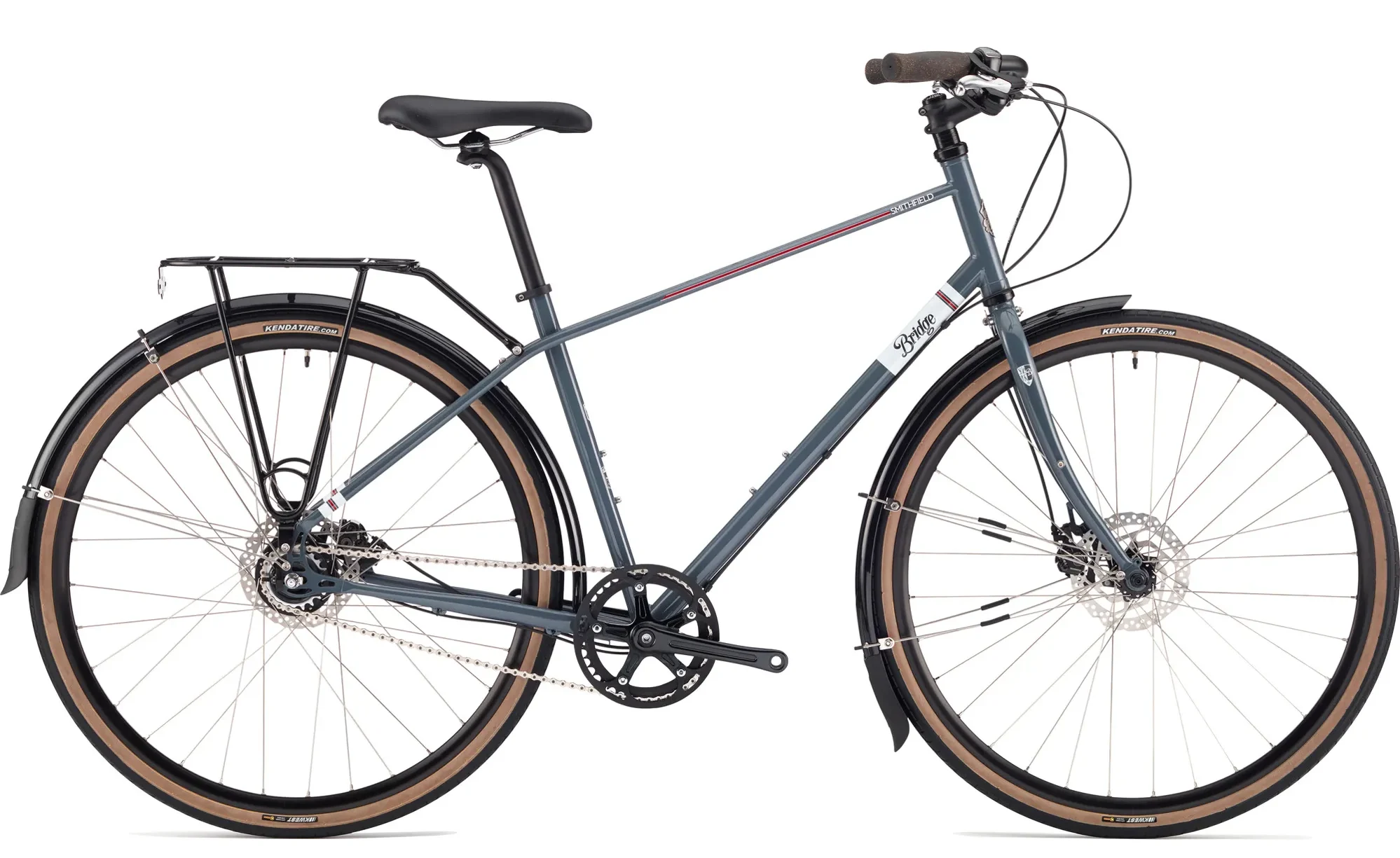
The Genesis Smithfield is a utility-focused electric bike that combines traditional steel-frame styling with a Shimano STEPS mid-drive system and a removable 418 Wh battery.
With 29-inch wheels, full mudguards, integrated lights and racks at both ends, it is clearly designed around commuting and everyday transport rather than sporty riding.
In this Genesis Smithfield review, we look at how its motor, range, comfort, handling, equipment and overall value stack up in the current UK ebike market.
Genesis Smithfield Short Summary
The Genesis Smithfield gets the fundamentals of a practical electric commuter remarkably right. Its Shimano mid-drive delivers assistance naturally rather than simply pushing the bike forwards, the steel frame and large-volume tyres produce a composed ride, and the generous standard equipment means very little needs adding before it becomes genuine everyday transport.
Its age is visible in the smaller 418 Wh external battery, basic display and Acera drivetrain. Newer rivals offer larger integrated batteries, smarter electronics and sometimes more powerful motors. The Smithfield also weighs around 23 kg, making stairs distinctly unpleasant.
At its original positioning those compromises were difficult to ignore. At the discounted prices now commonly available in the UK, they are much easier to accept. For riders who value comfort, character, proven Shimano components and real commuting practicality over the latest technology, the Smithfield is a particularly appealing package.
Score
Score: 8.9/10
Pros
- Smooth and natural Shimano mid-drive assistance
- Comfortable and composed on poor urban surfaces
- Strong climbing ability for a commuter ebike
- Front and rear racks, mudguards, lights and frame lock included
- Excellent steel frame with distinctive styling
- Strong value at current discounted pricing
Cons
- 418 Wh battery is small by current standards
- Acera nine-speed drivetrain feels basic
- Heavy to carry or manoeuvre without assistance
- Basic display lacks modern connectivity features
Who It Is For
The Smithfield makes most sense for commuters, leisure riders and everyday cyclists who want one electric bike capable of handling city streets, country lanes, towpaths and longer journeys. It particularly suits riders who appreciate a stable, comfortable position and expect to carry luggage regularly. Anyone needing to carry a bike upstairs every day, wanting maximum battery capacity or prioritising sophisticated connected features should look elsewhere.
Table of Contents
Genesis Smithfield Specifications
| Specification | Genesis Smithfield |
|---|---|
| Motor | Shimano STEPS DU-E6100 |
| Motor position | Mid-drive |
| Nominal power | 250 W |
| Maximum torque | 60 Nm |
| Sensors | Torque, cadence and crank-position sensing |
| Battery | Shimano STEPS BT-E8014 |
| Battery capacity | 418 Wh, 36 V |
| Battery position | External down-tube mounted, removable |
| Claimed maximum range | Up to approximately 93 miles / 150 km in Eco |
| Realistic mixed range | Roughly 35–55 miles for many riders |
| Assisted speed | 15.5 mph UK limit |
| Frame | Genesis Mjolnir double-butted chromoly steel |
| Fork | Rigid alloy |
| Sizes | Small, Medium, Large |
| Weight | Approximately 23 kg for a medium test bike |
| Wheels | 29-inch |
| Tyres | Maxxis Grifter 29 × 2.0 in |
| Brakes | Shimano MT200 hydraulic discs |
| Rotors | 160 mm front and rear |
| Gearing | Shimano 1×9 |
| Rear derailleur | Shimano Acera M3100 |
| Cassette | Shimano 11–36T |
| Chainring | 38T |
| Display | Shimano SC-E5000 on reviewed specification |
| Mudguards | Full-length painted alloy |
| Racks | AtranVelo AVS front and rear |
| Lights | Integrated front and rear |
| Lock | Trelock frame-mounted ring lock |
| Kickstand | Included |
| Frame warranty | Lifetime for original owner |
| Typical market position | Mid-range at current discounted UK pricing |
Design and Build Quality
Frame and Finish
The Smithfield looks refreshingly unlike most electric commuters. Its double-butted chromoly frame uses a distinctive twin-top-tube arrangement that gives it the character of an old British roadster without turning the bike into a retro novelty.
Steel adds weight, but it also contributes to the Smithfield’s ride character. The frame has more subtle compliance than the heavily oversized aluminium structures common on inexpensive ebikes, helping remove some of the harshness from cracked roads and coarse surfaces.
The external battery inevitably looks less polished than the fully integrated systems used on newer competitors. It sits visibly on the down tube rather than disappearing inside it. That dates the design visually, although the practical advantage is straightforward access and removal.
Overall finishing is convincing. This does not feel like an electric drivetrain attached to a generic frame. It feels like a bicycle Genesis deliberately designed around everyday transport.
Integration and Component Quality
The commuter equipment is one of the Smithfield’s strongest attributes. Full mudguards, lights, a kickstand and racks at both ends are already fitted, while the Trelock ring lock is useful for quick stops when combined with a more substantial security lock.
Cable routing cannot match the almost invisible integration of the newest urban ebikes, but everything is sensibly arranged and serviceable.
The main evidence of cost control appears in the drivetrain rather than the frame. Shimano Acera works perfectly adequately, but it is a decidedly ordinary groupset to find next to an otherwise sophisticated mid-drive system.
Genesis Smithfield Review: Motor Performance and Power Delivery
Motor and Torque
The Shimano STEPS DU-E6100 is a 250 W mid-drive producing up to 60 Nm of torque. More importantly, it uses torque, cadence and crank-position sensing rather than relying on a basic cadence sensor.
That distinction changes the way the bike rides. Assistance responds to the force being applied through the pedals, so pushing harder generates more support. The result feels considerably more like having stronger legs than being pushed along by an electric motor.
At around 2.8 kg, the motor is also relatively compact. Its narrow dimensions help preserve a natural pedalling stance rather than forcing the cranks unusually far apart.
Acceleration and Pedal Assistance
The Smithfield does not deliver the startling initial shove found on some high-torque modern ebikes. Assistance builds progressively, and that suits its character.
At junctions, selecting a lower gear before stopping makes a significant difference. Apply meaningful pressure to the pedals and the motor responds quickly enough to move the 23 kg bike away confidently. Start in too high a gear and the system feels noticeably more restrained.
The three main assistance levels are sufficiently distinct. Eco is useful when preserving range on flatter terrain, Normal provides the best everyday balance, and High gives meaningful support on hills or when accelerating with luggage.
The transition around the UK assistance cut-off is reasonably natural because the system is fundamentally pedal-responsive rather than aggressively motor-led.
Hill-Climbing Performance
This is where the E6100’s mid-drive layout proves its value. Because motor power passes through the bicycle’s gearing, selecting an appropriate low gear allows the motor to operate efficiently even as gradients steepen.
The 60 Nm output is enough for ordinary urban hills without demanding excessive rider effort, and steeper gradients remain manageable when the 11–36T cassette is used properly.
It is not comparable with the 75–85 Nm motors now appearing on heavier trekking and cargo-oriented ebikes, but the Smithfield does not need to be. For solo commuting, pannier loads and typical British hills, there is enough useful torque available.
Battery Range and Charging
Real-World Range
A 418 Wh battery now looks relatively modest. Many current mid-range urban ebikes have moved beyond 500 Wh, while long-distance models increasingly offer substantially more.
Genesis nevertheless quotes up to around 93 miles in Eco mode. That figure should be viewed as a favourable-condition maximum rather than an everyday expectation.
Real-world evidence is considerably more informative. A demanding mixed-mode ride has exceeded 50 miles while including more than 1,100 metres of climbing, demonstrating that the Shimano system can use its relatively small battery efficiently.
For normal ownership, roughly 35–55 miles is a sensible working expectation, depending heavily on assistance level, rider weight, gradients, wind and temperature. Flat riding in Eco can push considerably beyond that, while repeated steep climbs in High mode can reduce it substantially.
That remains more than adequate for most commuting patterns, although riders covering long distances every day now have better high-capacity options.
Charging and Battery Practicality
The external battery is removable, allowing it to be charged indoors rather than requiring mains power beside the bicycle. That is especially useful in flats, offices and shared storage areas.
Published charging figures for this particular battery and charger combination are inconsistent. Around four hours has frequently been quoted for a full charge, while documentation for some compatible Shimano 2A charging configurations indicates a longer turnaround from completely empty. We would therefore regard it as a battery best charged between journeys rather than relying on a precisely timed rapid recharge.
The battery itself is a mature Shimano component, and replacement hardware remains part of an established ecosystem. Shimano rates the battery for substantial cycle life, with meaningful capacity expected to remain after 1,000 charge cycles.
Ride Quality and Comfort
Riding Position and Ergonomics
The Smithfield uses a swept-back 680 mm handlebar with substantial backsweep, creating a relaxed but not completely upright riding position.
Weight sits comfortably through the saddle rather than loading the wrists heavily, which suits commuting and longer leisure rides. The Genesis Urban saddle has more padding than a performance saddle without becoming excessively broad.
The motor’s narrow Q-factor also matters on longer rides. Your feet remain in a relatively natural position rather than being pushed noticeably outwards by a bulky motor housing.
Fork and Tyres
There is no suspension fork on the current specification, but the 29 × 2.0-inch Maxxis Grifter tyres provide a considerable amount of cushioning themselves.
Their combination of diameter and volume allows the Smithfield to roll calmly across broken tarmac, patched roads, hard-packed towpaths and relatively smooth gravel. Grip in wet conditions is reassuring, while the larger tyre volume removes much of the sharp vibration that would otherwise reach the rigid frame.
Do not mistake it for a trail bike. Repeated roots, deep potholes and rough off-road surfaces expose the limitations of the rigid front end.
Early Smithfield review bikes were fitted with a simple suspension seatpost. Current UK specifications list a rigid 27.2 mm post, so buyers wanting maximum isolation from rough roads may want to budget for an aftermarket suspension post.
Rider Fit
Three sizes cover roughly the mid-160s to upper-180s centimetres in rider height, although body proportions matter as much as height alone.
The twin top tubes make the Smithfield less accessible than a genuine low-step commuter. Riders with limited hip mobility, or anyone repeatedly mounting the bike while carrying rear luggage, may prefer a step-through alternative.
Braking and Handling
Braking Performance
Shimano’s MT200 hydraulic brakes are inexpensive but dependable. They provide a significant practical advantage over mechanical discs because lever effort remains low and modulation is predictable.
The 160 mm rotors are not oversized for a 23 kg electric bike, but braking power is sufficient for urban riding and normal descending. The system makes it easy to progressively scrub off speed rather than delivering an abrupt bite.
Heavier riders regularly descending long, steep hills could benefit from larger rotors, but for the Smithfield’s intended purpose the standard setup is well judged.
Handling and Stability
The handling prioritises stability.
Long chainstays, large wheels and substantial tyres create a planted feeling once the bike is moving. It tracks confidently through faster corners and feels reassuring when panniers add weight.
That calmness comes at a price when walking the bike through narrow spaces or making very tight low-speed turns. The Smithfield never disguises its mass completely.
The central motor placement helps considerably, however. Keeping the drive unit low and between the wheels produces more balanced handling than a similarly heavy rear-hub commuter.
Gearing and Drivetrain
The drivetrain combines a 38T chainring with a Shimano 11–36T nine-speed cassette and Acera M3100 derailleur.
Its gear range works well with the motor. There is enough reduction for serious climbs and enough top end to pedal naturally towards the assistance limit.
Shift quality is positive rather than refined. Changes can feel slightly clunky under load, and the drivetrain is noisier than higher-tier Shimano systems. Riders should ease pedal pressure momentarily when changing gear because a mid-drive motor can place substantial force through the chain.
Acera is cheap to service and replacement parts are widely available, which matters on a working commuter. What it lacks is sophistication. At the Smithfield’s original RRP it looked under-specced; at today’s discounted price it is much easier to defend.
Display, Controls and Smart Features
Display and Controls
The SC-E5000 interface is deliberately basic. Large buttons allow assistance to be raised or lowered without searching through menus, while the small LCD provides speed, battery status, estimated range, trip distance and odometer information.
It also controls the integrated lights and supports walk assistance, which becomes surprisingly useful when pushing a bike of this weight uphill.
The display succeeds because it is simple, but it now looks dated alongside colour screens and larger integrated control units.
App and Connectivity
Smart functionality is one of the clearest areas where the Smithfield shows its age.
The SC-E5000 does not provide the straightforward Bluetooth smartphone integration available from newer Shimano, Bosch and proprietary systems. Firmware servicing is possible within Shimano’s E-TUBE ecosystem, but this is not a bike built around navigation, extensive ride statistics or phone-based customisation.
For some buyers that simplicity will be welcome. Technology-focused riders will find significantly more capable systems elsewhere.
Accessories and Everyday Practicality
The Smithfield is unusually complete straight from the shop.
Full-length alloy mudguards make year-round commuting much more realistic, while integrated front and rear lights run from the main electrical system. A chainstay-mounted kickstand simplifies loading, and the frame-mounted ring lock is useful when stopping briefly.
The standout equipment is the pair of AtranVelo AVS racks. Having carrying capacity at both ends gives far more flexibility than the usual rear-rack-only commuter, and AVS-compatible baskets, bags and crates can be attached or removed quickly.
There is one frustrating omission: a full chaincase. For a bicycle so clearly intended to be ridden in ordinary clothes, better protection from the exposed chain would make sense.
If you are comparing practical commuters in a broader best ebike shortlist, this unusually complete equipment package is one of the strongest reasons to keep the Smithfield under consideration.
Weight, Storage and Transport
At roughly 23 kg for a medium test bike, the Smithfield is manageable by full-power commuter-ebike standards but emphatically not light.
Once moving, the motor largely neutralises that mass. Pushing through a station, turning the bike in a narrow hallway or lifting it over a doorstep makes the weight much more obvious.
Regularly carrying it upstairs would quickly become tiresome. Removing the battery takes roughly 2.6 kg away, which helps, but does not transform it into a lightweight bike.
The Smithfield is therefore far better suited to ground-level storage, a garage or secure bike room than a third-floor flat without a lift.
Maintenance, Reliability and Ownership
Mechanically, the Smithfield is reassuringly conventional.
Its derailleur, cassette, chain, hydraulic brakes, wheels and tyres are all components that an ordinary competent bicycle workshop can maintain. Acera parts are inexpensive and widely available, while the KMC ebike chain is designed to cope with the additional forces of a mid-drive motor.
Owners should pay particular attention to chain wear. Mid-drive systems transfer motor torque through the bicycle drivetrain, which means a neglected chain can accelerate cassette and chainring wear.
The electrical system is more proprietary, but Shimano STEPS is established and supported by a broad dealer network. Diagnostics and firmware work require appropriate Shimano equipment, so a shop familiar with STEPS is preferable for electrical faults.
There are isolated reports of faults across the wider E6100 ecosystem, as with virtually every established ebike system, but there is not enough evidence to identify a Smithfield-specific reliability problem.
Its bigger long-term consideration is technological age. Battery and electronic compatibility deserves checking if buying very old new-stock examples, particularly where a bike may have spent years stored without regular battery maintenance.
Warranty and Customer Support
Genesis provides a lifetime frame warranty for the original owner on its steel frames, which is a significant advantage for a bike intended to serve as long-term transport. Genesis-branded components generally receive shorter coverage, while third-party components follow their respective manufacturers’ warranty conditions.
Shimano’s STEPS electrical components, including the E6100 system, are generally covered for two years against manufacturing defects.
Genesis also benefits from being distributed through an established UK retail and workshop network rather than relying entirely on direct-to-consumer support. For an electric commuter expected to accumulate regular mileage, access to physical workshops has meaningful value.
Genesis Smithfield vs the Competition
Specialized Turbo Como 3.0
The Turbo Como 3.0 is the more modern urban bicycle. Its 530 Wh integrated battery offers greater capacity, its 50 Nm motor delivers similarly natural pedal assistance and its MasterMind display provides far more sophisticated connectivity.
It also offers an 80 mm suspension fork, larger 2.3-inch tyres and a genuine low-step frame, making it easier to mount and more comfortable on very poor surfaces.
The Genesis counters with slightly more motor torque, steel-frame character, front and rear carrying capability and a more traditional bicycle aesthetic. At discounted pricing, the Smithfield can also represent very strong value.
For maximum comfort and technology, we prefer the Como. For simplicity, character and utility, the Genesis remains compelling.
Gazelle Medeo T9
The Medeo T9 approaches commuting from a more European trekking-bike direction. Its current Bosch Active Line Plus system produces 50 Nm, paired with a substantially larger 545 Wh battery and 75 mm suspension fork.
Gazelle also offers more frame choices and a sophisticated Bosch Smart System.
The Smithfield feels more distinctive and its Shimano motor produces slightly stronger peak torque, but the Gazelle has the more current electrical architecture and better battery capacity. Riders planning particularly long commutes should favour the Medeo.
Cube Supreme Hybrid ONE 500
The Cube demonstrates how quickly the market has moved. Its Bosch Performance Line motor offers substantially more torque, paired with a 500 Wh integrated battery, 10-speed Shimano Cues drivetrain and suspension fork.
It is also heavier, and its low-entry aluminium design has little of the Genesis’s traditional character.
If climbing performance and modern specification are the priorities, the Cube is stronger on paper. The Smithfield makes its case through lower current pricing, lower weight, steel construction and a more elegant approach to utility cycling.
Value for Money
The Smithfield’s value proposition depends almost entirely on which price you use.
At its original premium positioning, a 418 Wh battery and nine-speed Acera drivetrain were difficult to overlook. Rival manufacturers already offered more sophisticated equipment, and the market has progressed considerably since then.
At current discounted UK prices, however, the calculation changes.
You are getting a reputable torque-sensing Shimano mid-drive, a carefully designed chromoly frame, hydraulic brakes, wide tyres, removable branded battery, lighting, full mudguards, two luggage racks, a kickstand and frame lock.
Those are expensive items to retrofit individually.
The biggest compromises are concentrated in areas that do not fundamentally undermine the riding experience. The drivetrain is basic but functional. The display is old-fashioned but easy to use. The battery is relatively small but efficient enough for ordinary commuting.
That makes the discounted Smithfield much better value today than it arguably was when new.
Genesis Smithfield Review Verdict
The Genesis Smithfield succeeds because it was designed as a complete bicycle rather than a collection of attractive ebike specifications.
Its greatest strength is the way the steel frame, large tyres, stable geometry and smooth Shimano motor work together. Assistance feels natural, hills become considerably easier, and the bike remains comfortable enough for substantially longer journeys than a typical city run.
There are clear signs of age. A 418 Wh battery is modest today, Acera gearing is ordinary, the display belongs to an earlier generation of ebike electronics and the lack of a chaincase is surprising on such a utility-focused machine.
Yet none of those issues spoils the core riding experience.
At its original premium price we would hesitate when faced with today’s stronger competition. At the heavily discounted prices now available, the Smithfield becomes far easier to recommend.
The Genesis Smithfield is worth buying because it combines the feel of a proper, thoughtfully designed bicycle with a proven mid-drive system and almost everything required for everyday transport already installed.
Score: 8.9/10
Frequently Asked Questions
What is the real-world range of the Genesis Smithfield?
Genesis quotes up to around 93 miles or 150 km in Eco mode, but that represents favourable conditions. A more useful expectation is approximately 35–55 miles for mixed everyday riding, depending on rider weight, terrain, wind, temperature and assistance level. Longer distances are possible with restrained Eco use, while continuous High assistance on steep terrain will reduce the figure substantially.
Is the Genesis Smithfield good for hills?
Yes. The Shimano E6100 mid-drive produces 60 Nm of torque and sends its assistance through the bicycle’s gearing. Selecting a low gear allows the motor to provide substantial help even on steeper gradients. It is not as powerful as newer 75–85 Nm trekking motors, but it has more than enough climbing ability for typical commuting and leisure riding.
What rider height does the Genesis Smithfield fit?
The Smithfield is available in Small, Medium and Large sizes. Current sizing information broadly covers riders from around 164 cm to the upper-180 cm range, with overlap between sizes. Geometry and body proportions should also influence the decision, particularly because the Smithfield uses twin top tubes rather than the low-step frame found on many urban ebikes.
Can the Genesis Smithfield battery be removed?
Yes. The Shimano BT-E8014 battery is externally mounted on the down tube and can be removed. This makes indoor charging much easier and allows some weight to be removed when lifting or transporting the bicycle. The external design is less visually integrated than modern internal batteries, but it is arguably more convenient for riders without a power outlet where the bike is stored.
How comfortable is the Genesis Smithfield on rough roads?
Very good for a rigid commuter. The chromoly frame and high-volume 29 × 2.0-inch Maxxis tyres absorb considerably more vibration than a narrow-tyred urban bike. Broken tarmac, cobbles and firm towpaths are handled confidently. There is no suspension fork, however, so deep potholes, roots and genuinely rough trails still transmit significant impacts through the front of the bike.
Is the Genesis Smithfield still worth buying?
At its original premium positioning, newer competitors now offer substantially more battery capacity and technology. At the discounted prices currently appearing in the UK, the Smithfield is much more attractive. The Shimano mid-drive remains capable, the frame is unusually good and the included racks, lights, mudguards and lock add genuine value. Its age matters less if connectivity and maximum battery capacity are not priorities.