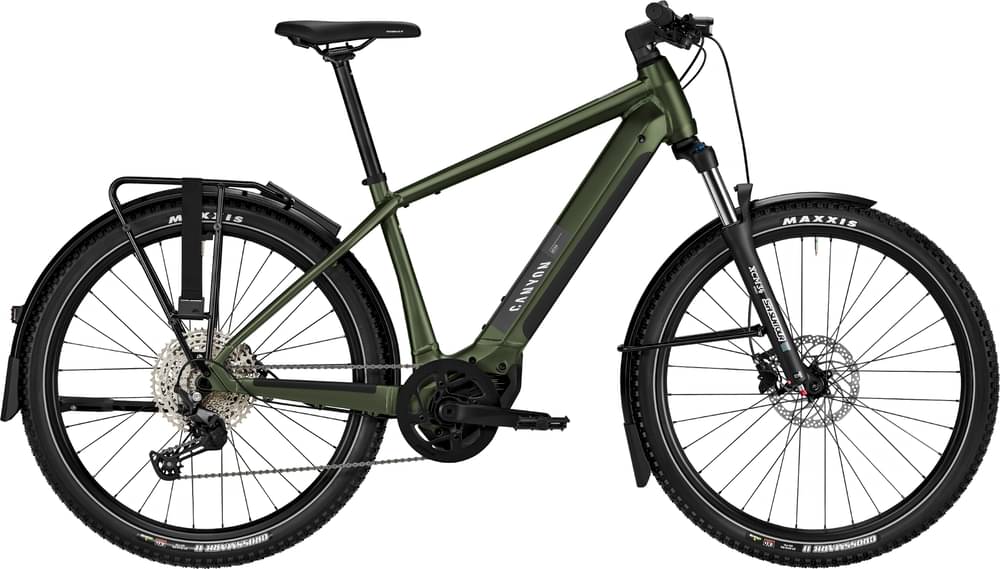
This is our Canyon Pathlite:ON 5 review, which is an electric trekking bike designed for riders who do not want to choose between everyday transport and recreational cycling. It combines a Bosch mid-drive system with a large battery, suspension, wide tyres and practical equipment for riding both on and away from paved roads.
The current Pathlite:ON 5 SUV is also considerably different from earlier bikes carrying the Pathlite:ON 5 name, so this review focuses specifically on the newer 750 Wh UK and European version.
We look at its motor performance, range, comfort, handling, components and everyday usability to establish where the Pathlite:ON 5 fits in the increasingly competitive trekking ebike market.
Canyon Pathlite:ON 5: Short Summary
The Canyon Pathlite:ON 5 SUV is an unusually capable all-round electric bike. Its Bosch Performance Line CX motor has the responsiveness and low-speed strength needed for steep hills, heavier riders and loaded riding, while the large 750 Wh battery gives it substantially more long-distance potential than a typical commuter ebike.
Comfort and versatility are equally important. The 100 mm suspension fork, wide Maxxis tyres and suspension seatpost take the edge off poor roads and gravel tracks, while integrated lights, mudguards, a rear rack and kickstand mean very little needs to be added before the bike can handle everyday transport.
The main compromise is weight. At more than 28 kg, the Pathlite:ON 5 is cumbersome to carry and noticeably less lively once the motor stops assisting. Some of its peripheral components are also relatively basic compared with the quality of the Bosch electrical system. Even so, particularly when positioned in the mid-range rather than premium end of the market, the overall package offers a great deal.
Score: 9.0/10
Pros
- Powerful and responsive Bosch Performance Line CX motor
- Large 750 Wh battery suits long-distance riding
- Comfortable on poor roads and light off-road surfaces
- Wide-range Shimano CUES gearing works well on hills
- Rack, mudguards, lights and kickstand fitted as standard
- Strong overall equipment level for its market position
Cons
- Very heavy to carry or lift
- Battery removal is less convenient than on some rivals
- Basic suspension fork compared with more expensive trekking bikes
- Shimano MT200 brakes are adequate rather than exceptional
Who It Is For
The Canyon Pathlite:ON 5 is best suited to commuters, leisure riders and touring cyclists who want one electric bike to cover several types of riding. It makes particular sense for longer journeys, hilly routes, poor road surfaces and riders who regularly use gravel paths or forest roads.
Anyone who needs to carry an ebike upstairs every day should consider a lighter alternative. Riders mainly interested in technical off-road riding will also be better served by a genuine electric mountain bike.
Canyon Pathlite:ON 5 Specifications
| Specification | Canyon Pathlite:ON 5 SUV |
|---|---|
| Motor | Bosch Performance Line CX Smart System |
| Motor position | Mid-drive |
| Torque | 85 Nm |
| Battery | Bosch PowerTube 750 Wh |
| Claimed maximum range | Up to 150 km |
| Realistic mixed-use range | Commonly well below the maximum, depending heavily on conditions |
| Charger | Bosch 4A |
| Full charging time | Approximately 6 hours |
| Assisted speed | 25 km/h |
| Throttle | No |
| Frame | Aluminium |
| Fork | SR Suntour XCM34 BOOST |
| Fork travel | 100 mm |
| Rear suspension | None |
| Seatpost | Canyon suspension post |
| Seatpost travel | 50 mm |
| Wheels | 27.5 inches |
| Tyres | Maxxis Crossmark II, 2.25 inches |
| Brakes | Shimano MT200 hydraulic discs |
| Brake rotors | 180 mm |
| Gearing | Shimano CUES, 10-speed |
| Cassette | 11–48T |
| Chainring | 42T |
| Display | Bosch Purion 200 |
| Lights | Integrated front and rear |
| Rear rack | Included |
| Mudguards | Included |
| Kickstand | Included |
| Connectivity | Bosch eBike Flow |
| Weight | Approx. 28.1 kg in size M |
| Market position | Mid-range to upper mid-range trekking ebike |
Design and Build Quality
Frame and Finish
The Pathlite:ON 5 looks substantial because it is substantial. A large Bosch PowerTube battery occupies most of the downtube, while the Performance Line CX motor adds considerable volume around the bottom bracket.
Canyon has nevertheless done a good job of making the electrical components look like part of the bike rather than additions bolted onto a conventional frame. The battery is fully integrated, the motor sits neatly within the lower frame and cable routing is generally tidy.
The aluminium chassis favours strength and stability over minimal weight. That approach makes sense for a trekking ebike expected to carry luggage and cover rougher surfaces, although nobody is likely to mistake the Pathlite for a lightweight hybrid.
Geometry is moderately sporty for a trekking bike. The rider is not pushed into an aggressive mountain-bike position, but neither does the Pathlite place you as upright as a traditional Dutch-style city ebike. The result works particularly well for mixed riding because enough weight remains over the front wheel for confident steering on loose surfaces.
Some riders looking exclusively for relaxed urban comfort may want a more upright position. The adjustable stem helps, although the relatively long frame means it is worth paying careful attention to Canyon’s sizing rather than assuming the same size you use on another hybrid will automatically feel right.
Integration and Component Quality
The Pathlite:ON 5 is particularly well equipped for everyday use.
Canyon includes full mudguards, integrated lights, a rear rack, kickstand and bell. These are easy features to underestimate when comparing specification tables, but they have a major effect on ownership. A bike that arrives ready for wet commutes and pannier use is more useful than one requiring several separate accessories immediately after purchase.
The Ergon GA3 grips are another thoughtful detail. Their small supporting wing spreads pressure across the palm and suits longer rides better than basic cylindrical grips.
Component quality becomes more mixed when looking beyond the Bosch system. The Suntour fork, Shimano MT200 brakes and standard flat pedals are functional rather than luxurious. They make sense at the Pathlite’s current market positioning, but this is clearly a bike where Canyon has prioritised the motor, battery and core platform.
That is arguably the right decision. Upgrading contact points or pedals later is easy. Replacing an underpowered motor or undersized battery is not.
Motor Performance and Power Delivery
Motor and Torque
The Bosch Performance Line CX is the strongest part of the Pathlite:ON 5 package.
This generation produces 85 Nm of torque, giving it considerably more low-speed assistance than lightweight urban systems. The important point is not simply the torque figure, however. Bosch’s control system responds closely to pedal input, which makes the motor feel much more natural than inexpensive cadence-sensor systems.
Apply more pressure and assistance increases almost immediately. Reduce the effort and the motor backs away smoothly.
That behaviour matters on a bike with this much mass. Starts on hills, junctions and slow manoeuvres would feel awkward if the motor arrived with a large delay or sudden surge. Instead, assistance is predictable enough to make the Pathlite manageable even when the gradient increases.
There is audible motor noise under harder acceleration, particularly when climbing in the more powerful assistance settings. It remains an electrical hum rather than something that dominates the ride.
Acceleration and Pedal Assistance
Acceleration is strong without being unnecessarily aggressive.
From a standstill, the motor quickly compensates for the weight of the bike. This is particularly noticeable at traffic lights or when restarting on an incline, where a heavy unassisted trekking bike would require considerably more effort.
Lower assistance settings preserve more of a traditional cycling sensation, while the stronger modes can take most of the strain out of headwinds and steep climbs.
The system works best when the rider uses the gears properly. Moving to an easier gear before a climb lets the motor turn at a more efficient cadence and produces a smoother result than staying in a high gear and relying entirely on torque.
One characteristic cannot be avoided: assistance ends at the UK legal limit of 25 km/h.
Once the motor stops helping, the Pathlite’s weight, tyres and upright frontal area become much more obvious. It is possible to pedal beyond the assistance threshold, but doing so requires considerably more effort than on a lightweight electric hybrid.
For most owners this will not be a major problem. The bike is designed to provide effortless progress within the assistance range rather than behave like a fast conventional road bike above it.
Hill-Climbing Performance
Hilly routes are where the Bosch CX motor earns its place.
Moderate gradients require relatively little effort when an appropriate assistance level is selected. More importantly, the motor retains useful support as speed falls, which is where weaker hub motors can begin to struggle.
The 11–48T cassette also gives the drivetrain enough range for genuinely steep climbs. Dropping into the largest sprockets allows both rider and motor to maintain a sensible cadence rather than grinding slowly in an oversized gear.
Long climbs will naturally use battery faster, especially with a heavier rider or loaded panniers. Yet the combination of a high-torque mid-drive and large battery gives the Pathlite much greater climbing flexibility than a typical city ebike.
It also remains controllable on loose uphill surfaces. Because the motor reacts to pedal pressure rather than simply delivering an abrupt fixed surge, power is easier to meter when traction is limited.
Battery Range and Charging
Real-World Range
The 750 Wh Bosch PowerTube is one of the defining features of the Pathlite:ON 5.
Canyon quotes up to 150 km under favourable conditions. As with virtually every maximum ebike range figure, that number should not be treated as an everyday expectation.
Range changes dramatically according to terrain, assistance mode, rider mass, speed, wind, temperature, tyre pressure and luggage. A light rider using low assistance across flat terrain may get surprisingly close to the upper end of the battery’s potential. Repeated steep climbs in a high support mode can consume energy several times faster.
For planning normal mixed riding, it is more useful to think of the Pathlite as a bike capable of a substantial full day of riding without requiring conservative battery management, rather than expecting a particular number on every charge.
For commuting, 750 Wh provides considerable breathing room. Riders covering moderate daily distances are unlikely to need to recharge after every journey. For leisure riding, the extra capacity means route choices can be based more on where you want to go and less on where the next socket is located.
There is a downside to depending on that capacity. Riding a 28 kg Pathlite for any significant distance with an empty battery is not appealing, so retaining a sensible reserve on longer routes remains worthwhile.
Charging and Battery Practicality
The supplied Bosch 4A charger takes roughly six hours to charge the 750 Wh battery completely from empty, while around half a charge is reached in a little over two hours.
In real use, completely draining the battery before every recharge is unlikely. An overnight charge therefore presents no difficulty, and even a shorter charging session can add substantial usable range.
The PowerTube can be charged while fitted to the bike or removed for indoor charging.
Battery removal is less elegant.
Because the large battery comes out from the lower area of the downtube, its weight has to be supported while it is released. Once familiar with the mechanism it becomes manageable, but systems where the battery lifts cleanly from the top or side are easier to handle.
That distinction matters mainly to riders who plan to remove the battery after almost every journey. If the bike is stored somewhere with access to power, charging it in place is considerably simpler.
Ride Quality and Comfort
Riding Position and Ergonomics
The Pathlite:ON 5 offers a riding position that sits between a conventional hybrid and a recreational trekking bike.
The torso remains relatively relaxed, but there is enough forward reach to keep the rider engaged with the front wheel. This helps when surfaces become loose or uneven and prevents the vague steering that can affect very upright bikes.
It may not be ideal for everyone. Riders specifically looking for a vertical, low-pressure comfort position can find the reach longer than expected, particularly in the larger sizes. The adjustable stem provides useful correction, but getting the frame size right remains important.
The Ergon grips work well over longer distances, while the Selle Royal saddle is reasonably suited to the moderately upright position.
The suspension seatpost is more useful than its modest specification might suggest. It is not intended to absorb major impacts. Instead, it removes some of the repetitive vibration and sharpness transmitted through the rigid aluminium rear triangle.
That is exactly the type of comfort improvement that matters during longer rides.
Suspension and Tyres
At the front is an SR Suntour XCM34 BOOST fork with 100 mm of travel.
The amount of travel sounds close to mountain-bike territory, but the fork itself is relatively basic. It is designed primarily to increase comfort and maintain front-wheel contact rather than provide the sophisticated damping found on a quality trail bike.
On broken tarmac, potholes, compacted gravel and rough cycle paths, it does what it needs to do. Larger hits expose its limitations more quickly.
The 2.25-inch Maxxis Crossmark II tyres complement the fork. Their volume absorbs small surface imperfections and their tread provides substantially better traction on loose ground than narrow urban tyres.
There is a trade-off. Wide, moderately treaded tyres create more rolling resistance than slick commuting rubber. With the motor running, the difference is easy to ignore. Above the assistance limit, it contributes to the feeling that the Pathlite prefers steady progress rather than high-speed pedalling.
For a mixed-surface bike, the compromise is sensible.
Rider Fit
The step-over Pathlite:ON 5 is best suited to riders comfortable with a conventional top tube, while alternative frame formats within the wider Pathlite range can make mounting easier.
Sizing deserves attention because the cockpit can feel relatively long. Riders near the boundary between two sizes should consider reach as well as height.
The substantial weight also affects fit in a way ordinary geometry charts cannot show. A rider may be perfectly comfortable once moving but find balancing the bike while stationary more demanding than expected.
Shorter or lighter riders should therefore consider not only saddle height but how confidently they can control the bike when walking it, turning in a tight space or stopping on an incline.
Braking and Handling
Braking Performance
Shimano’s MT200 hydraulic disc brakes use 180 mm rotors front and rear.
They are dependable entry-level hydraulic brakes with light lever action and predictable modulation. For commuting, leisure riding and ordinary touring, stopping power is sufficient.
The question is whether they are an ambitious enough choice for such a heavy bike.
With a rider and luggage added, the complete moving mass can become considerable. On repeated steep descents, stronger four-piston brakes would provide more reserve and better heat management.
For normal UK riding, the MT200s are unlikely to be a deal-breaker. Their simplicity also makes pad replacement and routine maintenance straightforward.
They are nevertheless one of the clearest areas where a more expensive rival can feel more substantial.
Handling and Stability
The Pathlite feels reassuring once it is moving.
A relatively long wheelbase, centrally mounted motor and low battery placement create a planted centre of gravity. At cruising speed the bike tracks confidently and does not require constant steering corrections.
This stability is particularly welcome on gravel, where twitchy steering can quickly reduce confidence.
It also handles loaded panniers well. Additional rear weight changes the steering less dramatically than it would on a short, lightweight urban bike.
The other side of that stability appears at low speed.
Tight turns, crowded cycle parking and narrow gates remind you that this is a long and heavy machine. Steering is not slow, but the physical mass means mistakes require more effort to correct.
For its intended role, the balance is appropriate. Canyon has favoured predictability and confidence over playful agility.
Gearing and Drivetrain
The Pathlite:ON 5 uses a 10-speed Shimano CUES drivetrain with an 11–48T cassette and 42T front chainring.
CUES is a particularly sensible choice for an ebike because durability under load matters more than saving a few grams.
The gear range is broad. At one end, the 48-tooth largest sprocket provides enough mechanical advantage for steep climbs. At the other, the higher gears are suitable for cruising near the assistance limit without forcing an unnaturally high cadence.
Shift quality is positive and predictable rather than exceptionally light.
The main ownership consideration is that a powerful mid-drive sends both rider and motor torque through the chain and cassette. Poor shifting technique can therefore wear drivetrain components relatively quickly.
Backing off pedal pressure slightly during a gear change is good practice. Keeping the chain clean and replacing it before excessive wear spreads to the cassette can also reduce long-term running costs.
Ten speeds are more than enough here. A larger number of ratios would look better on a specification sheet without significantly improving how the bike performs in its intended environment.
Display, Controls and Smart Features
Display and Controls
The Bosch Purion 200 combines the main controls and colour display into a compact unit positioned near the left grip.
It is easy to operate without removing a hand from the handlebar and presents essential information such as speed, battery status and assistance level clearly.
The screen is deliberately small. Riders accustomed to large centrally mounted displays may prefer more visual information, particularly for navigation, but the compact format keeps the cockpit uncluttered.
Assist settings can be changed quickly while riding, and the buttons are sufficiently distinct that frequent glances are unnecessary once familiar with the layout.
For this type of bike, that simplicity works well.
App and Connectivity
The Bosch Smart System connects to the eBike Flow app, adding considerably more functionality.
Depending on software and services available, riders can adjust certain motor characteristics, manage ride modes, install firmware updates, record rides and use compatible navigation and security features.
The important point is that the app is an enhancement rather than something you must constantly interact with.
The Bosch ecosystem is also a reassuring choice for long-term ownership. Software, batteries, displays and motors are supported within one of the most widely used ebike platforms on the market.
Security features can make the electrical system less useful to a thief, but they should complement rather than replace a high-quality physical lock. The large removable battery itself is valuable enough that owners parking regularly in public should think carefully about security.
Accessories and Everyday Practicality
The Pathlite:ON 5 is much closer to a complete transport solution than many sportier electric bikes.
Full mudguards are already fitted, making wet roads far less unpleasant. The permanently powered lights remove the need to remember separate rechargeable units. A kickstand is useful when loading panniers, and the rear rack provides proper carrying capacity without requiring an aftermarket system.
For commuters, those features matter every day.
A pair of suitable panniers can turn the Pathlite into a practical alternative to the car for shopping, work equipment or everyday errands.
The rack does not mean that every rack-mounted child seat or other load-carrying accessory is automatically approved. Canyon has specifically highlighted child-seat compatibility on newer Pathlite variants designed for it, so buyers intending to carry a child should confirm the approved configuration for this exact Pathlite:ON 5 SUV rather than relying purely on the rack’s appearance.
Bottle and lock mounting options add further utility, although compatibility should again be checked before buying model-specific accessories.
Overall, this is one of the Pathlite’s stronger areas. It has been designed to be used as transportation rather than requiring the owner to turn an essentially recreational bike into one afterwards.
Weight, Storage and Transport
The specification that deserves the most consideration before purchasing is 28.1 kg.
The Bosch motor disguises that weight extremely effectively while riding. It cannot help when carrying the bike.
A flight of stairs becomes a serious task. Getting the bike into the back of a car requires care. Navigating tight hallways or lifting it onto a wall-mounted storage system can be awkward.
Removing the battery reduces some of the mass, but the battery itself is large and the removal procedure is not especially convenient.
Car-mounted bike racks also need to be checked carefully. Many older racks have individual bicycle weight limits below what a fully assembled Pathlite weighs.
This is not a criticism unique to Canyon. Large-battery trekking ebikes are inherently heavy.
The important question is whether that matters in your own circumstances. Someone storing the bike in a garage at ground level may barely think about its mass. Someone living several floors up without a lift could regret it almost immediately.
Weight should therefore be treated as part of the buying decision rather than simply another figure in the specifications.
Maintenance, Reliability and Ownership
The Pathlite combines familiar bicycle components with a sophisticated Bosch electrical system.
Routine maintenance is straightforward. Chains, cassettes, brake pads and tyres are conventional parts, and Shimano CUES and MT200 components can be serviced by a wide range of competent workshops.
Drivetrain wear deserves particular attention because of the motor’s torque. Keeping the chain clean, lubricated and within acceptable wear limits is one of the simplest ways to avoid unnecessary expense.
Bosch’s widespread service network is another advantage. A motor or battery fault still requires specialist attention, but Bosch-equipped ebikes are common enough that finding appropriate expertise is generally easier than with a proprietary electrical system from a small manufacturer.
Owner experiences around the Pathlite:ON SUV are mixed enough to justify some attention to initial setup. Reports exist of creaks, loose covers, drivetrain adjustment and other small assembly issues. These do not establish a universal reliability problem, but they make a careful inspection after delivery worthwhile.
Check that the gears are correctly indexed, bolts are properly tightened, the battery sits securely and no cables appear pinched or improperly routed.
Canyon’s direct-sales structure is also relevant. The value proposition can be strong because there is no conventional retailer in the middle of the purchase, but buyers who expect a local shop to handle every small adjustment automatically may prefer a dealer-supported alternative.
Warranty and Customer Support
Canyon provides its standard warranty alongside a longer guarantee covering eligible Canyon-developed components such as the frame.
It is important to distinguish this from blanket long-term coverage for every part on the bike. Bosch electronics, Shimano components and other third-party parts are subject to their respective warranty terms and conditions.
Canyon has expanded access to authorised service locations, which makes ownership easier than it was when direct-to-consumer bikes depended much more heavily on shipping and remote support.
Even so, the ownership experience remains different from buying through a traditional local dealer.
For confident riders who are comfortable performing basic adjustments or arranging servicing themselves, that trade-off is unlikely to outweigh the strong specification.
Someone who wants to return to the same shop for every noise, software question and adjustment may place more value on a competitor with a large physical dealer network.
Canyon Pathlite:ON 5 vs the Competition
Canyon Pathlite:ON 5 vs Cube Kathmandu Hybrid
The Cube Kathmandu Hybrid range targets a very similar buyer.
Both combine powerful Bosch mid-drive assistance with large batteries, suspension forks, integrated racks, mudguards and lights. The Cube generally feels more conventionally focused on trekking and touring, while the Pathlite carries slightly more of an off-road influence.
Cube also benefits from a broad dealer network in the UK. That can make sizing, servicing and warranty work more straightforward.
The Canyon counters with particularly strong equipment relative to its market position, especially when the Pathlite:ON 5 is discounted into the mainstream mid-range segment.
For riders prioritising dealer support, the Cube has a clear advantage. For buyers comfortable with Canyon’s direct-sales model, the Pathlite can offer more hardware for the money.
Canyon Pathlite:ON 5 vs Specialized Turbo Tero 4.0 EQ
The Specialized Turbo Tero 4.0 EQ takes the all-road concept further towards mountain-bike territory.
Its larger 29-inch wheels, 110 mm suspension fork and more trail-oriented chassis make it better suited to riders who expect rougher off-road surfaces. Certain versions also use stronger braking hardware.
The Pathlite has the advantage in outright motor torque with its 85 Nm Bosch CX system, compared with the 70 Nm Specialized motor, while its 750 Wh battery is slightly larger than the Tero’s 710 Wh unit.
Specialized also has a strong dealer network and a mature app ecosystem.
The choice therefore depends on priorities. The Tero is the more convincing option when off-road riding forms a large part of the plan. The Canyon is arguably the stronger trekking and long-distance all-rounder, particularly when battery capacity, motor strength and standard commuting equipment matter most.
Value for Money
The Pathlite:ON 5 makes the strongest case when viewed as a well-equipped mid-range trekking ebike rather than a premium machine.
Its most expensive and difficult-to-replace components are good ones. The Bosch Performance Line CX motor is powerful, refined and supported by a mature ecosystem. The 750 Wh PowerTube provides significantly more energy than many urban-focused rivals.
Canyon has then saved money in areas where compromise is easier to tolerate.
The Suntour fork is relatively simple. The MT200 brakes sit near the affordable end of Shimano’s hydraulic range. The pedals are basic and some finishing pieces lack the sophistication found on premium trekking bikes.
None of those compromises fundamentally undermines the bike.
The fork still improves comfort. The brakes still stop the bike predictably. Pedals can easily be changed. More importantly, there is no obvious need to upgrade the motor, battery or core drivetrain simply to make the bike suitable for its intended role.
Standard equipment adds further value. Lights, mudguards, a rear rack, kickstand and suspension seatpost are already present.
Against the best ebike options in the same broad category, the Pathlite therefore stands out less because of one exceptional component and more because very little is missing.
At full upper mid-range positioning, stronger brakes and suspension would be welcome. When discounted into the mainstream mid-range, its value proposition becomes considerably more compelling.
Canyon Pathlite:ON 5 Review Verdict
The Canyon Pathlite:ON 5 is a very effective example of what a modern trekking ebike can be.
Its greatest strength is versatility. The combination of an 85 Nm Bosch CX motor, large 750 Wh battery, broad gearing, suspension and practical accessories allows the same bike to handle commuting, long leisure rides, hilly routes, gravel paths and light touring without feeling badly compromised in any of them.
The electrical system is particularly convincing. Assistance is powerful without becoming difficult to control, climbing performance is strong and the battery capacity gives owners far more freedom than a lightweight urban system.
Comfort is also better than the relatively basic suspension specification initially suggests. Wide tyres, the 100 mm fork and suspension seatpost work together effectively on the poor surfaces that trekking bikes actually encounter.
There are compromises. The Pathlite is extremely heavy, its brakes and fork are relatively modest, and battery removal could be easier. Riders who prioritise local dealer support may also prefer established shop-based brands.
Those weaknesses do not undermine the fundamental package.
For someone looking for one ebike that can serve as daily transport during the week and a long-distance recreational bike at the weekend, the Canyon Pathlite:ON 5 is a highly convincing all-rounder.
Score: 9.0/10
Frequently Asked Questions
What is the real-world range of the Canyon Pathlite:ON 5?
Canyon quotes a maximum range of up to 150 km from the 750 Wh battery, but actual range varies substantially. Terrain, assistance level, rider weight, wind, temperature and speed all have a major effect. The battery is large enough for substantial full-day riding in normal conditions, but frequent steep climbing or heavy use of maximum assistance can reduce range considerably.
Is the Canyon Pathlite:ON 5 good for hills?
Yes. Hill climbing is one of its strongest areas. The Bosch Performance Line CX produces 85 Nm of torque and works through the bicycle’s gears rather than driving a hub directly. Combined with the wide 11–48T cassette, this allows the motor to provide strong assistance even on steep climbs, provided the rider selects an appropriate gear.
Can the Canyon Pathlite:ON 5 battery be removed?
Yes. The 750 Wh Bosch PowerTube can be removed from the frame and charged separately. It can also be charged while installed in the bike. Because the large battery is released from the lower part of the downtube, removal requires more care than systems where the battery simply lifts upwards or slides easily from the side.
How long does the Canyon Pathlite:ON 5 take to charge?
The Pathlite:ON 5 is supplied with a Bosch 4A charger. Bosch specifies approximately six hours to charge a completely depleted 750 Wh PowerTube to full capacity, with around half charge reached in roughly 2.3 hours. In normal ownership the battery is unlikely to be completely empty before every charging session.
Is the Canyon Pathlite:ON 5 suitable for off-road riding?
It works well on gravel roads, forest tracks, towpaths and other relatively smooth unsurfaced routes. The 100 mm Suntour fork and 2.25-inch Maxxis tyres provide much more capability than a rigid city ebike. However, it is not a true electric mountain bike. Technical trails, large rocks, jumps and repeated rough descents demand better suspension, brakes and trail-specific geometry.
Is the Canyon Pathlite:ON 5 worth buying?
For riders who want a powerful, long-range trekking ebike, it is a strong option. The motor, battery and practical equipment are the main reasons to choose it. Its weight and relatively basic suspension are the biggest compromises. It becomes especially attractive when positioned in the mid-range market, where few alternatives combine this much battery capacity, Bosch CX assistance and standard equipment.