
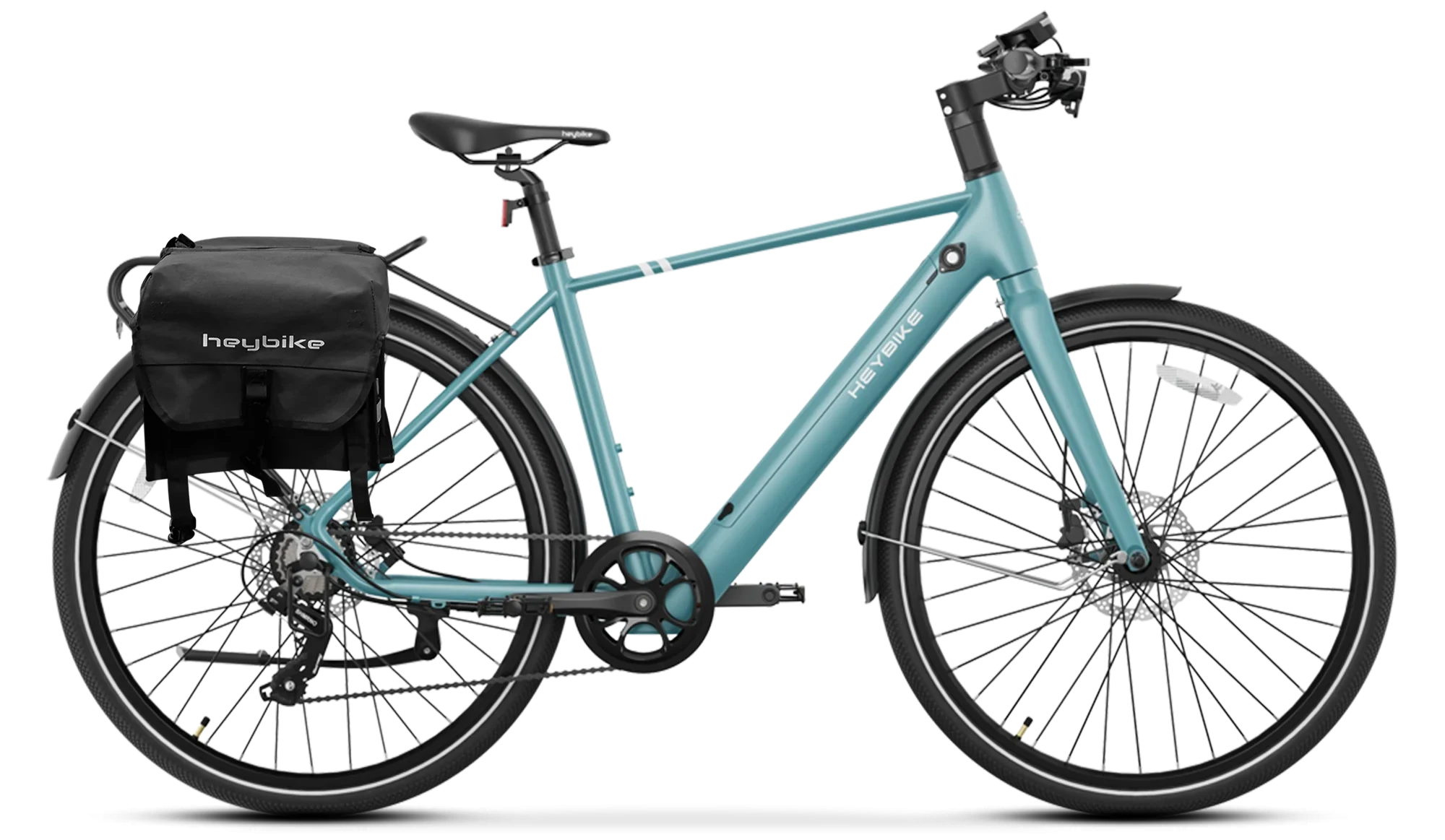
The Heybike EC 1 is a lightweight electric commuter designed to look and ride much more like a conventional hybrid bicycle than the bulky ebikes commonly found at the affordable end of the market. A rear hub motor, integrated removable battery, hydraulic disc brakes and 700C wheels give it a straightforward specification aimed primarily at urban riding, commuting and recreational cycling.
In this Heybike EC 1 review, we look at its real-world range, motor performance, handling, comfort, components and everyday practicality to see whether its simple approach makes it one of the more compelling commuter ebikes in its class.
Heybike EC 1 Review Summary
The Heybike EC 1 succeeds by keeping things relatively simple. At around 19 kg, it is considerably lighter than many affordable ebikes, and the slim aluminium frame, internally routed cables and integrated battery make it look more like a conventional hybrid than an electric bike. That low weight matters on the road as much as it does when lifting the bike, because the EC 1 remains pleasant to pedal beyond the assistance limit and is reasonably manageable even if the battery runs out.
Its 250 W rear hub motor provides enough help for urban riding and moderate hills, while the hydraulic disc brakes are unusually capable for a bike in this category. The main compromises are equally predictable. Its cadence sensor cannot match the natural response of a good torque-sensing system, the seven-speed Shimano drivetrain is basic and the rigid fork transmits more impact on rough roads than a suspension-equipped commuter. The 360 Wh battery also delivers much less range in everyday riding than the headline maximum suggests.
For commuting and mixed urban riding, however, the EC 1 gets a remarkable number of important things right.
Score: 9/10
Pros
- Much lighter than many affordable electric bikes
- Clean, discreet frame design with integrated battery
- Hydraulic disc brakes provide confident stopping power
- Removable Samsung battery is convenient for charging
- Comfortable and efficient on roads and cycle paths
- Still rides reasonably well without electrical assistance
Cons
- Cadence sensor feels less natural than a torque sensor
- Real-world range falls well short of the maximum claim
- Seven-speed drivetrain is fairly basic
- Rigid fork can feel harsh over potholes and broken surfaces
Who It Is For
The Heybike EC 1 is best suited to commuters, students and leisure riders who want a relatively lightweight electric bike that still behaves like a normal hybrid. It works particularly well for flatter and moderately hilly urban journeys where low weight and easy pedalling matter more than maximum motor torque. Riders dealing with very steep hills, rough trails or extremely long journeys should consider a more powerful trekking or mid-drive ebike instead.
Table of Contents
Heybike EC 1 Specifications
| Specification | Heybike EC 1 |
|---|---|
| Motor | Rear hub motor |
| Nominal motor power | 250 W |
| Torque | Approx. 37–40 Nm |
| Sensor | Cadence/pedal sensor |
| Battery | Samsung lithium-ion |
| Battery capacity | 360 Wh |
| Battery voltage | 36 V |
| Battery capacity | 10 Ah |
| Battery type | Integrated and removable |
| Claimed maximum range | Up to 100 km |
| Realistic mixed-use range | Approximately 45–65 km for many riders |
| Charging time | Approximately 4–5 hours |
| Maximum assisted speed | 25 km/h / 15.5 mph |
| Frame | Aluminium alloy |
| Fork | Rigid aluminium |
| Wheels | 700C |
| Tyres | 700 × 40C puncture-resistant |
| Brakes | Hydraulic disc brakes |
| Rotor size | Approx. 160 mm |
| Gearing | Shimano 7-speed |
| Freewheel | 14–28T |
| Chainring | 42T |
| Display | 3.4-inch LCD |
| Connectivity | Bluetooth / Heybike app |
| Headlight | Integrated 30-lux light |
| Rear light | Integrated |
| Mudguards | Included |
| Kickstand | Included |
| Rear rack | Optional |
| Weight | Approx. 19.2 kg |
| Rider sizing | M and L frames |
| Warranty | Two years |
| Market position | Budget to lower mid-range commuter ebike |
There is one specification inconsistency worth noting. Heybike’s current UK material lists two different maximum load figures in different parts of the same product information, so riders close to the stated limit should use the lower figure unless Heybike confirms otherwise.
Design and Build Quality
Frame and Finish
The EC 1 is one of the better examples of how an affordable electric bike can avoid looking unnecessarily bulky. Its aluminium frame uses a relatively slim downtube despite containing the battery, while the small rear motor is easy to overlook unless you know what you are looking for. From a few metres away, there is little to distinguish the EC 1 from a normal flat-bar hybrid, and that discretion is a significant part of its appeal.
Cable routing is largely concealed, the battery fits flush with the downtube and the welds are cleaner than the bike’s market position might suggest. The result is a considerably more polished design than the externally mounted batteries and bundles of exposed wiring still found on some inexpensive ebikes. Independent testing has also been positive about the general frame finish and construction, although the paint can mark relatively easily, so riders storing the bike beside other bicycles may want to take some care.
Overall construction is impressive for the category. Heybike has resisted the temptation to make the EC 1 visually complicated simply because it contains a motor and battery, and the relatively conventional appearance should age better than some of the more aggressively styled alternatives.
Integration and Component Quality
Component selection follows a sensible hierarchy. The brakes are better than we would normally expect at this level, the battery uses Samsung cells and the fundamental chassis is relatively lightweight, while less money has clearly been spent on the drivetrain and finishing kit. That is a compromise we can accept because the important components are the ones that most affect everyday use.
The alloy handlebar has a subtle rise and backsweep that suits commuting, while the saddle has a moderately sporty profile with a central pressure-relief channel. Full-length mudguards are included, along with a kickstand and lighting, while a rear carrier is available separately rather than being permanently attached to the bike. That keeps the standard EC 1 lighter and visually cleaner, although regular commuters using panniers should factor a rack into their setup.
There is no suspension fork, so comfort depends heavily on the 40 mm tyres, saddle and frame geometry. For city riding, that is not necessarily a disadvantage. A cheap suspension fork adds weight and complexity, and the rigid aluminium fork helps keep the EC 1 noticeably lighter than many similarly priced competitors.
Motor Performance and Power Delivery
Motor and Torque
The EC 1 uses a 250 W rear hub motor. Heybike does not clearly state torque on the current UK specification, but independent tests and earlier specifications place it at approximately 37–40 Nm, which is modest by modern ebike standards but appropriate for a lightweight commuter.
Powerful trekking bikes can produce more than twice as much torque, but comparing those systems directly misses the point. The EC 1 weighs far less and is designed primarily for urban riding rather than hauling a heavy machine up mountain roads. On relatively flat terrain, the motor has more than enough power to make starts from junctions easier, reduce effort into headwinds and take much of the strain out of normal urban gradients.
The rear-hub architecture also keeps the drivetrain mechanically simple because motor power goes directly into the rear wheel instead of travelling through the chain and gears. That reduces drivetrain wear and removes some of the servicing considerations associated with powerful mid-drive systems.
Acceleration and Pedal Assistance
The main limitation is the cadence sensor. Rather than measuring how strongly you are pushing the pedals, it simply detects rotation. Once the cranks begin moving, the system knows assistance is required and activates the motor, creating a short but noticeable delay between starting to pedal and feeling the electrical support.
In real-world riding, that delay amounts to part of a pedal rotation rather than several seconds, so it rarely becomes frustrating. Once running, power arrives smoothly enough, but the system still cannot match a good torque sensor. On a torque-sensing bike, pushing gently produces a small amount of assistance and pressing harder produces more, so the motor feels almost like an extension of your legs. The EC 1 instead delivers support according to the selected assistance setting once it detects pedalling.
For ordinary commuting, this works perfectly well. The higher settings provide useful acceleration through traffic, while lower levels preserve battery capacity and make the bike feel more like a conventional hybrid. One of the EC 1’s biggest advantages becomes apparent when assistance stops at 25 km/h. Because the bike weighs around 19 kg and the motor offers relatively little resistance, travelling beyond the assistance threshold does not suddenly feel like pedalling a motorcycle. It remains noticeably more enjoyable above the cut-off than many heavy budget ebikes.
Hill-Climbing Performance
Moderate hills are comfortably within the EC 1’s abilities. Select an easier gear, continue contributing through the pedals and the rear motor removes much of the effort from ordinary urban inclines. Once gradients become genuinely steep, however, its limitations become clearer.
A hub motor cannot use the bicycle’s gears in the way a mid-drive can, so as road speed falls on a steep climb the motor moves away from its most efficient operating range. More rider effort is therefore required, particularly because the seven-speed drivetrain does not provide an especially low climbing gear.
This does not make the EC 1 a poor climbing bike for its category. It simply means buyers living somewhere exceptionally hilly should not assume that all 250 W ebikes perform the same way. For rolling urban routes, the EC 1 works well. For repeated steep climbs with a heavier rider and luggage, a higher-torque hub motor or mid-drive system would be the better choice.
Battery Range and Charging
Real-World Range
The EC 1 uses a 36 V, 10 Ah Samsung battery, giving 360 Wh of capacity. Heybike advertises up to 100 km of range, but that should be treated as a favourable-condition maximum rather than an everyday expectation.
Independent testing provides a more useful picture. Using maximum assistance, around 48 km or 30 miles from a charge has been demonstrated, while more economical low-assistance riding has produced substantially greater distances. For many riders, 45–65 km is therefore a sensible mixed-use expectation, with terrain, rider weight, temperature, speed and assistance level all having a significant effect.
A lightweight rider travelling steadily on flat cycle paths may exceed that range comfortably, while a heavier rider repeatedly accelerating, climbing hills and using maximum assistance could fall below it. Cold weather also reduces battery performance, which matters during a British winter.
For commuting, the range remains perfectly respectable. Someone riding 15–20 km per day should have plenty of capacity without needing to charge at every opportunity. The battery becomes less suitable only if the EC 1 is expected to function as a genuine long-distance touring bike.
Charging and Battery Practicality
Charging takes approximately four to five hours from empty, which makes overnight charging effortless and allows a useful amount of energy to be added during a working day. More importantly, the battery is removable, so it can be taken indoors for charging while the bicycle stays in a garage, communal storage area or workplace bike park.
The integration is better than on many removable systems. When installed, the battery follows the shape and colour of the frame instead of looking like a separate plastic box strapped to the downtube. That gives the EC 1 both the convenience of removable charging and much of the visual cleanliness normally associated with permanently integrated batteries.
For commuters living in flats or anyone unable to park the entire bike beside an electrical socket, that combination is particularly useful.
Ride Quality and Comfort
Riding Position and Ergonomics
The EC 1 feels much more like a conventional hybrid than a heavy electric utility bike. The handlebar places the rider in a moderately upright position, providing good visibility in traffic without creating excessive wind resistance, while enough weight remains over the front wheel to make steering feel controlled rather than vague.
Independent riding impressions consistently point towards a comfortable position, and that matches the geometry. This is a bike designed for commuting and recreational distances rather than an aggressively stretched road-bike posture. The saddle is firmer than the oversized padded seats fitted to many city ebikes, which we actually prefer for longer journeys because excessive padding can become uncomfortable once rides extend beyond short trips.
Two frame sizes are available. Medium is aimed broadly at riders from around 160 to 180 cm, while large overlaps significantly and extends the fit towards approximately 190 cm. Taller riders approaching the upper end should pay particular attention to reach, as independent testing suggests the cockpit can feel comparatively short for very tall cyclists.
Rigid Fork and Tyres
There is no suspension fork, which will divide opinion. On normal asphalt the rigid aluminium fork is perfectly appropriate and gives the steering a direct, relatively efficient feel, but deep potholes and sunken drains can send a noticeable shock through the handlebar.
The 700 × 40C tyres therefore play an important role. They are considerably wider than traditional road-bike tyres and provide enough air volume to absorb ordinary road vibration, expansion joints and smaller imperfections. Independent winter testing found them comfortable enough on typical road surfaces while also providing predictable grip in wet conditions.
Their light tread gives the EC 1 more versatility than a pure city slick, so hard-packed tracks, canal paths and light gravel are entirely reasonable. Mud, rocks and genuinely rough forest trails are not. Slightly reducing tyre pressure can improve comfort further, although going too low increases rolling resistance and puncture risk, so finding the right balance for rider weight matters more on a rigid bike like this than on one with suspension.
Braking and Handling
Hydraulic Brake Performance
One of the EC 1’s strongest components is its hydraulic disc brake system. Independent examples of the bike have used RSX hydraulic brakes with approximately 160 mm rotors, and testing in wet British conditions has been particularly positive.
Lever pressure is light and stopping power builds progressively rather than arriving abruptly, which is exactly what we want from a commuting bike. Mechanical disc brakes can provide adequate stopping power, but they normally require more hand pressure and regular cable adjustment. Hydraulic systems compensate automatically for pad wear and generally provide smoother modulation.
The EC 1’s relatively low weight helps too. These brakes are not trying to control a 30 kg fat-tyre machine, so there is plenty of stopping capacity for normal urban riding and faster descents. One detail worth checking during setup is brake lever orientation, as some European-supplied examples have arrived with the opposite front/rear lever arrangement to what many UK cyclists expect.
Handling and Stability
Handling is another area where the EC 1’s low weight pays off. It changes direction easily and feels much more agile between cars, bollards and cycle-path barriers than a heavyweight commuter. The rear motor adds some mass to the back wheel, but it is small enough that it does not dominate the way the bike steers.
At higher speeds the chassis remains stable, and independent testing on fast, wet descents found the bike predictable, with the 40 mm tyres maintaining reassuring grip. There is also relatively little resistance once the motor switches off at 25 km/h.
That last point matters more than it sounds. Many heavy ebikes encourage the rider to remain close to the assisted speed because pushing beyond it feels unpleasant. The EC 1 transitions into ordinary bicycle behaviour much more naturally, which is one of the main reasons it works so well as an everyday commuter.
Gearing and Drivetrain
The EC 1 uses a Shimano seven-speed derailleur, a 14–28T freewheel and a 42-tooth chainring. It is basic equipment, but it is also familiar, inexpensive to replace and available through almost any competent bicycle workshop.
For urban commuting, seven gears are usually enough because the motor handles much of the workload during acceleration and gentle climbs, reducing the need for closely spaced ratios. The relatively limited 14–28T range becomes more noticeable on steep hills, where there simply is not an exceptionally low climbing gear available. Combined with the modest motor torque, this means genuinely steep gradients require considerably more rider effort.
Shift quality itself is respectable when properly adjusted, and independent testing has found the drivetrain reliable through extended use. For an affordable commuter, we would rather have a simple Shimano drivetrain paired with hydraulic brakes than an extra few gears combined with cheaper braking hardware.
Display, Controls and Smart Features
3.4-Inch LCD Display
The central 3.4-inch LCD is unusually large for such a visually discreet bicycle. Speed, battery level, assistance information and normal trip data are easy to read while riding, and the screen remains clear enough in changing light conditions.
The main criticism is aesthetic. Heybike has put considerable effort into hiding the battery and motor, only to position a relatively large display directly in the centre of the cockpit. Some riders will appreciate the visibility, while others may wish for something smaller and more understated.
Functionally, there is little to complain about. The display carries an IPX6 rating and includes Bluetooth connectivity for the Heybike app.
Heybike App
The EC 1 connects to the Heybike mobile app, which can record rides, display additional riding information and provide access to certain bicycle settings. The important point is that the app remains optional rather than becoming a requirement for basic riding.
Some versions of Heybike’s software have allowed assistance and speed-related settings to be adjusted beyond locally permitted limits. UK riders should keep the bicycle configured to comply with EAPC requirements, meaning a 250 W nominal motor and assistance ending at approximately 15.5 mph.
Used sensibly, the app is a useful addition rather than the centre of the ownership experience, which is exactly how we prefer ebike software to work.
Accessories and Everyday Practicality
The standard EC 1 covers most commuting basics. Full-length mudguards are particularly valuable in the UK, where even a short journey on wet roads can otherwise cover the rider and drivetrain in spray. The integrated front light produces a 30-lux beam and removes the routine of charging and attaching a separate unit, while current specifications also include a rear light, reflectors and a kickstand.
The main omission is a rear rack. Heybike sells a compatible carrier separately, so riders who use panniers can add one without much difficulty. Leaving it optional also makes sense for people prioritising low weight or using the bike recreationally, giving owners the choice between keeping the EC 1 relatively minimalist or turning it into a more traditional commuter setup.
One caution concerns the claimed payload. Heybike’s current UK information contains inconsistent maximum-load figures in different sections. Anyone approaching the lower published limit, particularly once luggage is included, should obtain confirmation from Heybike rather than assuming the larger number applies.
Weight, Storage and Transport
At approximately 19.2 kg, the EC 1 sits in a very useful middle ground. It is not genuinely lightweight by normal bicycle standards, but it is light for a full-size ebike with a removable 360 Wh battery, and that difference becomes obvious every time you are not riding.
Lifting it up a short staircase is realistic for many adults, manoeuvring it through a hallway is manageable and putting it onto a suitable vehicle rack does not feel like a strength-training exercise. Compare that with the 25–30 kg machines common at the budget end of the ebike market and the practical advantage becomes substantial.
The battery can also be removed to shave off a little additional weight before lifting. The EC 1 still occupies as much floor space as a normal hybrid, so it will not replace a folding bike for tiny flats or crowded trains, but for mixed bike-and-train commuting its manageable mass makes it far more appealing than most fat-tyre and utility-style alternatives.
Maintenance, Reliability and Ownership
Mechanically, the EC 1 is reassuringly straightforward. The seven-speed Shimano drivetrain uses conventional parts, the tyres are a standard 700C size and hydraulic brake pads are ordinary wear components rather than proprietary items. This should keep routine servicing relatively simple.
The rear hub motor also places less additional strain on the chain and freewheel than a mid-drive system because electrical power bypasses the mechanical drivetrain. Chains and sprockets should therefore have a relatively ordinary service life provided they are kept clean and lubricated.
There is more mixed feedback around the electrical side of the EC 1 family. Isolated owners have reported controller, display, wiring or motor-related errors, including intermittent electrical faults. These cases are not sufficient to characterise the EC 1 as broadly unreliable, but they do highlight the importance of after-sales support.
Heybike operates primarily as a direct-to-consumer brand, so diagnosing an electrical problem may involve emails, photos, videos and replacement components rather than simply wheeling the bicycle back into the shop where it was purchased. That trade-off is common among affordable online ebike brands. After assembly, it is sensible to check that the brakes operate correctly, wheels are secure, gears are properly indexed, cables are seated correctly and all fasteners have been tightened appropriately.
Warranty and Customer Support
Heybike currently provides a two-year warranty for electric bikes purchased through its official channels, excluding normal wear items. Coverage can also continue for a subsequent owner within the original warranty period if the necessary proof of purchase and original order information are available, which is useful from a resale perspective.
The more important distinction is how support is delivered. Heybike does not have the same UK workshop footprint as brands sold extensively through traditional bicycle shops, so a fault may begin with remote diagnosis before replacement parts or another remedy are arranged.
Experiences with support appear mixed. Many owners report straightforward purchases and helpful assistance, while others describe slower communication or delays receiving components. That makes the EC 1 better suited to someone comfortable owning a direct-sales bicycle than a buyer who wants every service interaction handled face-to-face by a local dealer.
Heybike EC 1 vs the Competition
Heybike EC 1 vs TENWAYS CGO600
The TENWAYS CGO600 is perhaps the clearest alternative for riders who prioritise low weight and clean urban design. It is substantially lighter than the Heybike and uses a torque sensor, giving its assistance a more immediate and natural feel. Its belt drivetrain also dramatically reduces routine maintenance.
The disadvantage is simplicity. The CGO600 uses a single-speed transmission, making it better suited to flatter cities, while its battery is also smaller than the EC 1’s 360 Wh unit. The Heybike counters with seven gears, a larger removable battery and greater flexibility when terrain varies.
For flat urban commuting where minimum weight and refined assistance matter most, the TENWAYS has the more sophisticated design. For riders who want gears and a larger removable battery without moving further up the market, the EC 1 makes a compelling case.
Heybike EC 1 vs Fiido C21
The Fiido C21 is an especially close competitor. It is lighter than the EC 1 and uses a torque sensor, immediately giving it an advantage in assistance quality, while its nine-speed gearing is also more sophisticated than Heybike’s seven-speed drivetrain.
The EC 1 has one significant advantage in battery practicality. Its 360 Wh pack is substantially larger than the standard C21 battery and can be removed for charging. On the Fiido, the main battery is smaller and integrated permanently into the frame, although a range extender is available.
Both bikes use hydraulic brakes and both work well as light urban and gravel-capable commuters. The Fiido makes more sense if riding feel, gearing and lower weight are the priorities, while the Heybike is stronger for buyers who place more value on a removable battery and larger standard capacity.
Value for Money
The EC 1’s value becomes clearest when you look beyond motor power. There are plenty of affordable electric bikes with larger motors, bigger batteries and more aggressive specification sheets, but most are substantially heavier. Heybike instead spends its budget on creating something that behaves more like a normal bicycle.
The aluminium frame is relatively light, the battery disappears neatly into the downtube, hydraulic brakes are standard and the Shimano drivetrain, while basic, uses inexpensive and widely available replacement parts. The removable Samsung battery is another meaningful advantage over several lightweight competitors.
The main cost-saving is found in the electrical assistance and drivetrain. The rear motor uses a cadence sensor rather than torque sensing, the gearing comes from Shimano’s entry-level range and there is no suspension fork. Those compromises are easy enough to understand because they help preserve the EC 1’s biggest strength: its relatively low weight.
A better torque sensor would be our first choice for improving a future generation, but the current system still works effectively for commuting. More importantly, the bike avoids one of the biggest problems affecting inexpensive ebikes: becoming so heavy that the motor is needed simply to disguise the mass of the bicycle itself.
That combination makes the EC 1 particularly competitive within the budget to lower mid-range commuter category and a credible option for riders comparing the best electric bike choices for everyday urban use.
Heybike EC 1 Review Verdict
The Heybike EC 1 is a reminder that an affordable electric bike does not need enormous tyres, oversized suspension or a huge battery to be useful. Its strongest characteristic is balance.
At around 19 kg, it remains manageable away from the saddle and pleasant to pedal when the motor is not running. The 250 W rear hub provides enough assistance for normal commuting, while the 360 Wh removable battery offers useful everyday capacity without turning the frame into something enormous. Hydraulic brakes are a standout inclusion, and the 700 × 40C tyres provide enough comfort and grip to make the rigid chassis work well across typical British roads.
Its weaknesses are equally clear. Cadence-based assistance cannot match the smoothness of a torque sensor, steeper hills reveal the limitations of both the modest motor and narrow seven-speed gearing, and real-world battery range is considerably lower than the headline maximum.
None of those compromises fundamentally undermines what the EC 1 is trying to achieve. For commuters who want an electric bike that still looks, handles and pedals much like a conventional hybrid, the Heybike EC 1 is one of the more convincing affordable options available.
Score: 9.0/10
Frequently Asked Questions
What is the real-world range of the Heybike EC 1?
Heybike advertises up to 100 km, but everyday range is likely to be substantially lower. Around 45–65 km is a more useful expectation for many riders, although low assistance on flat terrain can extend this significantly. Independent testing has achieved around 48 km using maximum assistance, while more economical riding has produced considerably greater distances.
Is the Heybike EC 1 good for hills?
The EC 1 handles moderate urban hills reasonably well, particularly when the rider selects an appropriate gear and contributes meaningful pedal effort. Steeper gradients expose the limitations of its relatively low-torque rear hub motor. If your regular route contains sustained steep climbs, a higher-torque hub motor or mid-drive ebike would make climbing considerably easier.
How heavy is the Heybike EC 1?
The current EC 1 is listed at approximately 19.2 kg, including its battery. That makes it noticeably lighter than many affordable full-size ebikes, which frequently exceed 25 kg. It is still heavier than a conventional hybrid, but carrying it up shorter flights of stairs or lifting it onto a suitable vehicle rack is realistic for many riders.
Can the Heybike EC 1 battery be removed?
Yes. The 360 Wh Samsung battery is integrated into the downtube but can be unlocked and removed. This allows the battery to be charged indoors while the bicycle remains in a garage or communal storage area, and it also reduces the bike’s weight slightly when it needs to be carried.
Does the Heybike EC 1 have a torque sensor?
No. The EC 1 uses a cadence or pedal-rotation sensor. The motor detects when the pedals are turning and then provides assistance according to the selected level. It works adequately but does not respond proportionally to pedal force in the same way as a torque sensor, so assistance feels less natural than on more sophisticated commuter ebikes.
Is the Heybike EC 1 worth buying?
Yes, particularly for riders looking for a relatively lightweight commuter with hydraulic brakes and a removable battery. Its motor and drivetrain are fairly basic, but the low weight, conventional handling and practical battery design make those compromises easier to accept. Riders prioritising torque-sensing assistance should also compare alternatives from TENWAYS and Fiido before deciding.