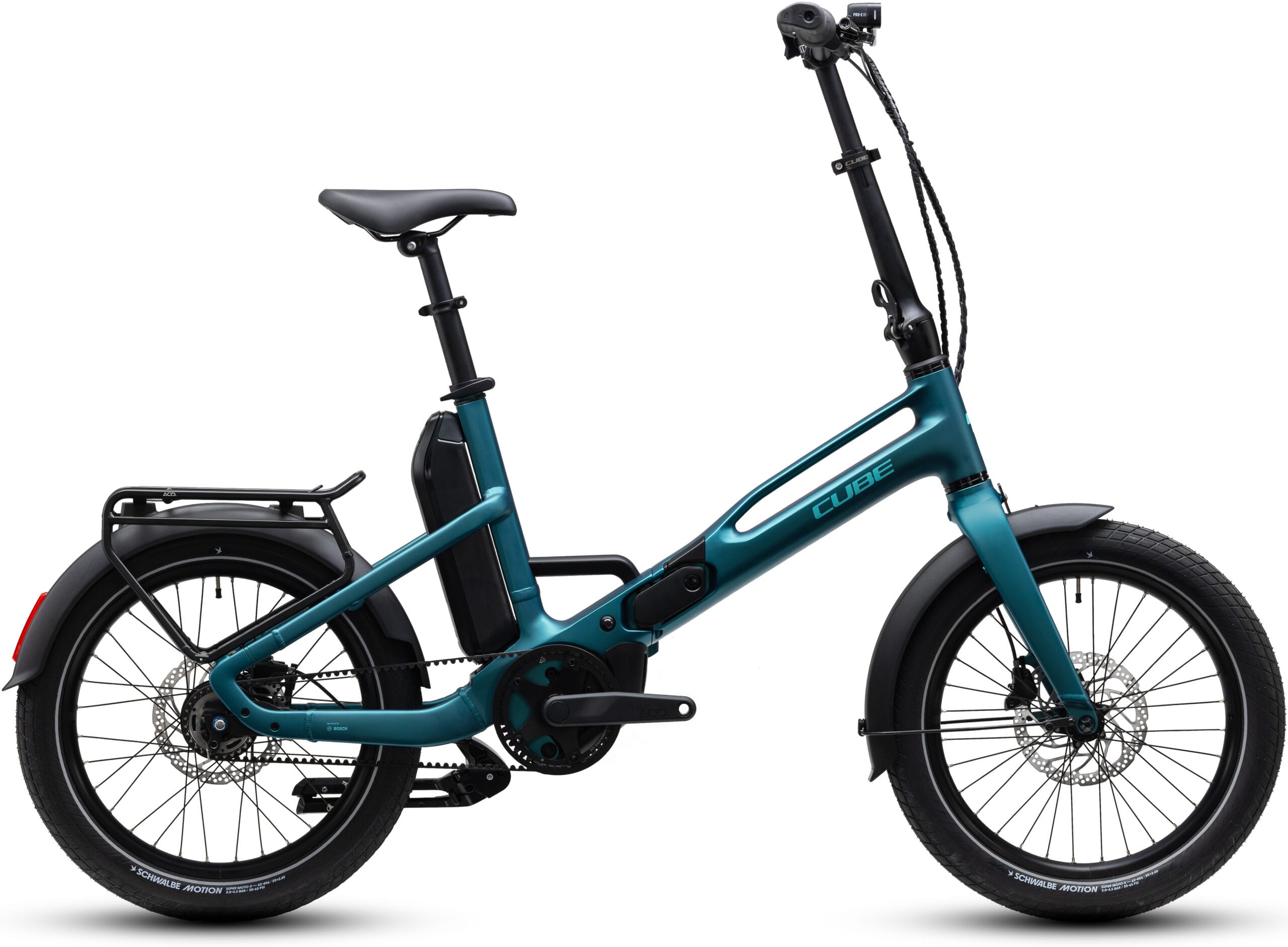
The Cube Fold Hybrid 540 is a premium folding electric bike designed for riders who want the performance and equipment of a full-sized urban ebike in a more manageable package. It is aimed at commuters, motorhome owners, boat users and anyone who needs to store a capable electric bike in a relatively small space.
Its headline feature is not simply that it folds. The more important distinction is what Cube has managed to retain. The Fold Hybrid 540 uses a centrally mounted Bosch Performance Line motor producing 75 Nm of torque, a removable 540 Wh battery and a proper nine-speed Shimano Cues drivetrain. Hydraulic disc brakes, integrated lights, mudguards and a rear carrier are also fitted as standard.
This is therefore closer to a compact urban ebike that folds than an ultralight folding bicycle with electrical assistance.
Our Cube Fold Hybrid 540 review examines its confirmed production specification against the demands of commuting, hill climbing, mixed-surface leisure riding, loaded journeys and multimodal travel. Particular attention is paid to the trade-off at the heart of the bike: excellent riding capability, but considerably more weight than the most portable folding ebikes. But is it still the best folding ebike?
Cube Fold Hybrid 540 Specs at a Glance
- Motor: Bosch Performance Line mid-drive, 250 W nominal, 75 Nm
- Battery: Bosch PowerPack 540, 540 Wh, 36 V
- Estimated range: Approximately 35 to 75 miles in normal use
- Weight: 25.3 kg
- Assisted speed: 15.5 mph in the UK
- Frame: Aluminium Superlite, one size
- Recommended rider height: Approximately 160 to 190 cm
- Tyres: Schwalbe Super Moto-X, 62-406
- Brakes: Shimano MT200 hydraulic discs, 180 mm rotors
- Suspension: Rigid aluminium fork
- Gearing: Shimano Cues 9-speed, 11-36T
Table of Contents
Design and Build Quality
The Cube Fold Hybrid 540 does not follow the classic folding-bike formula of tiny tubing, exposed hinges and narrow tyres. Its Aluminium Superlite frame looks substantial, with a low step-through design and a large central folding joint. The result is closer in appearance to a compact utility bike than a traditional folder.
That impression is reinforced by the 20-inch wheels, wide 62 mm Schwalbe tyres and low-mounted Bosch motor. These components give the bike visual weight, but they also make it feel much more purposeful than a lightweight folder intended only for short urban hops.
The 540 Wh PowerPack is positioned vertically behind the seat tube. This keeps the centre of gravity relatively low and central while preserving the open step-through area. It is not as visually discreet as a battery concealed inside the frame, but the external arrangement makes removal, replacement and off-bike charging much easier.
Cube has also improved the folding mechanism for this generation. The main release lever is easy to reach, while the handlebar folds down independently. An integrated carrying handle provides a sensible lifting point near the bike’s centre of mass. When folded, the bike measures approximately 92 x 45 x 81 cm. That is compact enough for many car boots, motorhome storage compartments and hallway cupboards, although it remains considerably larger than a folded Brompton.
Cable routing is tidy around the motor and main frame. The hydraulic hoses and electrical wiring are positioned to avoid becoming trapped or pulled when the frame and handlebar are folded. The integrated rear carrier also looks like part of the frame rather than an accessory added afterwards.
There is only one step-through frame size, but the telescopic seatpost and highly adjustable folding stem provide a broad range of adjustment. Overall fit and finish are consistent with Cube’s reputation for well-integrated, practical ebikes.
Motor Performance and Power Delivery
The Bosch Performance Line motor is one of the strongest reasons to choose the Cube Fold Hybrid 540 over a lighter folding ebike. It delivers a nominal 250 W in accordance with UK electric-bike regulations, but can produce substantially more power during short periods of acceleration. Its 75 Nm torque figure is especially impressive in this category.
Power is delivered through the crank rather than directly through one of the wheels. The motor therefore benefits from the bike’s nine gears, allowing it to operate efficiently when climbing. This is a major advantage over basic folding ebikes with modest front or rear hub motors.
On level roads, Eco and Tour modes should provide all the assistance most riders need. The motor responds to pedalling pressure rather than switching on with a crude surge, so acceleration feels progressive and predictable. The response is particularly useful when leaving junctions or joining traffic because support arrives quickly without making the bike difficult to control.
Headwinds and rolling terrain are unlikely to trouble it. The higher assistance settings provide enough support to maintain useful commuting speeds without forcing the rider to push a large gear. Assistance fades progressively as the bike approaches the UK limit of 15.5 mph, avoiding the abrupt resistance sometimes felt on cheaper systems.
The combination of 75 Nm and an 11-36T cassette also gives the Cube credible climbing ability. Riders still need to select an appropriate gear and maintain a reasonable cadence, but the motor should handle steep urban roads and loaded starts more confidently than most compact hub-drive alternatives.
There is no throttle. Assistance is provided only while the rider pedals, although Bosch walk assistance can help when pushing the bike up a ramp or incline.
Compared with a Brompton Electric C Line, the Cube is heavier and less compact, but its mid-drive motor provides considerably more torque and makes better use of the gearing on long or steep climbs. The Tern Vektron S10 is a closer rival, although the Cube offers a larger battery and a newer 75 Nm version of the Bosch Performance Line system at a lower list price.
Battery Range and Charging
The Bosch PowerPack 540 has a capacity of 540 Wh. That is unusually generous for a folding electric bike and should be sufficient for several days of short commuting or a substantial leisure ride.
Some retailers advertise a possible range of up to 120 miles, but that figure requires unusually favourable conditions, very low assistance and considerable rider input. It should not be treated as the normal result.
A more useful expectation is approximately 35 to 75 miles per charge. On a mostly flat route, with mild weather, moderate assistance and an average-weight rider, 50 to 65 miles should be achievable. Hilly routes, repeated starts, cold weather, soft tyres and frequent Turbo use could reduce that to around 30 to 45 miles.
As a practical guide:
- Eco: Approximately 60 to 90 miles in favourable conditions
- Tour or Tour+: Approximately 45 to 65 miles
- Auto or Sport: Approximately 35 to 50 miles
- Turbo: Approximately 25 to 40 miles
These are realistic planning estimates rather than guaranteed figures. The 2027 Fold Hybrid 540 was still a preorder model when reviewed, so no independent production-bike range result should be presented as measured fact yet. The estimates reflect the battery capacity, Bosch system characteristics, bike weight and performance of the closely related Fold Hybrid platform.
Cube supplies a compact Bosch 2A charger. A full charge from empty takes approximately 7.7 hours, while a partial top-up is considerably faster. The slow charger is easy to carry and places less thermal stress on the battery, but commuters who regularly drain the pack may prefer a compatible faster Bosch charger.
The battery is locked to the frame and can be removed for indoor charging. Bosch’s battery-management system protects it against excessive temperature, overcharging and deep discharge. With sensible care, a modern Bosch Smart System battery can retain useful capacity through around 1,000 full charging cycles, although temperature, storage conditions and charging habits all affect longevity.
Ride Quality and Comfort
The Cube Fold Hybrid 540 has no conventional suspension fork or rear shock, but that does not automatically make it uncomfortable. Its Schwalbe Super Moto-X tyres measure approximately 62 mm wide and contain enough air volume to absorb cracks, drain covers and minor potholes effectively.
Tyre pressure matters. At maximum pressure, the ride can feel firm and busy on broken tarmac. Reducing the pressure within the manufacturer’s permitted range lets the tyres deform over rough surfaces and noticeably improves comfort. Pressure must still be high enough for the rider’s weight and any luggage to prevent rim strikes or instability.
The riding position is relatively upright, with a high handlebar and easy step-through access. This is well suited to urban observation, casual riding and repeated stops. Riders can adjust both the height and effective reach of the cockpit, although the one-size frame cannot provide the same precision as a conventional range of frame sizes.
A commuter travelling five to fifteen miles should find the broad saddle, comfortable grips and upright position easy to live with. The bike is also suitable for longer leisure rides, provided the saddle position is adjusted correctly. Its stability and large battery make it more convincing over distance than most lightweight folding ebikes.
Shorter riders near 160 cm benefit from the low frame and substantial adjustment range. Tall riders around 190 cm should be able to obtain suitable saddle height, although the cockpit may feel more compact than a full-sized trekking bike. A test ride is advisable for anyone at either end of the recommended range.
Heavier riders will appreciate the strong motor, wide tyres and hydraulic brakes, but Cube specifies a maximum rider weight of approximately 100 kg including clothing and equipment. That limit is lower than on some utility-oriented rivals and should be checked carefully before purchase.
The small wheels make the bike agile in congested streets, but the long wheelbase, central motor and battery placement prevent it from feeling nervous. It is happiest on tarmac, paved cycle routes, towpaths and firm gravel rather than genuinely rough off-road trails.
Braking and Handling
Cube fits Shimano BR-MT200 hydraulic disc brakes with large 180 mm rotors at both ends. MT200 brakes are not premium mountain-bike components, but they are dependable, widely supported and more than capable of controlling a 25.3 kg urban ebike.
The hydraulic system requires less lever pressure than mechanical disc brakes and provides better modulation. This makes it easier to reduce speed gently in traffic without grabbing the brakes, while still leaving enough power for emergency stops.
The unusually large rotors are useful when the bike is carrying luggage or descending a prolonged hill. They provide greater leverage and manage heat more effectively than smaller rotors commonly fitted to compact bikes. Performance should remain consistent in wet weather, although every disc brake requires slightly longer stopping distances on wet or contaminated surfaces.
Handling is stable rather than playful. The 20-inch wheels respond quickly to steering input, but the wide tyres and 1,144 mm wheelbase calm the initial response. The low motor position also helps the bike remain balanced through corners.
At walking speed, the combination of small wheels and substantial overall weight is noticeable. The front wheel can turn quickly if the rider is distracted, but the broad handlebar provides useful control. Once moving, the bike feels more planted than its wheel size suggests.
Luggage on the rear carrier adds weight behind the rider, so heavy items should be packed low and evenly. The optional frame-mounted front carrier is preferable to a handlebar basket because its load does not rotate directly with the steering.
Features and Accessories
The Bosch Purion 200 combines the control buttons and colour display in a compact unit beside the left grip. It shows speed, battery status, assistance level, trip data and estimated remaining range without occupying much handlebar space. The buttons can be operated without removing a hand from the grip.
Because the bike uses Bosch’s Smart System, it connects to the eBike Flow app. Riders can install software updates, record activities, adjust compatible assistance modes and access digital security functions. The standard system does not include an integrated GPS tracker. Bosch’s full alarm and tracking features require compatible additional hardware and may involve a Flow+ subscription.
Everyday equipment is one of the Cube’s strongest areas. Front and rear lights draw power from the main battery, removing the need to charge separate lamps. The 80-lux ACID front light is suitable for unlit cycle routes as well as making the rider visible in traffic. The rear light is integrated neatly into the mudguard.
Full-length mudguards, a bell and a stable two-leg kickstand are included. The kickstand is especially useful while loading the carrier or folding the frame because it holds the bike more securely than a conventional single-leg stand.
The integrated rear carrier supports compatible ACID RILink and SM-Link accessories. Cube also provides an HIC mounting interface for an optional front carrier, which can carry up to approximately 12 kg when used within the bike’s overall weight limits.
There are no obvious conventional bottle-cage bosses, so riders wanting to carry water may need a carrier-mounted bottle, handlebar accessory or bag. The battery has a physical lock, but buyers should still use a high-quality independent lock through the frame and a fixed object.
Weight and Portability
At 25.3 kg, the Cube Fold Hybrid 540 is heavy for something described as a folding bike. It is roughly 8 kg heavier than an Electric C Line and several kilograms heavier than a Tern Vektron S10.
The integrated handle makes short lifts more controlled, and removing the battery can reduce the carried weight. Even so, this is not a bike most people will want to carry up several flights of stairs every day.
Its folding system is best understood as a storage and transport feature. It makes the bike easier to place in a car boot, motorhome, boat, garage corner or compact flat. It is less suitable for commuters who expect to fold the bike at every station and carry it through long corridors or onto busy trains.
The folded dimensions of approximately 92 x 45 x 81 cm are respectable for a sturdy 20-inch ebike, but the package does not become as small or self-contained as a Brompton. It may also need to be lifted into a car rather than rolled aboard.
For occasional carrying, the balance and central handle are helpful. For frequent lifting, weight is the Cube’s clearest weakness.
Value for Money
At the medium range, the Cube Fold Hybrid 540 sits well above inexpensive hub-motor folders but below several premium Bosch-powered competitors. Its value becomes clearer when the complete specification is considered.
The 75 Nm Bosch motor, 540 Wh battery, Shimano Cues drivetrain and hydraulic brakes would be respectable on a conventional urban ebike at this price. Cube then adds an engineered folding frame, integrated carrier, lights, mudguards, wide puncture-protected tyres and Smart System connectivity.
The Shimano Cues drivetrain is a sensible choice. It is designed to cope with the higher loads produced by ebike motors and uses widely available wear components. A derailleur and chain require more cleaning than the Nexus hub and belt drive fitted to the more expensive Fold Hybrid Deluxe 540, but they are straightforward to service and provide a useful spread of gears.
Cube also has an established European dealer network, while Bosch motors and batteries can be diagnosed by numerous approved workshops. Replacement parts should be easier to obtain than components for many direct-to-consumer folding ebikes. Cube provides a six-year guarantee on eligible aluminium frames, with electrical components generally covered for two years, subject to the retailer’s and manufacturer’s terms.
The closest alternative is the Tern Vektron S10. The Tern is lighter, folds into a narrower package and has a higher rider-weight allowance, but it usually costs considerably more. The Brompton Electric C Line is much easier to carry and folds more compactly, but offers less motor torque, less battery capacity and fewer utility features.
The Cube Fold Hybrid Deluxe 540 is another relevant alternative. It uses a low-maintenance belt drive and five-speed internal hub, but costs around £300 more. Riders covering substantial mileage in wet conditions may find that upgrade worthwhile.
For storage-constrained riders who still want a powerful, fully equipped ebike, the standard Fold Hybrid 540 offers a strong balance of performance and price.
Pros and Cons
Pros
- Smooth and powerful 75 Nm Bosch mid-drive motor
- Large 540 Wh removable battery
- Stable handling and strong hill-climbing ability
- Wide, comfortable and puncture-protected tyres
- Hydraulic brakes with 180 mm rotors
- Lights, mudguards, kickstand and rear carrier included
- Broad adjustment range for different riders
- Established Bosch and Cube dealer support
Cons
- Heavy at 25.3 kg
- Too bulky for frequent train-platform carrying
- Slow 2A charger
- No suspension
- 100 kg rider limit may exclude some buyers
- GPS tracking hardware is not included
Verdict
The Cube Fold Hybrid 540 is one of the most convincing options for riders who need an ebike that can be made smaller, but do not want to sacrifice motor performance, range or everyday equipment.
Its 75 Nm Bosch motor, 540 Wh battery, stable geometry and practical accessories make it suitable for commuting, leisure rides, motorhome travel and demanding urban terrain. It should feel far more capable on hills and longer journeys than a typical lightweight folding ebike.
The main reason to buy it is versatility. It rides and carries luggage like a substantial urban ebike, then folds for storage or vehicle transport.
Its 25.3 kg weight is the decisive limitation. Choose the Cube if storage space is the problem. If regular lifting and public-transport portability are the priorities, a lighter folding ebike will make more sense.
Frequently Asked Questions
Is the Cube Fold Hybrid 540 waterproof?
The Cube Fold Hybrid 540 is designed to withstand normal rain, spray and wet-road use. Its Bosch electrical system and connectors are protected against everyday weather exposure. It should not be submerged or cleaned with a pressure washer, as concentrated water can penetrate bearings, seals and electrical connections. After winter or coastal rides, wipe the bike down and keep the battery contacts clean and dry.
Can the Cube Fold Hybrid 540 climb steep hills?
Yes. Its Bosch Performance Line motor produces up to 75 Nm of torque and works through a nine-speed Shimano Cues drivetrain. That combination gives it much better climbing ability than most basic folding ebikes with small hub motors. Riders must still select a low gear and pedal at a steady cadence. Range will fall more quickly on sustained climbs, especially in the highest assistance setting.
How long does the Cube Fold Hybrid 540 battery last?
A realistic range is approximately 35 to 75 miles, depending on assistance level, terrain, weather, rider weight and tyre pressure. Frequent Turbo use or steep terrain can reduce that figure to around 25 to 40 miles. In favourable conditions, Eco mode may exceed 75 miles. Battery condition also changes gradually with age and charging cycles.
How long does the battery take to charge?
The included Bosch 2A charger requires approximately 7.7 hours for a complete charge from empty. Partial charging is faster, and the battery does not need to be fully discharged before being connected. It can be charged on the bike or removed and charged indoors.
What rider height is the Cube Fold Hybrid 540 suitable for?
Cube recommends the one-size frame for riders approximately 160 to 190 cm tall. The telescopic seatpost and adjustable folding stem provide considerable flexibility. Riders close to either end of that range should arrange a test ride because leg length, reach and preferred riding position can affect fit independently of total height.