
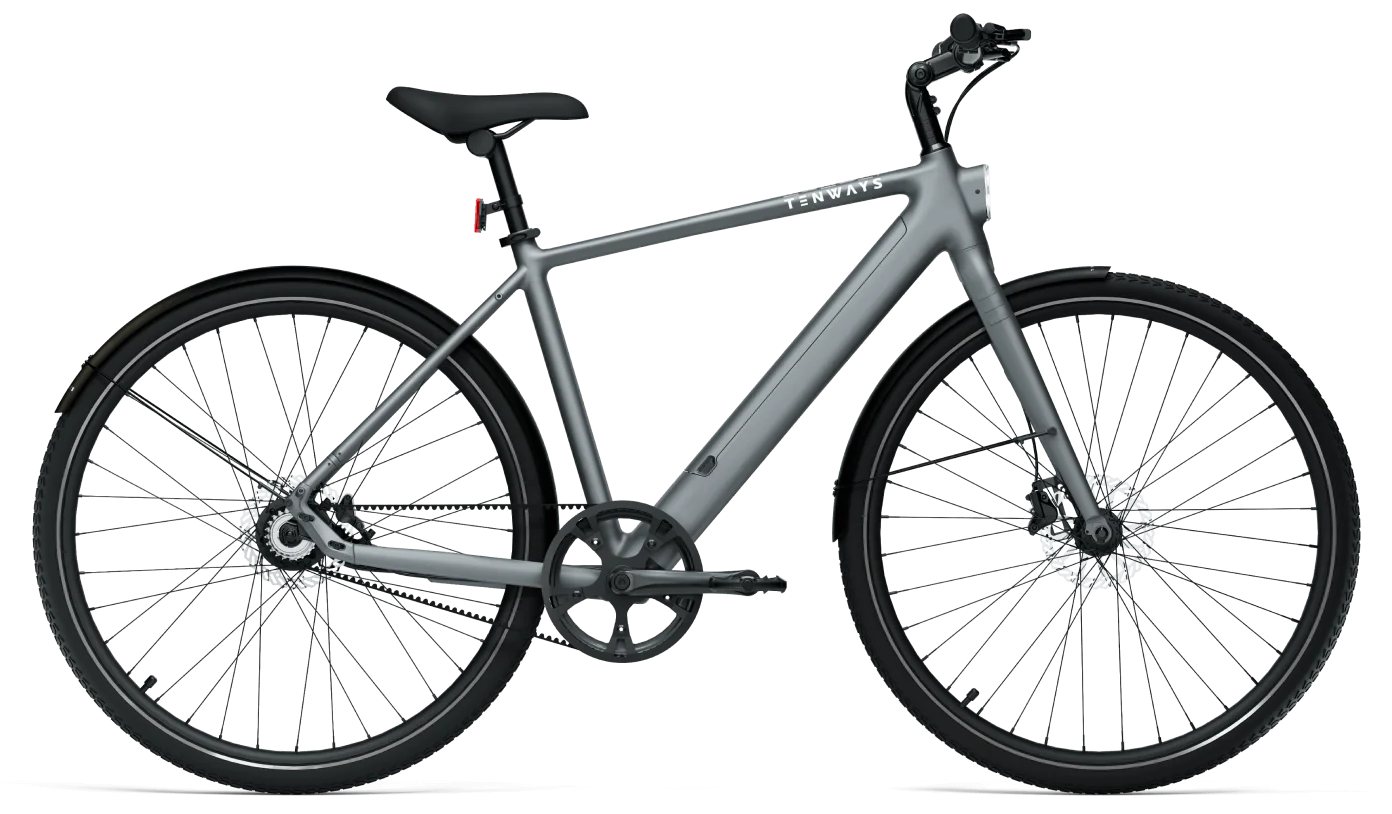
The Tenways CGO600 Pro takes a refreshingly simple approach to the electric commuter bike. Rather than relying on a large motor, oversized battery and long equipment list, it combines a lightweight aluminium frame with discreet electric assistance and a low-maintenance Gates belt drive.
The result is an ebike that looks and behaves much more like a conventional urban bicycle than many of its rivals. The current New Edition refines the formula further with cleaner cable integration, an updated display and integrated rear lighting.
In this Tenways CGO600 Pro review, we look at how that minimalist approach translates to everyday commuting, including motor performance, real-world range, comfort, hills, maintenance and long-term practicality.
Tenways CGO600 Pro: Short Summary
The Tenways CGO600 Pro is one of the strongest options for riders who want an electric commuter that still feels like a normal bicycle. Its low weight, natural torque-sensing assistance and Gates belt drive give it an unusually clean and uncomplicated character. It is quiet, responsive around town and considerably easier to manoeuvre, store and carry than many full-size commuter ebikes.
Its limitations are closely connected to the same minimalist design. The single-speed drivetrain is excellent for reducing maintenance but becomes restrictive on steep hills, while the rigid aluminium frame prioritises efficiency and low weight over plush comfort. For predominantly flat or gently rolling commuting, though, the balance works extremely well.
Score: 9.1/10
Pros
- Natural torque-sensing motor assistance
- Lightweight for a full-size commuter ebike
- Quiet and low-maintenance Gates belt drive
- Removable battery
- Responsive urban handling
- Hydraulic disc brakes
- Discreet electric-bike design
- Improved integration on the New Edition
Cons
- Single-speed drivetrain is limiting on steep hills
- Rigid aluminium frame can feel firm on poor roads
- Some early New Edition bikes attracted complaints about assistance behaviour
- Standard saddle and grips will not suit everyone
Who it is for
The CGO600 Pro is best suited to urban commuters, first-time ebike buyers and experienced cyclists who want electric assistance without the weight and complexity of a typical commuter ebike. It makes the most sense on flat or moderately rolling routes, particularly for riders who value low maintenance, low weight and easy storage. Riders facing frequent steep climbs, carrying heavy loads or prioritising maximum comfort should consider a geared or more heavily equipped alternative.
Table of Contents
Tenways CGO600 Pro Specifications
| Specification | Tenways CGO600 Pro |
|---|---|
| Motor | Mivice M070 rear hub motor |
| Motor power | 250 W UK |
| Maximum torque | 40 Nm |
| Sensor | Torque sensor |
| Battery | 360 Wh, 36 V 10 Ah lithium-ion |
| Battery cells | LG |
| Claimed range | Up to 100 km / 62 miles |
| Realistic mixed-use range | Roughly 30–45 miles for many riders |
| Charging time | Around 4 hours |
| Maximum assisted speed | 25 km/h / 15.5 mph |
| Throttle | No |
| Frame | 6061 aluminium |
| Fork | Rigid aluminium |
| Drivetrain | Single speed |
| Belt | Gates CDN carbon belt |
| Crankset | Gates CDX |
| Brakes | Tektro hydraulic discs |
| Wheels | 700C aluminium |
| Tyres | CST puncture-resistant 700 × 45C |
| Display | OLED, updated colour display on New Edition |
| Lights | Integrated front, integrated rear on New Edition |
| Battery | Removable |
| App | TENWAYS app |
| Weight | Around 17 kg for New Edition, Classic is lighter |
| Maximum permissible weight | 140 kg |
| Sizes | M, L, XL |
| Frame and rigid fork warranty | 5 years |
| Major electrical components | 2 years |
The most important number here is arguably the weight. The CGO600 Pro is considerably lighter and mechanically simpler than the typical full-size commuter ebike, and that influences almost every aspect of how it rides and how easy it is to own.
Design and Build Quality
Frame and Finish
The CGO600 Pro remains one of the cleaner-looking electric commuters in its class. The aluminium downtube is slim enough that the integrated battery does not dominate the frame, while the compact rear hub motor is similarly discreet. There is no oversized battery housing or obviously electric-looking frame architecture, and from a few metres away it could easily be mistaken for a conventional urban hybrid.
The New Edition improves that presentation further by concealing more of the cabling. Combined with the single-speed belt drivetrain, the result is an unusually uncluttered bike with very little visual noise around the frame or cockpit. Tenways has clearly made simplicity part of the design language rather than merely using it as a way to reduce the component count.
There is substance behind the styling as well. The 6061 aluminium frame comes in three sizes rather than relying on extensive adjustment to make a single frame work for everybody. The geometry is closer to a sporty urban hybrid than a traditional Dutch city bike, giving the CGO600 Pro a reasonably purposeful riding position. The adjustable stem provides some flexibility, but riders expecting a very upright cruiser should be aware that the fundamental character remains relatively athletic.
Finish quality is convincing for its position in the market. Paintwork, battery integration and cable management all contribute to a bike that feels carefully considered rather than cheaply stripped back.
Integration and Component Quality
The removable downtube battery is particularly well executed. It preserves the clean appearance associated with a fully internal battery but can still be taken indoors for charging, which is a major practical advantage for anyone storing the bike in a communal area, garage or hallway without a nearby socket.
Component selection follows the same philosophy. Tektro hydraulic brakes, the Gates drivetrain and the Mivice motor system are all parts that influence the actual riding or ownership experience. Tenways has resisted adding unnecessary hardware purely to make the specification sheet look more generous.
The New Edition’s integrated rear light also feels like a worthwhile improvement. The Classic model’s separate rear-light arrangement always looked slightly inconsistent with such an otherwise tidy design, whereas the newer solution better matches the rest of the bike.
Some of the contact points are more ordinary. The standard grips are basic and the saddle is relatively firm, particularly once journeys become longer. Neither is a serious weakness because both can be replaced easily, but they are among the few areas where the CGO600 Pro feels less distinctive than the frame and drivetrain.
The CGO600 Pro succeeds because its simplicity feels intentional rather than stripped back.
Motor Performance and Power Delivery
Motor and Torque
The UK version uses a 250 W Mivice M070 rear hub motor delivering up to 40 Nm of torque. Those figures look modest beside commuter ebikes advertising 60 Nm, 80 Nm or more, but direct comparisons are misleading because the Tenways itself is considerably lighter than many of those bikes.
On flat roads and gentle gradients, 40 Nm is enough to provide meaningful assistance without turning the CGO600 Pro into something that feels motor-dominated. The bike still expects the rider to pedal properly, but the amount of effort required to accelerate and maintain speed is reduced significantly.
The torque sensor is arguably more important than the headline motor output. Instead of simply detecting that the pedals are moving and applying a predetermined level of assistance, the system monitors how much force is being put through them. Push harder and the motor responds with more help, while easing off naturally reduces assistance.
That creates a much closer relationship between rider effort and acceleration. Compared with the abrupt on-off behaviour of cheaper cadence-sensing systems, the CGO600 Pro feels much more like riding a conventional bicycle with stronger legs.
Acceleration and Pedal Assistance
Acceleration is smooth rather than dramatic. There is no throttle and no sudden surge when the cranks start rotating, so pulling away from junctions feels controlled even when maximum assistance is selected. The motor comes in quickly enough to remove much of the effort from starting, but it does not overwhelm the rider.
That predictability works particularly well in urban traffic. Tight corners, shared paths and crowded cycle infrastructure are easier to negotiate when assistance follows pedal pressure instead of arriving in a fixed block of power. Riders moving to an ebike for the first time should find the system intuitive because very little adjustment is needed to normal cycling technique.
The three assistance levels are also refreshingly simple. Lower assistance works well once the bike is moving on flat roads, while the highest level is useful when accelerating, riding into a headwind or dealing with moderate gradients. There is enough differentiation between the settings to make them useful without turning the controls into something that needs constant attention.
Some early New Edition owners reported assistance weakening sooner than expected as the bike approached the UK’s 25 km/h assistance limit. Controller changes and replacement components appear to have addressed at least some of those cases, and the issue does not affect every bike, but it remains something worth paying attention to when buying older stock.
When working as intended, the motor system is one of the CGO600 Pro’s greatest strengths. It feels more like an extension of the rider than a separate propulsion system.
Hill-Climbing Performance
Hills expose the main limitation of the CGO600 Pro’s minimalist approach. The motor itself handles gentle and moderate gradients reasonably well, particularly because pressing harder on the pedals immediately tells the torque sensor to provide more assistance. On ordinary rolling terrain, the combination works better than the modest torque figure might suggest.
The problem arrives when the gradient becomes steep enough that a conventional cyclist would normally shift down several gears. The Tenways cannot do that because there is only one mechanical ratio. As cadence falls, the rider has to push harder while the motor contributes as much assistance as it can.
Gentle gradients are therefore straightforward, and moderate hills remain manageable for most riders, but long or steep climbs demand significantly more physical input. A heavier rider, additional luggage or a strong headwind makes that limitation more obvious.
This does not make the CGO600 Pro poor at climbing. It simply means that the drivetrain has been optimised for low maintenance and flat urban riding rather than maximum versatility. Anyone facing repeated steep hills should consider the geared CGO600 Plus or a suitable mid-drive alternative instead.
Battery Range and Charging
Real-World Range
The CGO600 Pro uses a 360 Wh battery, which is smaller than the 500 Wh and 600 Wh units increasingly common on commuter ebikes. That initially looks like a disadvantage, but battery capacity alone tells only part of the story.
The Tenways weighs substantially less than many larger-battery rivals and combines an efficient hub motor with relatively fast-rolling tyres and a torque-sensing assistance system. Because the rider remains actively involved in propulsion, the bike can extract useful mileage from a comparatively compact battery.
Tenways quotes a maximum range of up to 100 km, or roughly 62 miles. That figure is better treated as an optimum-condition result than a normal commuting expectation. Real-world results across the CGO600 Pro platform show that regular use of stronger assistance settings brings range down considerably.
For most riders, roughly 30–45 miles per charge is a much more useful planning figure. A lighter rider using low assistance over predominantly flat terrain in mild weather can travel further, while hills, cold temperatures, headwinds and heavier loads can push the result below that range.
For normal commuting, however, the battery is rarely a serious constraint. Someone covering around 10 miles per working day should generally be able to charge every few days instead of needing to plug the bike in each evening.
Charging and Battery Practicality
A full recharge takes around four hours under normal conditions, which makes overnight or workplace charging straightforward. More importantly, the battery can be charged either while installed in the frame or after being removed.
That flexibility makes a noticeable difference in day-to-day ownership. A rider storing the bike in a communal cycle room, garage or hallway without a convenient power outlet can simply take the battery indoors. It also makes winter storage easier because the battery does not need to remain exposed to prolonged cold temperatures.
The removable design introduces one point worth checking. A small number of owners have reported battery-latch adjustment issues, including batteries that did not initially feel completely secure after being refitted. The reports are not consistent enough to indicate a fundamental design problem, but owners should make sure the battery has positively locked into place each time it is installed.
Ride Quality and Comfort
Riding Position and Ergonomics
The CGO600 Pro has a sportier riding position than its commuter classification might suggest. The relatively long reach, flat handlebar and rigid frame give it more in common with an urban hybrid or fitness bike than a traditional sit-up city bicycle.
For riders already accustomed to conventional hybrids, the position feels natural and efficient. It also works well with the torque-sensing motor because the CGO600 Pro expects the rider to remain involved rather than simply turning the pedals while the motor does everything else.
The adjustable stem provides useful flexibility, allowing the rider to raise the handlebar and reduce the effective reach to some degree. It does not completely transform the geometry, though, so anyone prioritising a very upright posture with minimal weight through the wrists may be happier on a different style of commuter.
The standard saddle and grips are adequate rather than exceptional. They are unlikely to cause problems on shorter urban journeys, but longer-distance commuters may benefit from fitting ergonomic grips or choosing a saddle better matched to their own anatomy.
Suspension and Tyres
There is no suspension fork, and for this type of bike we think that is the correct decision. Cheap suspension forks add weight and maintenance while often contributing relatively little control or comfort on normal roads.
Instead, much of the cushioning comes from the 700 × 45C tyres. Their relatively generous volume removes some of the high-frequency vibration from ordinary tarmac without creating the sluggish feel associated with oversized urban tyres.
On smooth roads and cycle lanes, the CGO600 Pro is comfortable and composed. Patched asphalt, cobbles and smaller potholes can still be managed without difficulty, although the rigid aluminium chassis means the rider remains aware of what is happening underneath the wheels.
Once the surface becomes genuinely rough, the limitations are clear. The bike can handle the occasional gravel path, but it is fundamentally designed for urban roads rather than broken tracks or off-road riding. Tyre pressure also makes a meaningful difference, and there is little benefit in running unnecessarily high pressures if comfort is a priority.
Rider Suitability
Three available frame sizes give the CGO600 Pro better fit flexibility than many one-size direct-to-consumer ebikes. The range accommodates a broad selection of adult riders, although anyone sitting close to the boundary between sizes should consult the latest geometry information rather than relying purely on height recommendations.
Shorter riders should also consider the conventional step-over frame. Anyone with limited mobility or difficulty swinging a leg over a top tube may find a step-through design more practical.
The relatively generous permissible weight rating broadens its usefulness, but heavier riders should again think carefully about terrain. The frame itself is capable, but the combination of 40 Nm and a single mechanical gear becomes more demanding when rider weight and steep hills are added together.
Braking and Handling
Braking Performance
The Tektro hydraulic disc brakes are well suited to the CGO600 Pro. Hydraulic systems generally require less hand pressure than inexpensive mechanical discs and provide more predictable modulation, particularly when slowing gradually in traffic.
On a comparatively lightweight ebike limited to standard UK assistance speeds, there is ample stopping power for normal urban riding. The brakes feel progressive rather than grabby, which makes it easy to regulate speed smoothly when approaching junctions or navigating crowded streets.
They are not unusually powerful by modern ebike standards, but there is no need for an oversized braking system on a bike of this weight and intended use. What matters more is consistency and control, and the Tektros perform well in both respects.
Correct initial setup remains important. Occasional reports of rubbing rotors suggest that caliper alignment is worth checking during assembly, but this is a routine bicycle adjustment rather than a significant weakness.
Handling and Stability
Handling is one of the areas where the CGO600 Pro most clearly separates itself from heavier commuter ebikes. Its low weight means it reacts more quickly to steering input and feels substantially less cumbersome at walking speed, through tight corners and when repositioning the bike in traffic.
The large wheels and relatively long wheelbase provide enough stability that this responsiveness does not make the bike nervous. Once travelling at normal commuting speeds, it feels planted and predictable, while still being much easier to change direction than a 25 kg urban ebike.
Battery placement also helps. The battery sits centrally in the downtube and the compact rear hub motor adds relatively little mass at the back, preventing the pronounced tail-heavy sensation found on some cheaper hub-motor bikes.
There is another benefit when the battery is empty or the electrical system is switched off. Because the complete bike remains relatively light, it can still be ridden like a slightly heavy conventional hybrid rather than feeling as though the motor has become essential to forward movement.
Gearing and Drivetrain
The Gates belt drive is one of the defining features of the CGO600 Pro. Instead of a conventional chain, cassette and derailleur, the bike uses a carbon-reinforced belt combined with a fixed single-speed ratio.
For commuting, the benefits are substantial. There is no derailleur indexing to adjust, no chain requiring regular cleaning and lubrication, and far less oily residue to collect road grit or end up on clothing. When correctly tensioned, the drivetrain is also extremely quiet.
That simplicity becomes particularly appealing for year-round riding. Rain, dirt and winter road grime are less troublesome when there is no lubricated chain continuously exposed to the elements, and routine drivetrain maintenance is reduced considerably.
The downside is unavoidable: there is only one mechanical gear. Electric assistance disguises that limitation well on flat roads, but it cannot reproduce the mechanical advantage of selecting a much easier gear when climbing a steep hill. Stronger cyclists may also find cadence becoming relatively high when pedalling significantly beyond the assistance cut-off.
Whether the drivetrain is one of the bike’s best features or its biggest weakness therefore depends heavily on where you live. On relatively flat urban routes, the belt-drive simplicity is extremely appealing. In steep cities, the lack of gears is far harder to ignore.
Display, Controls and Smart Features
The cockpit follows the same minimalist philosophy as the rest of the bike. Speed, battery status, assistance level and basic ride data are presented without a large display dominating the handlebar, while the absence of a gear shifter helps keep the controls unusually clean.
Current New Edition bikes use an updated colour display, whereas Classic versions retain the earlier simpler arrangement. Battery percentage is particularly useful because it provides a clearer picture of remaining capacity than the basic bar indicators still used on many commuter ebikes.
The TENWAYS app adds ride recording, journey statistics and navigation features. It is useful without becoming an essential part of operating the bike, which suits the character of the CGO600 Pro well. Riders who enjoy tracking journeys can use the connected features, while those who simply want to switch the bike on and commute can largely ignore them.
More technologically ambitious rivals increasingly offer built-in GPS tracking, geofencing and more sophisticated theft-protection systems. The Tenways does not lead the class in this respect, so anyone regularly parking the bike outside should still rely on a serious physical lock rather than expecting the electronics to provide comprehensive security.
Accessories and Everyday Practicality
The New Edition improves daily practicality by integrating both front and rear lighting. The Classic model’s separate rear-light arrangement always seemed slightly out of place on such an otherwise cleanly designed bike, so the newer setup feels much more coherent.
Mudguards are particularly important for UK commuting and should be considered essential for anyone intending to use the bike throughout the year. A compatible rear rack is also available for carrying panniers, work equipment or moderate shopping loads.
That level of carrying capacity suits the CGO600 Pro well. A laptop bag or pair of panniers fits naturally with the lightweight commuter concept, whereas loading the bike heavily begins to undermine some of the simplicity and agility that make it attractive.
Anyone routinely transporting children, bulky shopping or heavy equipment should consider a purpose-built cargo bike or more heavily equipped commuter instead. The CGO600 Pro is best understood as an efficient personal transport bike rather than a utility platform.
Weight, Storage and Transport
Weight is one of the strongest reasons to choose the CGO600 Pro over a more powerful or heavily equipped commuter ebike. The Classic Edition is lighter than the New Edition, but both remain substantially below the weight of many full-size electric bikes.
The difference becomes particularly noticeable when the bike is not being ridden. Walking it through a railway station, turning it inside a narrow hallway, lifting the front wheel over steps and manoeuvring it into storage are all significantly easier than with a much heavier machine.
Most importantly, carrying it upstairs is at least realistic. Around 17 kg is not exceptionally light by conventional bicycle standards, but it is unusual for a full-size ebike with a useful removable battery and proper commuting range.
Removing the battery reduces the carrying weight further. For someone living in an upstairs flat or regularly combining cycling with public transport, this practical advantage may matter far more than gaining another few hundred watt-hours of battery capacity or substantially more motor torque.
Maintenance, Reliability and Ownership
The Gates single-speed drivetrain removes several of the maintenance tasks normally associated with commuter bicycles. There is no derailleur indexing to drift out of adjustment, no chain requiring repeated lubrication and cleaning, and fewer exposed drivetrain components collecting water and dirt.
Routine maintenance therefore focuses mainly on tyres, brakes, wheels and ordinary fastener checks. Long-term ownership accounts include CGO600 Pro bikes covering substantial distances with relatively little intervention beyond normal wear items, which supports the basic logic behind the simplified drivetrain.
There are some recurring issues worth knowing about. Battery-latch adjustment has affected a minority of bikes, while some early New Edition owners reported unusual assistance behaviour as the bike approached the legal assistance limit. Occasional brake rub, spoke-tension problems and drivetrain noises also appear in owner discussions.
None of these issues is consistent enough to justify describing the CGO600 Pro as broadly unreliable. They do highlight the importance of proper initial assembly and adjustment, particularly when buying directly rather than through a local dealer.
The use of recognisable bicycle components helps with longer-term ownership. Tyres, brake pads and many normal wear parts can be dealt with by competent bike workshops without specialist Tenways knowledge, while replacement electrical components remain available directly from the manufacturer.
Warranty and Customer Support
Tenways provides relatively strong frame coverage for this part of the market. The aluminium frame and rigid fork receive five years of warranty protection, while major electrical components such as the motor, battery, controller, display and torque sensor receive two years.
Several mechanical components also receive two years of coverage, while brakes and consumable items have shorter warranty periods. Battery degradation is treated differently from a manufacturing failure, as is normal across the electric-bike industry.
Replacement components and accessories are available directly from Tenways, which is particularly important for a brand with a significant direct-to-consumer presence. Customer-service experiences naturally vary, but there are multiple examples of controllers, battery-latch components and other parts being supplied when faults have been identified.
Access to a competent local bicycle workshop remains useful, especially for riders who do not want to diagnose mechanical problems themselves. The CGO600 Pro is mechanically simple by ebike standards, but it is still a bicycle that benefits from proper setup and routine servicing.
Tenways CGO600 Pro vs the Competition
Tenways CGO600 Pro vs ENGWE N1 Air
The ENGWE N1 Air targets a very similar type of urban rider. It combines a lightweight carbon frame with torque-sensing rear-hub assistance and a removable battery, while keeping overall weight impressively low.
Its conventional geared drivetrain gives it a clear advantage when gradients become steeper, and its connected technology and security features are more extensive than those offered by the Tenways. Riders who want more equipment and greater drivetrain flexibility may therefore prefer the ENGWE.
The CGO600 Pro takes the opposite approach. Its Gates belt removes the derailleur and chain completely, creating a quieter and lower-maintenance ownership experience. Hydraulic braking and the mature CGO platform also work in its favour.
The ENGWE is the more versatile choice for riders wanting gears and additional technology. The Tenways makes more sense for someone deliberately trying to eliminate drivetrain maintenance and mechanical complexity.
Tenways CGO600 Pro vs Fiido Air
The Fiido Air pushes the lightweight commuter concept even further. Extensive carbon construction brings its weight several kilograms below the CGO600 Pro while still offering a belt drive and natural torque-sensing assistance.
That makes the Fiido particularly attractive for multi-modal commuting involving trains, stairs and frequent lifting. If carrying the bike is a major part of every journey, those kilograms make a meaningful difference.
The compromise is battery capacity and outright assistance. The Tenways carries considerably more energy and provides stronger motor support, making it better suited to longer everyday journeys or riders wanting more help from the electrical system.
We would choose the Fiido where portability dominates almost every other requirement. For riders looking for a stronger balance between low weight, useful range and everyday assistance, the CGO600 Pro is the more rounded option.
Value for Money
The CGO600 Pro now competes in a crowded part of the lightweight ebike market. Carbon-framed rivals, geared urban bikes and increasingly sophisticated connected ebikes are all targeting the same type of customer, sometimes with considerably longer specification lists.
Judged purely by the amount of hardware supplied, the Tenways can therefore seem relatively simple. That simplicity is intentional, and much of its value lies in what has been selected rather than how many components have been fitted.
The important investment has gone into low weight, a proper torque-sensing Mivice system, Gates drivetrain components, hydraulic brakes, a removable battery and clean frame integration. Tenways has also avoided adding components that would increase weight or servicing requirements without necessarily making the bike better for its intended role.
There is no cheap suspension fork simply to make the specification appear more substantial, nor is there a basic derailleur fitted only so the bike can advertise several gears. The relatively compact battery also helps preserve the low overall weight instead of turning the CGO600 Pro into another heavy commuter.
The value proposition becomes particularly attractive when Classic Edition stock is discounted, assuming the correct size remains available. The New Edition faces stronger competition because newer rivals increasingly offer more technology and drivetrain versatility, but the CGO600 Pro still represents good value for riders who specifically prioritise low weight, low maintenance and natural assistance.
Who Should Buy the Tenways CGO600 Pro?
The CGO600 Pro works particularly well for commuters who fundamentally enjoy cycling but want electric assistance to remove some of the effort from everyday journeys. Its strongest environment is a relatively flat city or suburb where the single-speed drivetrain rarely becomes a limitation.
It is also an excellent match for riders living in flats, using trains as part of their commute or regularly moving the bike through restricted storage areas. The difference between this and a much heavier commuter ebike becomes particularly significant when stairs, narrow hallways or repeated lifting are involved.
Year-round commuters will appreciate the Gates belt because there is substantially less drivetrain cleaning and lubrication to worry about. Experienced cyclists may enjoy the bike just as much as first-time ebike buyers because the torque sensor preserves the relationship between rider effort and acceleration rather than making the motor dominate the experience.
Those who regularly encounter steep climbs should probably look elsewhere. The same applies to riders prioritising a very upright position, suspension comfort, heavy cargo capacity or maximum battery range. The CGO600 Pro is not designed to do everything, and much of its appeal comes from how effectively it concentrates on lightweight urban commuting.
Tenways CGO600 Pro Review Verdict
The Tenways CGO600 Pro remains one of the clearest examples of how effective a lightweight electric commuter can be when unnecessary hardware is removed. Its greatest strength is not the motor, battery or Gates belt individually, but the way those elements complement one another.
The torque sensor gives the motor a natural response, the low weight keeps handling close to that of a conventional bicycle, and the belt drive removes much of the drivetrain maintenance normally associated with year-round commuting. Together, they create an ebike that feels unusually normal to own and ride.
Its biggest compromise is equally clear. The single-speed drivetrain works brilliantly on flatter routes but becomes restrictive once genuinely steep gradients enter the picture. Competition has also improved considerably, with lighter carbon bikes, more connected commuters and geared alternatives all deserving consideration.
Even so, very few bikes combine low weight, natural assistance and mechanical simplicity as convincingly as the CGO600 Pro.
Score: 9.1/10
If your commute is predominantly flat and you want a best electric bike that behaves as much like a normal bicycle as possible, the CGO600 Pro remains one of the strongest options available.
Frequently Asked Questions
What is the real-world range of the Tenways CGO600 Pro?
Tenways claims up to 100 km, or around 62 miles, but that represents favourable riding conditions rather than typical everyday use. For mixed commuting, approximately 30–45 miles is a more realistic expectation for many riders. High assistance, hills, cold weather, headwinds and heavier riders reduce range, while lower assistance and predominantly flat terrain can push it considerably higher.
Is the Tenways CGO600 Pro good for hills?
The CGO600 Pro performs well enough on gentle and moderate gradients because its torque sensor increases motor assistance as the rider pushes harder. Steep climbs expose the limitations of the single-speed drivetrain, as there is no lower gear to select when cadence drops. Riders who regularly encounter demanding hills are likely to be better served by a geared commuter such as the CGO600 Plus.
Can the Tenways CGO600 Pro battery be removed?
Yes. The 360 Wh battery is integrated into the downtube but can be unlocked and removed, allowing it to be charged indoors while the bike remains in a garage, communal store or other location without a convenient socket. The removable design is particularly useful for flat dwellers and winter storage. After reinstalling it, make sure the battery has positively locked into the frame before riding.
How long does the Tenways CGO600 Pro take to charge?
A full charge takes roughly four hours under normal conditions, making workplace or overnight charging straightforward. There is generally no need to run the battery completely flat before plugging it in. During particularly cold weather, storing and charging the battery indoors is preferable to leaving it exposed to low temperatures for extended periods.
Is the Tenways CGO600 Pro waterproof?
The bike is designed to cope with normal wet-weather cycling and can be ridden in rain, but it should not be treated as waterproof in the sense of tolerating immersion or pressure washing. Electrical connectors and the removable battery interface deserve normal care, while storing the bike somewhere dry will help reduce corrosion and prolong the life of its components.
What is the difference between the CGO600 Pro Classic and New Edition?
Both versions follow the same fundamental formula of a single-speed Gates belt, removable 360 Wh battery, rear hub motor and torque-sensing assistance. The New Edition improves cable integration, updates the display and incorporates the rear light more neatly into the bike. It is slightly heavier, while some early New Edition bikes also attracted reports of unusual assistance behaviour near the legal speed limit.